


















Lesson 23 of 45 · Kinship, Family and Social Organization
Kinship Terminology Systems: Eskimo, Hawaiian, Iroquois and More
See how languages sort aunts, uncles and cousins: Eskimo, Hawaiian, Iroquois, Crow, Omaha and Sudanese systems, with a kin-term lookup and parallel versus cross cousins.
In English the word "aunt" covers your mother's sister, your father's sister and your uncle's wife. The word "cousin" covers the children of all of them. That feels natural to English speakers, but it is a choice. Other languages use one word for your mother and her sister, or keep your father's sister and your mother's sister apart, or give each relative a unique name.
Lewis Henry Morgan was the first to compare these naming systems on a large scale. He collected kinship terms from Native American and many other communities through letters and visits and published them in 1871. His evolutionary conclusions did not last, but his data and his question did: what do these words tell us about how a society organizes people?
What you will learn
- The difference between a term of reference and a term of address.
- Kin-type notation (F, M, B, Z, S, D, H, W) and how to read it.
- Parallel cousins versus cross cousins.
- The main systems: Eskimo, Hawaiian, Iroquois, Crow, Omaha and Sudanese.
- What terminology can and cannot tell us about social structure.
Key terms
Term of reference: the word you use when talking about a relative ("my aunt").
Term of address: the word you use when talking to them ("Auntie").
Kin type: an exact relationship written in shorthand, such as FZD for father's sister's daughter.
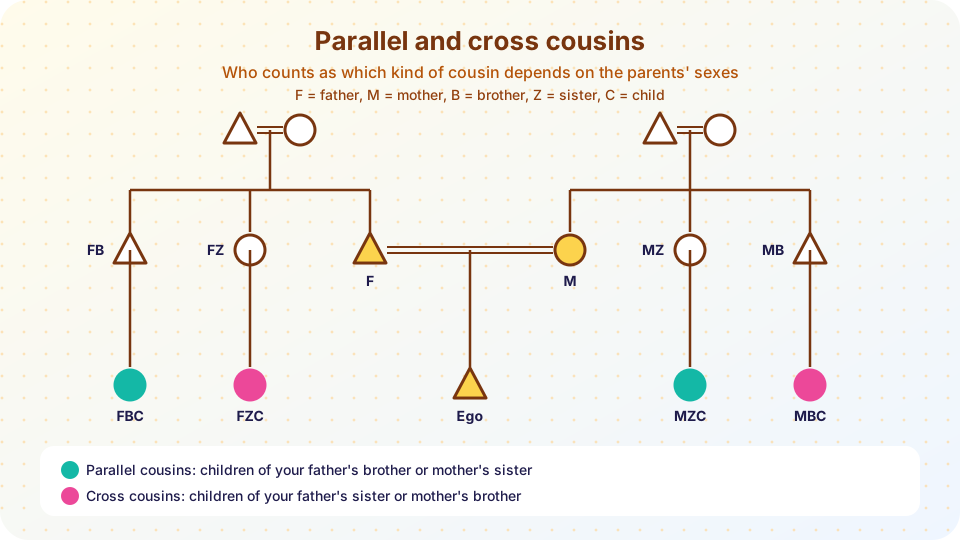
Parallel cousin: the child of your father's brother or your mother's sister.
Cross cousin: the child of your father's sister or your mother's brother.
Classificatory term: one term applied to several different kin types.
Reading kin types
Anthropologists use letters so that a relationship has one precise name no matter the language: F father, M mother, B brother, Z sister, S son, D daughter, H husband, W wife. A string reads from Ego (the person we start from) outward. So MB is mother's brother, and MBD is mother's brother's daughter.
Now the central idea. Your father's brother (FB) and your mother's sister (MZ) are the same-sex siblings of your parents. Their children are parallel cousins. Your father's sister (FZ) and your mother's brother (MB) are opposite-sex siblings of your parents. Their children are cross cousins. In English both groups are just "cousins". In many societies the difference matters a great deal: parallel cousins are treated as siblings, while cross cousins may be preferred marriage partners.
The six classic systems
Morgan and later Murdock sorted systems by how they treat cousins. The names are conventional labels, not statements about the peoples.
Eskimo (lineal). The nuclear family has its own terms: mother, father, brother, sister. Aunts and uncles are separated from parents, and all cousins share one word. This is the English pattern. It emphasizes the nuclear family and is common where the nuclear family is the core unit.
Hawaiian (generational). Terms depend mainly on generation. Mother's sister and father's sister are called "mother"; uncles are called "father"; all cousins are called "brother" and "sister". A person has many mothers, fathers and siblings.
Iroquois. Father's brother is "father" and mother's sister is "mother". Parallel cousins are called "brother" and "sister". Cross cousins get their own word and are potential spouses. Mother's brother and father's sister keep separate terms. Iroquois-type terminology is common with unilineal descent. A close relative, the Dravidian type found in South India, uses the same logic and makes cross-cousin marriage a prescribed pattern.
Crow. Found in matrilineal societies such as the Crow of the American plains. Father's sister's children are classed with the father's group, so a man may call his father's sister's son "father." Generations are "skewed" to keep each matrilineal line in one category.
Omaha. The patrilineal mirror image: mother's brother's children are classed with the mother's group, so a man may call his mother's brother's daughter "mother".
Sudanese (descriptive). Nearly every kin type has its own term, found in Arabic-speaking regions and other places. A mother's brother's son is different from a father's brother's son.
In practice, many languages blend these types, and scholars use more detailed componential analysis. Alfred Kroeber's classic 1909 list included generation, sex, relative age and whether a relative is related through a male or female link.
What do terms tell us?
Morgan thought terms were fossils from an earlier stage of "primitive promiscuity". That idea is false. Later scholars found links with other features: Iroquois terms often go with unilineal descent and groups that exchange spouses; Eskimo terms with households based on the nuclear family; Hawaiian terms with bilateral descent. These are patterns, not laws. Terms also change when marriage patterns and migration change. Two cautions apply. A term does not prove a person feels the same affection for all people called by it. And the system is a cultural model that works in speech but does not predict everyone's behavior.
Common misconceptions
"Calling an uncle 'father' means people cannot tell them apart." Speakers distinguish their own father from other men they call father, using context and added words such as "big father" or "real father".
"Kinship terms show how people really feel." They show categories. Warmth, quarrels and distance happen inside the categories.
"Eskimo type is the natural one." It is a common type in Western societies, not a universal baseline.
Try it
This lookup tool translates kin types into terms for three systems. It is a simplified teaching model for a male Ego and uses English words as labels. Add a kin type, such as "FZD", and compare. The Iroquois sister's-children rule is simplified.
Press Run (or Ctrl + Enter) to see the console output here.
No output.
The next demonstration counts how many different words each system uses and how it treats parallel versus cross cousins.
Press Run (or Ctrl + Enter) to see the result here.
Program input · what you'd type while the program runs
Type the answers before you press Run, one per line. Each time the program reads a line (with input()), it gets the next line from this box.
Notice that Eskimo and Iroquois use the same number of words in this simplified model but group relatives differently. The count is not the point; the grouping is.
Check your understanding
Quick check · 5 questions
of 5 answered You scored / 5 · perfect!
-
1. Which pair are parallel cousins to Ego?
Parallel cousins descend from same-sex siblings of Ego's parents: FB and MZ. -
2. In a Hawaiian terminology system, the main factor in naming relatives is
Hawaiian terminology groups relatives mostly by generation, so all cousins are called brothers and sisters. -
3. What does the kin type MBD mean?
The letters read from Ego outward: M (mother), B (brother), D (daughter). -
4. Which system distinguishes cross cousins from parallel cousins and often goes with unilineal descent?
Iroquois terminology treats parallel cousins as siblings and gives cross cousins a separate term. -
5. Why was Morgan's idea that terms were fossils of primitive promiscuity rejected?
Later research found links between terms and living social structure, not a hidden evolutionary stage.
Summary
- Kinship terms sort relatives in culturally specific ways; reference and address terms can differ.
- Kin types (F, M, B, Z, S, D, H, W) give a precise, language-independent notation.
- Parallel cousins descend from same-sex siblings; cross cousins from opposite-sex siblings.
- The six classic systems are Eskimo, Hawaiian, Iroquois, Crow, Omaha and Sudanese.
- Terminology patterns relate to descent and marriage but do not predict feelings or behavior.
Next: Marriage and family
Track your progress
Create a free account to tick off lessons and pick up where you left off on any device.
of Anthropology lessons completed