


















Lesson 15 of 45 · Human Evolution and Archaeology
Chapter 3 Review: Human Evolution and Archaeology
Review chapter three: natural selection, primates, hominin evolution, archaeological methods and dating, and the move from foraging to farming to cities, with a ten-question quiz.
You have just traveled across about seven million years. This review pulls the chapter's ideas into one page, gives you a table of dates to anchor the story, and ends with a ten-question quiz that mixes the whole chapter.
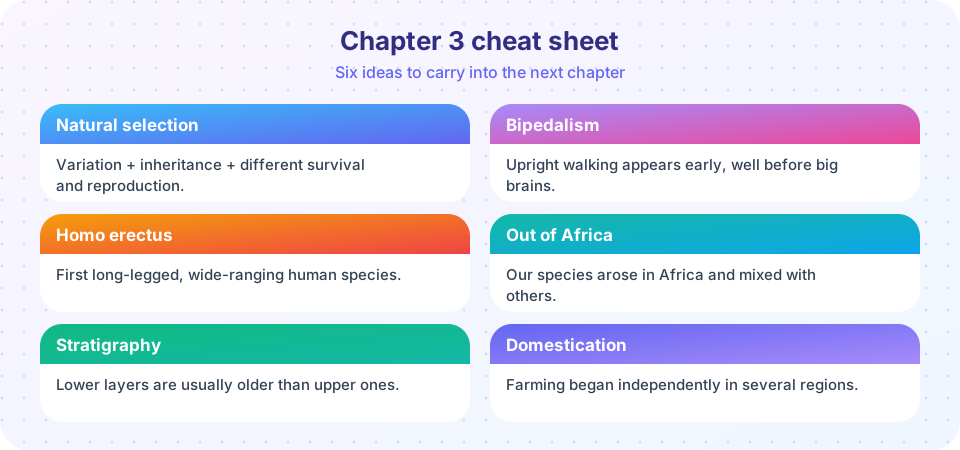
Recap table
| Lesson | What to remember |
|---|---|
| Overview | Seven stops, from about 7 million to 5,500 years ago; evidence from fossils, dating and DNA |
| Natural selection and primates | Variation, inheritance, competition, differential reproduction; humans are apes; chimpanzees and bonobos are our closest relatives |
| Hominin evolution | Upright walking first; a bush of species; Neanderthals, Denisovans and mixing |
| Archaeological methods and dating | Context, stratigraphy, radiocarbon half-life of 5,730 years |
| Foraging, farming, cities | Independent origins of farming; costs and benefits; cities and states |
Dates worth remembering
| Event | Approximate date |
|---|---|
| Human and chimpanzee lineages split | 6 to 7 million years ago |
| Laetoli footprints | 3.7 million years ago |
| Oldest known stone tools (Lomekwi) | 3.3 million years ago |
| Homo erectus appears | 1.9 million years ago |
| Earliest Homo sapiens fossils | 300,000 years ago |
| Start of farming (Fertile Crescent) | 11,500 years ago |
| First cities (Uruk) | 5,500 years ago |
You do not need every number exactly. Learn the order and the rough size of each gap.
Three habits from this chapter
- Say how sure you are. Dates have margins, species names get revised, and new fossils change pictures.
- Look for several lines of evidence. Fossils, tools, dates and DNA agree or disagree; both outcomes are informative.
- Avoid ladders. Evolution and social change both branch and double back.
Common misconceptions
"Humans evolved from chimpanzees." They share a common ancestor with us.
"Radiocarbon dating dates everything." It dates organic remains up to about 50,000 years old.
"Farming was an unmixed blessing." It supported more people and brought new costs.
"Neanderthals were a dead end with no connection to us." Many living people carry a small share of Neanderthal DNA.
Try it
Practice the order of events with flashcards. Press Show, then Next.
Now put the seven dates in order and measure how long ago each was relative to the whole span. This uses the numbers in the table above.
Press Run (or Ctrl + Enter) to see the result here.
Program input · what you'd type while the program runs
Type the answers before you press Run, one per line. Each time the program reads a line (with input()), it gets the next line from this box.
Check your understanding
Quick check · 10 questions
of 10 answered You scored / 10 · perfect!
-
1. Which are the four ingredients of natural selection?
All four must be present for selection to change a population. -
2. Which pair are our closest living relatives?
Their lineage split from ours most recently. -
3. What did the Laetoli footprints show?
Footprints in volcanic ash preserved the walking pattern. -
4. Which species was the first hominin with body proportions like ours and a wide range outside Africa?
Homo erectus had long legs and spread to Asia. -
5. A sample has 12.5% of its original carbon-14. About how old is it?
12.5% means three half-lives: 3 x 5,730 = 17,190 years. -
6. Why do archaeologists oppose looting even when the objects survive?
Context is what turns an object into evidence. -
7. Which is NOT an independent origin of farming?
No farming developed in Antarctica. -
8. Early cuneiform writing was mostly used for
Many of the earliest tablets record goods and rations. -
9. Ancient DNA shows that modern humans
People with ancestry from outside Africa carry roughly 1 to 2 percent Neanderthal DNA. -
10. Why is 'a ladder of progress' a poor picture of human evolution?
Evolution branches without a goal.
Summary
- Natural selection, mutation, drift and gene flow explain how populations change; humans are apes related most closely to chimpanzees and bonobos.
- Hominin evolution is a bush: upright walking, stone tools, Homo erectus, Neanderthals and Denisovans, and Homo sapiens from about 300,000 years ago.
- Archaeologists reconstruct the past through context, stratigraphy and dating, such as radiocarbon with a 5,730-year half-life.
- Farming began independently in many places from about 11,500 years ago; cities and states followed.
Track your progress
Create a free account to tick off lessons and pick up where you left off on any device.
of Anthropology lessons completed