


















Lesson 11 of 45 · Human Evolution and Archaeology
Natural Selection and Our Primate Relatives
Learn how natural selection, mutation, drift and gene flow work, then explore the primate family tree, primate traits, social life and where humans fit among the apes.
Every lesson on human origins rests on a handful of evolutionary ideas. They are simple to state, and surprisingly easy to misuse. You will learn them here with plain examples, and then use them to place humans on the primate family tree among monkeys and apes.
The second half of the lesson is about our living relatives. Primates are not "stand-ins" for early humans, but watching how they live shows what kinds of behavior can come from a primate body and a social brain, and which are special to us.
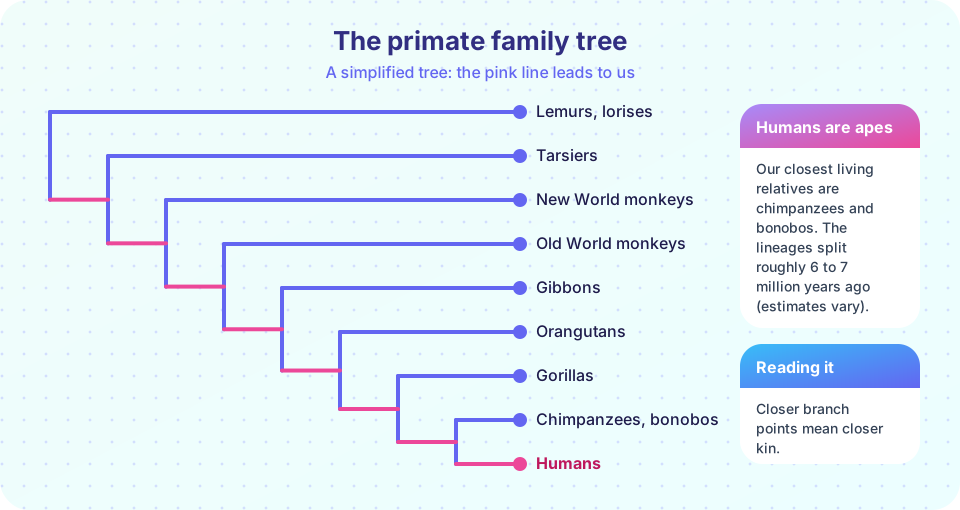
What you will learn
- The four ingredients of natural selection and the other forces of evolution.
- Examples of adaptation in humans and other animals.
- How to read a family tree (a cladogram).
- Main traits of primates and the main groups.
- What primate studies, such as Goodall's, tell us about behavior and culture.
Key terms
Natural selection: the process by which inherited traits that help individuals survive and reproduce become more common over generations.
Adaptation: an inherited trait that has been favored by selection in a given environment.
Genetic drift: random changes in how common a gene variant is, especially strong in small populations.
Gene flow: movement of gene variants between populations through migration and mating.
Primate: a member of the order that includes lemurs, monkeys, apes and humans.
How natural selection works
Charles Darwin and, independently, Alfred Russel Wallace described natural selection in the 1850s; Darwin's book On the Origin of Species appeared in 1859. The idea needs four ingredients:
- Variation: individuals in a population differ in their traits.
- Inheritance: some of that variation is passed from parents to offspring.
- Competition: more offspring are born than the environment can support.
- Differential reproduction: individuals whose traits fit the environment better leave more offspring.
If all four are present, the population's makeup changes over generations. Nobody chooses or plans it. The word "fitness" in evolution means reproductive success, not strength or health in general.
Other evolutionary forces
Selection is not the only force.
- Mutation creates new variation by changes in DNA.
- Genetic drift shifts how common a variant is by chance, and it is strongest in small groups.
- Gene flow spreads variants when people move and have children with those from other groups.
Examples in humans
- Lactase persistence: in some populations with a long tradition of dairying, genetic variants that keep the milk-digesting enzyme active in adulthood became common (see the four fields).
- Sickle-cell variant and malaria: in regions where malaria is common, people with one copy of the sickle-cell variant are more resistant to severe malaria, so the variant stays common even though two copies cause disease. This is an example of a trade-off: a variant is "good" or "bad" only relative to an environment.
- Skin color: darker skin protects against ultraviolet damage near the equator, and lighter skin allows more vitamin D production in regions with weak sunlight. Skin color varies gradually across the world, a pattern that does not match any simple division into "races".
Reading a family tree
The tree in the picture is a cladogram. The branch points (nodes) show where lineages split from a common ancestor. Two groups that share a more recent branch point are more closely related. Chimpanzees and bonobos are our closest living relatives because their lineage branched off from ours more recently than any other living group. The ancestor of the two lineages was an ape that was neither a chimpanzee nor a human. The split is thought to have happened roughly 6 to 7 million years ago, and the estimates vary with the method used.
Humans and chimpanzees are very similar in DNA sequence, roughly 98 to 99 percent in the parts that can be aligned. Small differences in when and where genes switch on, however, produce very large differences in body and behavior.
What makes a primate
The order Primates includes more than 500 species. Most share a cluster of traits:
- Grasping hands and feet with nails rather than claws in most species, and a mobile thumb or big toe.
- Forward-facing eyes that give depth perception, useful for judging branches.
- Relatively large brains for body size, with a large visual cortex.
- Long childhoods with extended parental care and learning.
- Complex social lives: living in groups, forming alliances, grooming.
Main groups
| Group | Examples | Notes |
|---|---|---|
| Strepsirrhines | Lemurs, lorises, bushbabies | Wet noses, often nocturnal; lemurs are native to Madagascar |
| Tarsiers | Tarsiers | Very large eyes; small, nocturnal |
| New World monkeys | Howler, spider and capuchin monkeys | Americas; many have grasping tails |
| Old World monkeys | Baboons, macaques, colobus monkeys | Africa and Asia; tails never grasp |
| Apes | Gibbons, orangutans, gorillas, chimpanzees, bonobos, humans | No tail; broad chest, flexible shoulders |
What primate studies tell us
In 1960 Jane Goodall, working at Gombe in Tanzania, observed chimpanzees stripping leaves from twigs and using them to fish for termites. That was the first widely accepted report of tool making in a wild animal. It forced scientists to rethink what separates humans from other animals. Later teams compared chimpanzee groups across Africa and found that groups differed in behaviors, such as nut-cracking or grooming styles, in ways not explained by environment alone. A 1999 comparison by Andrew Whiten and colleagues described dozens of such behaviors as likely cultural: learned and shared in a group.
Chimpanzees and bonobos differ in social life in ways researchers have long compared: chimpanzee groups show male-centered coalitions and sometimes lethal conflict between groups, while bonobo groups show strong female bonds and more frequent use of sexual behavior for social tension relief. These comparisons are a reminder that "our nearest relatives" do not give one simple model of human nature.
Primates also show where we are different. Humans cooperate with unrelated people on a vast scale, share food regularly, teach deliberately, and use symbolic language. How these abilities evolved is a central question of the next lessons.
Common misconceptions
"Evolution means progress toward perfection." Selection favors traits that help in a particular environment. When the environment changes, the favored traits change.
"Individuals evolve." Populations evolve. An individual keeps its genes; the mix of genes in a population shifts over generations.
"It's only a theory, so it's a guess." In science, a theory is a well-tested explanation. Evolution is supported by fossils, anatomy, DNA and direct observation.
"Chimpanzees are our ancestors." They are our cousins: they share a common ancestor with us.
Try it
First, a toy simulation of a gene variant that gives a small survival advantage. Small and large populations are compared; chance (drift) matters much more in the small one. This is a simplified model, not data.
Press Run (or Ctrl + Enter) to see the result here.
Program input · what you'd type while the program runs
Type the answers before you press Run, one per line. Each time the program reads a line (with input()), it gets the next line from this box.
Second, explore the primate groups. Choose an animal and see its group and one distinguishing clue.
Check your understanding
Quick check · 5 questions
of 5 answered You scored / 5 · perfect!
-
1. Which is NOT one of the four ingredients of natural selection described in this lesson?
Selection has no plan: traits that suit the environment simply leave more offspring. -
2. Genetic drift is strongest in
Chance events matter more when few individuals carry the variant. -
3. Which group are our closest living relatives?
Their lineage branched off from ours most recently. -
4. What did Goodall's 1960 observations at Gombe show?
Chimpanzees stripped twigs and used them to fish for termites. -
5. In evolution, 'fitness' means
Fitness is how many offspring survive to reproduce, relative to others.
Summary
- Natural selection needs variation, inheritance, competition and differential reproduction; mutation, drift and gene flow also shape populations.
- Examples such as lactase persistence and the sickle-cell variant show that a trait's value depends on the environment.
- On the primate tree, chimpanzees and bonobos are our nearest living relatives; humans are apes.
- Primate studies show tool use and learned traditions, and also highlight what is distinctive about humans.
Next: Hominin Evolution
Track your progress
Create a free account to tick off lessons and pick up where you left off on any device.
of Anthropology lessons completed