


















Lesson 17 of 45 · Culture and Fieldwork
The Culture Concept: Learned, Shared, Symbolic
Understand the anthropological meaning of culture: five key features, enculturation, culture and biology, how traditions spread and change, and the debates about the concept.
"Culture" is one of the most used and most misused words in English. In everyday speech it can mean fine art, a company's atmosphere or a group's food and festivals. Anthropologists use a wider and more precise meaning: everything people learn as members of a group that shapes how they live and what their lives mean.
The concept is the core of cultural anthropology, and it is also debated by anthropologists themselves. In this lesson you will meet the standard meaning, five features that give it shape, how it relates to biology, and why some scholars now handle the word with caution.
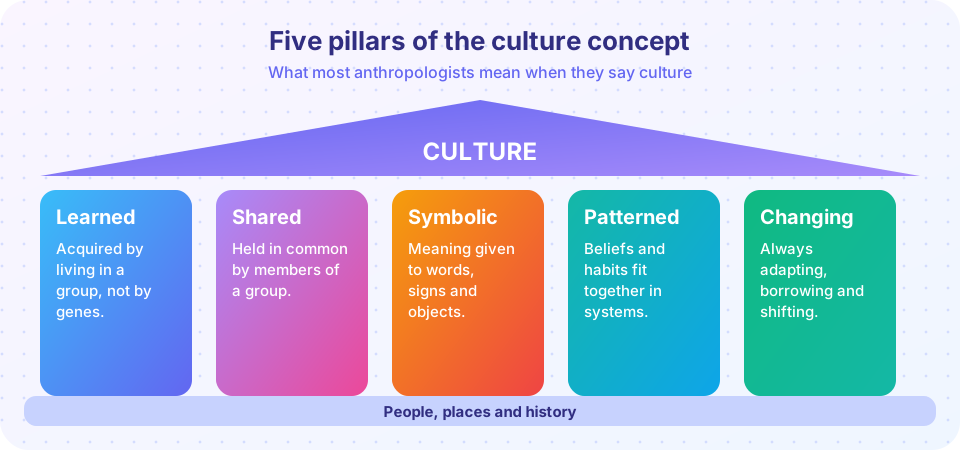
What you will learn
- A definition of culture and its five key features.
- How enculturation differs from acculturation.
- Why culture is not the same as genes, nationality or "society".
- How cultural traits spread, change and sometimes drift by chance.
- Why the concept is criticized and how anthropologists respond.
Key terms
Culture: the learned, shared and symbolically meaningful patterns of thought and behavior of a group.
Enculturation: the process of learning your own culture, mostly in childhood.
Acculturation: change that happens when groups with different cultures come into sustained contact.
Society: an organized group of people; culture is what they share and pass on.
Subculture: a group within a larger society with some distinct values, practices or styles.
A concept with a long history
In 1871 Edward Tylor offered a broad definition (see the history of anthropology): culture is the complex whole that includes knowledge, belief, art, morals, law, custom and other habits acquired by members of a society. In 1952 Alfred Kroeber and Clyde Kluckhohn collected 164 definitions in the literature. That tells you the word is flexible, and that you should always ask which meaning an author has in mind.
Five pillars
1. Culture is learned
You are not born knowing that a particular word means "dog" or that a certain gesture is rude. You learn it from other people through imitation, instruction, stories, praise and correction, a lifelong process called enculturation. Evidence that culture is learned comes from adopted children, who grow up fluent in the language and customs of the family that raised them, whatever their birth parents spoke.
2. Culture is shared
A habit that only you have is a quirk. Culture is what a group knows in common: shared expectations let strangers coordinate, from taking turns in a queue to understanding a joke. Sharing does not mean uniformity; members differ by age, gender, class and personality, and they argue about rules. What is shared is often the terms of the argument.
3. Culture is symbolic
A symbol is something that stands for something else by agreement, not by nature. The word "tree" has nothing treelike about it, which is why other languages use other sounds. Flags, wedding rings, colors of mourning and money are all symbols. The anthropologist Leslie White considered symbolic thought the foundation of culture, and Clifford Geertz described humans as animals suspended in webs of significance they themselves have spun. Because meanings are agreed rather than natural, they can differ.
4. Culture is patterned
Beliefs and habits fit together into systems. A society's food, work rhythm, marriage customs and values are linked. Ruth Benedict (Patterns of Culture, 1934) stressed overall patterns. Modern anthropologists are more cautious: they find culture less neatly integrated than a pattern suggests, with contradictions and conflicts inside every group.
5. Culture is changing
Cultures are not frozen. People invent, borrow and drop practices all the time. Change comes from new technology, contact with other groups, political shifts and generational difference. Treating a culture as timeless is a mistake anthropologists have to work to avoid.
Culture and biology
A common question is whether a habit is "nature" or "nurture". Anthropologists answer that humans are biologically cultural: our brains, long childhoods and capacity for language and imitation are evolved biological traits that make culture possible. But no gene dictates which language a child will speak.
Other animals have traditions too. Whiten and colleagues (1999) showed that wild chimpanzee communities differ in tool use and other habits in ways that suggest social learning (see natural selection and primates). What seems distinctive about human culture is its scale and cumulation: we build on the knowledge of earlier generations, so that tools, languages and institutions grow more elaborate over time.
Be careful with an easy slip: saying "that group is that way because of its genes" is a biological explanation for a cultural difference, and the evidence does not support it. Differences between groups' customs are explained by learning and history.
How culture is passed on
Researchers distinguish three routes of transmission, an idea formalized by Luigi Luca Cavalli-Sforza and Marcus Feldman in 1981:
- Vertical: from parents to children.
- Horizontal: between peers of the same generation.
- Oblique: from other adults, such as teachers or elders, to young people.
In fast-changing societies, horizontal and oblique routes become strong, which is one reason young people's slang and technology habits can differ greatly from their parents'.
Change and chance
Not every trend has a "reason". In a well-known study from 2003, Matthew Hahn and Alexander Bentley showed that the popularity of baby names in the United States over the twentieth century resembled what you would expect if people simply copied one another at random, without any preference for particular names: a "neutral" model of cultural drift. Real life has more going on, but the finding shows that some patterns come from copying and chance, as in the gene drift you saw in the primates lesson.
Contact and culture shock
When groups meet, ideas move: diffusion (a trait spreads from one group to another), acculturation (change from sustained contact) and sometimes forced assimilation. Individuals who live in an unfamiliar culture often go through culture shock, a term popularized by the anthropologist Kalervo Oberg in the 1950s: a period of confusion and stress when familiar cues no longer work, usually followed by gradual adjustment.
Criticisms of the concept
Some anthropologists worry that "a culture" can sound like a bounded, fixed thing that all members share, which turns people into stereotypes. Lila Abu-Lughod argued in 1991 that the concept can make differences between peoples seem deeper and more fixed than they are, and she proposed writing about specific people, practices and relations instead of "the X culture". Most anthropologists now use "culture" as a flexible tool: they stress variation inside groups, change over time and the influence of power.
Common misconceptions
"Culture is only art and festivals." In the anthropological sense it covers everyday habits, language, work, family, law and belief.
"Some people have no culture." Every human group has culture; the idea of "cultured" versus "uncultured" people is a value judgment, not a scientific concept.
"Culture determines everything people do." It shapes choices; individuals still negotiate, resist and innovate.
"Culture and race are linked." They are not: people who share ancestry can have very different cultures, and people with different ancestry can share one.
Try it
First, sort everyday habits into "learned" and "built in". Many habits mix both. Click an item to see why. This is a teaching demonstration, so the answers are simplified.
Second, a simulation of cultural drift. Each person copies a random person from the previous generation, with no preference for any variant. Notice how the most common variant becomes dominant much faster in a small group. This is a simplified model, not real data.
Press Run (or Ctrl + Enter) to see the result here.
Program input · what you'd type while the program runs
Type the answers before you press Run, one per line. Each time the program reads a line (with input()), it gets the next line from this box.
Check your understanding
Quick check · 6 questions
of 6 answered You scored / 6 · perfect!
-
1. Enculturation is
Acculturation is contact-induced change; enculturation is learning your own culture. -
2. Which feature of culture does a wedding ring illustrate most directly?
A ring stands for a social relationship by agreement. -
3. Evidence that culture is learned includes
Language and customs follow upbringing, not ancestry. -
4. Vertical cultural transmission goes from
Horizontal is peer to peer; oblique is from other adults to the young. -
5. Why do some anthropologists criticize the idea of 'a culture'?
Critics such as Lila Abu-Lughod urge attention to variation, change and power. -
6. In the cultural drift simulation, why does the top variant take over faster in small groups?
Random copying produces larger swings in small populations, as with genetic drift.
Summary
- Culture is learned, shared, symbolic, patterned and changing.
- Enculturation is learning your own culture; acculturation is change through contact.
- The capacity for culture is biological, but differences in culture are learned.
- Traditions spread vertically, horizontally and obliquely, and chance copying can drive change.
- Critics warn that "culture" can look too fixed; modern anthropology stresses variation, change and power.
Next: Participant Observation
Track your progress
Create a free account to tick off lessons and pick up where you left off on any device.
of Anthropology lessons completed