


















Lesson 13 of 45 · Human Evolution and Archaeology
Archaeological Methods and Dating
Learn how archaeologists find, dig and record sites, read soil layers and use relative and absolute dating such as radiocarbon, with a calculator and a simulated dig.
An archaeological dig looks slow for a reason. Digging is destructive: once a layer of soil is removed, it cannot be put back. The only thing that survives is the record the archaeologists make. For this reason the discipline's methods are about information, and a trowel is more useful than a shovel.
In this lesson you will follow a project from survey to laboratory, learn how soil layers (stratigraphy) tell a story in order, and see how clocks such as radiocarbon turn an order into dates.
What you will learn
- The steps of an archaeological project: survey, excavation, recording and analysis.
- The idea of context and why it matters more than the object.
- How stratigraphy and the law of superposition give relative order.
- How relative and absolute dating differ, and how radiocarbon dating works.
- Ethical rules about heritage, looting and the rights of communities.
Key terms
Context: where an object was found, what lay around it and in what layer.
Stratigraphy: the study of layers (strata) of soil and deposits.
Relative dating: placing things in order (older or younger) without giving a number of years.
Absolute dating: giving an age in years, with a margin of error.
Half-life: the time it takes half of a radioactive isotope to decay.
From survey to lab
1. Survey. Archaeologists walk a landscape, collect surface finds and map them. They also use tools that see through the ground without digging: ground-penetrating radar, magnetometers, and aerial laser scanning (lidar), which strips away tree cover digitally. Lidar surveys in Central America, for example, have revealed networks of ancient Maya buildings and roads under forest.
2. Excavation. Digging happens in a grid of squares and in small, controlled layers. The archaeologist notes color, texture and contents of each layer, draws it and photographs it. Soil is often sieved, and tiny seeds and bones are recovered by floating soil in water (flotation).
3. Recording. Every find gets a three-dimensional position (its provenience) and a label. Without this, an object loses most of its meaning.
4. Analysis. In the laboratory, specialists study the pottery, stone tools, animal bones, plant remains, human remains and chemistry. The results become a report, which is the lasting product of the excavation.
Context is everything
Suppose a team finds a stone blade. If it lies inside a sealed hearth layer with charcoal and animal bones, it tells a story about food, fire and date. If a looter pulls it out and sells it, only a pretty stone remains: nothing links it to a time, a place or a way of life. That is why archaeologists oppose looting even when the objects survive: the information is lost.
Stratigraphy: reading the layers
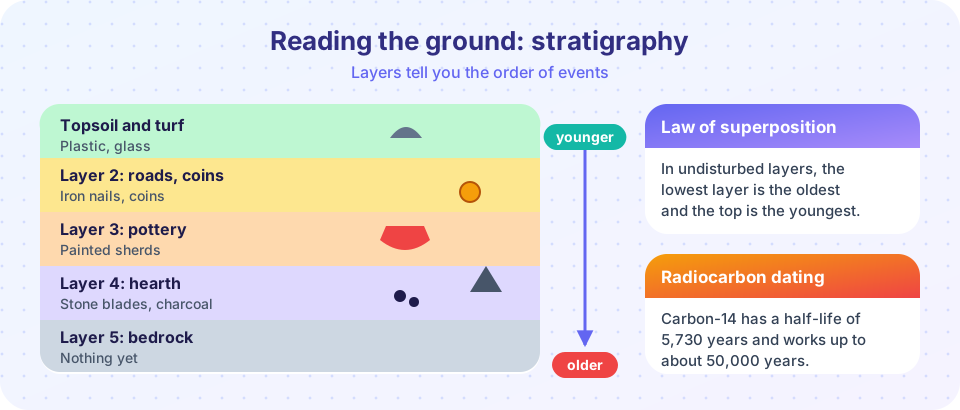
In 1669 the Danish scientist Nicolas Steno stated the law of superposition: in layers laid down one on top of another, the lowest is the oldest, unless disturbed. Archaeologists apply the same logic to deposits created by people: floors, ash, rubbish, collapsed walls.
Real sites are messier than a tidy cake. Pits dug into older layers, burrowing animals, plowing and floods all mix material. The skill is to find these disturbances and read them. A tool for this is the Harris matrix, a diagram devised by Edward Harris in the 1970s that records which deposit lay above, below or cut into which, so the sequence of events at a site can be worked out step by step.
Relative dating
Even without any numbers, you can say a lot.
- Superposition gives order within a site.
- Typology groups artifacts by style. If pottery styles change over time, a style can show which period a layer belongs to.
- Seriation arranges assemblages by how popular a style is: it rises, peaks and falls like a bell curve. Sir Flinders Petrie used it to order Egyptian graves at the end of the nineteenth century.
- Cross-dating links a site to another through a shared object, such as imported pottery.
Relative methods answer "before or after?". Absolute methods answer "how many years?".
Absolute dating
Radiocarbon dating
Living things take in carbon, including a small amount of radioactive carbon-14, which forms in the upper atmosphere. When an organism dies, it stops taking in carbon, and the carbon-14 inside decays at a steady rate. Its half-life is 5,730 years. If a sample of charcoal has one quarter of the carbon-14 found in living wood, two half-lives have passed, so it is about 11,460 years old.
| Half-lives passed | Fraction of carbon-14 left | Age |
|---|---|---|
| 0 | 100% | 0 |
| 1 | 50% | 5,730 years |
| 2 | 25% | 11,460 years |
| 3 | 12.5% | 17,190 years |
| 5 | about 3% | 28,650 years |
The formula is age = (5730 / ln 2) × ln(N0 / N), where N0 / N is the ratio of original to remaining carbon-14. Willard Libby developed the method in the late 1940s and won the Nobel Prize in Chemistry in 1960. It works on organic material (wood, charcoal, bone, shell, seeds) up to about 50,000 years old, because after that too little carbon-14 remains. Raw results are calibrated against records such as tree rings, because carbon-14 in the atmosphere has varied over time, and the date is always given with a margin of error.
Other methods
- Dendrochronology (tree-ring dating) matches the pattern of wide and narrow rings in timber to a master sequence, often giving the exact year of a tree's death.
- Potassium-argon and argon-argon dating use radioactive decay in volcanic rock to date layers older than about 100,000 years, such as those above and below early hominin fossils in East Africa.
- Luminescence methods (thermoluminescence and optically stimulated luminescence) estimate when minerals in pottery or sediment were last heated or exposed to light.
- Uranium-series dating dates cave formations and some bones.
Reliable chronologies usually combine several methods that agree.
Ethics and heritage
Archaeological sites belong to humanity's shared past, and often to living communities whose ancestors made them. Good practice includes:
- obtaining permission and working with descendants and local people;
- following laws on heritage, such as the 1990 Native American Graves Protection and Repatriation Act (NAGPRA) in the United States, which sets rules for the return of certain human remains and sacred objects;
- never buying looted antiquities;
- publishing results so that the information is shared.
Common misconceptions
"Radiocarbon dating can date dinosaurs or rocks." It only works on organic remains up to roughly 50,000 years old. Rocks and much older material need other methods.
"A radiocarbon date is exact." It always comes with an uncertainty range, and calibration is needed.
"Archaeologists dig up treasure." Their aim is information about people's lives; value in money is irrelevant, and selling finds is unethical.
Try it
First, dig a simulated site. Press Dig down to remove one layer at a time and see what you would record. The finds are invented for the demonstration.
Second, a radiocarbon calculator. Enter the fraction of carbon-14 remaining and it returns an age, then plots the decay curve. This is the plain decay formula, without calibration.
Press Run (or Ctrl + Enter) to see the result here.
Program input · what you'd type while the program runs
Type the answers before you press Run, one per line. Each time the program reads a line (with input()), it gets the next line from this box.
Check your understanding
Quick check · 5 questions
of 5 answered You scored / 5 · perfect!
-
1. Why is context so important in archaeology?
Without context an object loses its age, use and connections. -
2. The law of superposition says that in undisturbed layers
Newer deposits are laid down on top of older ones. -
3. A charcoal sample has 25% of its original carbon-14. About how old is it?
25% means two half-lives have passed: 2 x 5,730 = 11,460 years. -
4. Radiocarbon dating works on
After about 50,000 years too little carbon-14 remains to measure. -
5. Which method dates timber to an exact year by matching ring patterns?
Tree-ring dating matches wide and narrow rings to a master sequence.
Summary
- Archaeology proceeds from survey to controlled excavation, recording and laboratory analysis; digging destroys, so records are the product.
- Context gives objects their meaning; looting destroys information.
- Stratigraphy gives relative order; absolute methods such as radiocarbon, tree rings, argon and luminescence give ages.
- Radiocarbon uses carbon-14's half-life of 5,730 years and works up to about 50,000 years, with calibration and error margins.
- Good practice involves communities, heritage law and shared publication.
Track your progress
Create a free account to tick off lessons and pick up where you left off on any device.
of Anthropology lessons completed