


















Lesson 43 of 45 · Projects and Practice
Anthropology Glossary: Key Terms from A to Z
A glossary of about fifty core anthropology terms with short definitions, grouped for study, plus a searchable word list and a flashcard quiz you can edit.
Anthropology has a large technical vocabulary because it describes things that ordinary words blur. This glossary gives short definitions of the terms you have met and links them to the chapters where they are explained. Use it for review and for writing. Definitions are brief on purpose: the lessons give examples and debates.
What you will learn
- The key terms of the course in one place.
- How terms group into families of related ideas.
- How to test yourself with a flashcard script.
Key terms
Emic and etic: insiders' categories versus the analyst's categories.
Reflexivity: reflecting on how the researcher shapes the research.
Cultural relativism: understanding beliefs and practices in their own context before judging them.
Glossary by family
Method and theory
| Term | Meaning |
|---|---|
| Ethnography | A detailed written description of a way of life, based on long fieldwork. |
| Participant observation | Learning by living with people and taking part in daily activity. |
| Emic / etic | Insiders' view / outside analyst's view. |
| Reflexivity | Examining how your own position affects what you see and write. |
| Thick description | Describing actions together with the meanings that make them intelligible. |
| Holism | Studying a society's parts in relation to the whole. |
| Cultural relativism | Understanding a practice in its own context before evaluating it. |
| Ethnocentrism | Judging other cultures by the standards of your own. |
Culture and society
| Term | Meaning |
|---|---|
| Culture | Learned, shared ideas, practices and objects that people use to make sense of life. |
| Enculturation | The process of learning a culture. |
| Norm | A shared expectation of how to behave. |
| Social structure | Patterns of relationships and positions in a society. |
| Agency | People's capacity to act, choose and change things. |
Kinship (chapter 5)
| Term | Meaning |
|---|---|
| Descent | The rule that traces group membership through ancestors. |
| Patrilineal / matrilineal | Descent through men / through women. |
| Bilateral (cognatic) | Descent counted through both parents. |
| Lineage / clan | Descent group with known links / with claimed common ancestry. |
| Moiety | One of two halves of a society. |
| Exogamy / endogamy | Marrying outside / inside a defined group. |
| Affinal kin | Relatives by marriage. |
| Parallel / cross cousins | Children of same-sex / opposite-sex siblings of one's parents. |
| Bridewealth / dowry / brideservice | Goods to the bride's kin / goods with the bride / work for the bride's family. |
| Polygyny / polyandry | One man with several wives / one woman with several husbands. |
| Household | People who share a home and daily resources. |
| Relatedness | Ways people become kin, including care, feeding and shared life. |
Economy and power (chapter 6)
| Term | Meaning |
|---|---|
| Subsistence strategy | How a society mainly gets food. |
| Reciprocity | Giving and returning within relationships (generalized, balanced, negative). |
| Redistribution | Goods collected by a center and shared out. |
| Embeddedness | Economic life as part of social institutions. |
| Gift | A transfer that creates or confirms a relationship. |
| Band, tribe, chiefdom, state | Service's four types of political organization. |
| Big man | A leader who earns a following through generosity. |
| Leveling mechanism | A custom that keeps anyone from dominating. |
| Hegemony | Rule maintained through consent that makes the order seem natural. |
| Structural violence | Harm built into social structures. |
| Intersectionality | The combining effects of race, class, gender and other categories. |
Symbols and meaning (chapter 7)
| Term | Meaning |
|---|---|
| Symbol | Something that stands for something else by convention. |
| Linguistic relativity | The idea that language influences thought. |
| Code-switching | Moving between languages or varieties in conversation. |
| Ritual | Formal, repeated, symbolic action. |
| Rite of passage | A ritual marking a change of status: separation, liminal phase, incorporation. |
| Liminality / communitas | The in-between phase / the equality of people sharing it. |
| Material culture | Objects people make and use, with their meanings. |
| Repatriation | Returning cultural objects or remains to descendants. |
Global and applied (chapter 8)
| Term | Meaning |
|---|---|
| Globalization | Growing flows of people, goods, money, media and ideas across borders. |
| Scape | Appadurai's term for a global flow (ethno, techno, finance, media, ideo). |
| Diaspora | A dispersed population that keeps ties to a homeland. |
| Transnationalism | Living and keeping ties across borders. |
| Hybridity | Mixing of cultural forms to make new ones. |
| Applied anthropology | Using anthropology to address practical problems. |
| Explanatory model | A person's account of an illness's cause and cure. |
| Informed consent | Voluntary agreement based on understanding, open to withdrawal. |
| Decolonizing | Examining and changing colonial legacies in research and knowledge. |
Try it
First, a searchable glossary. Type a word fragment in the code and run it. This is a small excerpt, and you can add terms.
Press Run (or Ctrl + Enter) to see the console output here.
No output.
Second, a flashcard quiz that shows each definition and asks for the term. It prints the answer key so you can check yourself. The order is shuffled with a fixed seed so it is repeatable.
Press Run (or Ctrl + Enter) to see the result here.
Program input · what you'd type while the program runs
Type the answers before you press Run, one per line. Each time the program reads a line (with input()), it gets the next line from this box.
Check your understanding
Quick check · 4 questions
of 4 answered You scored / 4 · perfect!
-
1. What does 'emic' refer to?
Emic means the view from within the culture; etic is the outsider analyst's frame. -
2. Bridewealth is
Dowry goes with the bride; bridewealth goes to the bride's kin. -
3. A scape in Appadurai's sense is
He named five scapes: ethno, techno, finance, media and ideo. -
4. Which pair names the in-between phase of a rite and the togetherness it can produce?
The in-between phase of a rite can create strong feelings of togetherness.
Summary
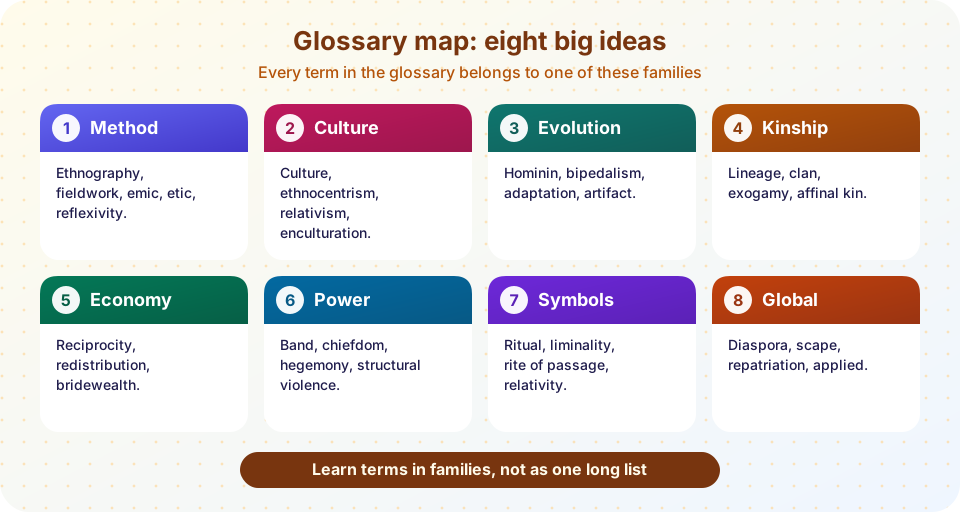
- The glossary groups terms into families: method, culture, kinship, economy and power, symbols, and global and applied.
- Many terms are pairs (emic/etic, exogamy/endogamy, patrilineal/matrilineal).
- Learning terms in families helps you remember how ideas connect.
Track your progress
Create a free account to tick off lessons and pick up where you left off on any device.
of Anthropology lessons completed