


















Lesson 28 of 45 · Economy, Politics and Power
Authority and States: Bands, Tribes, Chiefdoms and Beyond
Learn how societies organize authority: Weber's power and legitimacy, Service's four types, big men and chiefs, leveling mechanisms and critiques of the ladder.
Politics is about how groups make decisions, settle disputes and decide who may use force. Political anthropology began by asking a puzzle: how do societies without kings, police or written laws keep order? The answers changed how we think about government. Order can come from kinship, ritual, shaming, councils and the threat of being left alone, not only from a ruler with an army.
This lesson sets out the vocabulary of power and authority, introduces the classic types of political organization, looks at the leaders of small-scale societies and ends with serious criticisms of the neat "ladder" from bands to states.
What you will learn
- The difference between power and authority, and Weber's three kinds of authority.
- Service's bands, tribes, chiefdoms and states, and Fried's alternative scheme.
- How big men differ from chiefs.
- How egalitarian societies keep leaders from dominating.
- Why many scholars criticize evolutionary ladders.
Key terms
Power: the ability to get others to act, with or without their consent.
Authority: power that people accept as legitimate.
State: a political system with centralized institutions that claims a monopoly on the legitimate use of force over a territory (Weber's definition).
Egalitarian: a society with few ranked positions beyond age and sex.
Leveling mechanism: a custom that stops a person from becoming too dominant, such as ridicule, sharing demands or gossip.
Power and legitimacy
Max Weber separated power (getting your way) from authority (power that others consider rightful). He described three sources of legitimate authority. Traditional authority rests on custom, as with hereditary rulers. Charismatic authority rests on the exceptional qualities of a person, as with prophets or war leaders. Legal-rational authority rests on rules and offices, as in modern bureaucracies. Real leaders often combine these. Weber also defined the state as the entity that successfully claims the monopoly of legitimate physical force in a territory, a definition anthropologists still use as a starting point.
Four types of political organization
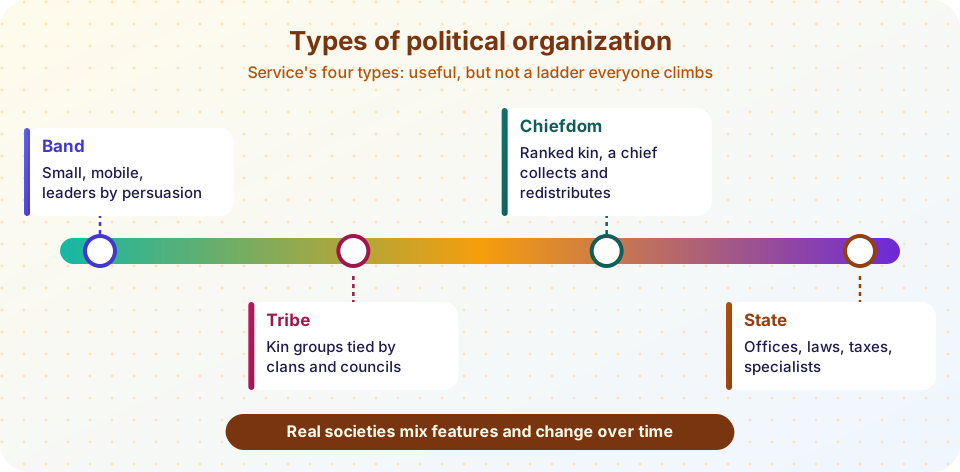
Elman Service (1962) described four types, ordered roughly by scale. Morton Fried (1967) offered a related scheme of egalitarian, ranked and stratified societies.
- Bands: small groups of foragers, often a few dozen people, moving seasonally. Leadership is informal and based on skill or age. Decisions come through discussion.
- Tribes: kin-based groups, usually farmers or herders, that unite through clans, age sets or councils when threatened. No permanent central authority.
- Chiefdoms: ranked societies where a chief, usually from a high-ranking lineage, collects goods and redistributes them at feasts. Hereditary rank matters. Many Polynesian societies are the classic examples.
- States: centralized governments with offices, laws, taxation, specialized officials, often writing and a standing military. Early states arose independently in Mesopotamia, Egypt, the Indus valley, China, Mesoamerica and the Andes.
Leaders in small-scale societies
Marshall Sahlins (1963) contrasted the Melanesian big man with the Polynesian chief. A big man gains influence by organizing feasts, helping others with exchange payments and building a following. His status is earned and must be maintained. A chief inherits a position and is surrounded by ritual. Real cases are not so clean, but the contrast is helpful. A big man who stops being generous may lose followers overnight.
Among the Nuer, the "leopard-skin chief" was a ritual specialist who could mediate in feuds but had no power to enforce decisions. Among the Maasai, age sets group men who were initiated together, and elders and warriors have different roles over a lifetime.
How egalitarian societies stay egalitarian
If anyone can become powerful, how do societies avoid it? Richard Lee described how Ju/'hoansi hunters were teased when they boasted about a kill and had meat belittled. Christopher Boehm argued in Hierarchy in the Forest (1999) that mobile foragers practice reverse dominance: the group uses ridicule, ostracism and in extreme cases violence to keep would-be bullies in check. Pierre Clastres argued in Society Against the State (1974) that some Amazonian societies actively resisted the emergence of coercive power. James C. Scott in The Art of Not Being Governed (2009) described how upland peoples of Southeast Asia used mobility and farming choices to stay out of the reach of lowland states. These views are debated, but they show that "no state" can be a political choice.
Critiques of the ladder
The sequence from band to state suggested that societies climbed an evolutionary ladder. Many anthropologists now reject that story for several reasons.
- Evidence from archaeology shows complex societies that did not fit the scheme, such as hunter-gatherer societies on the Northwest Coast with rank, slavery and large houses, and early cities without clear kings.
- Sequences are not inevitable. Societies can fission, shrink or switch between more and less hierarchical forms, sometimes seasonally.
- States are not always the end point. Scholars such as Scott argue that early states relied on taxation of grain and forced labor, and that many people fled them.
- The typology can hide variation. Two "chiefdoms" can be very different. David Graeber and David Wengrow (The Dawn of Everything, 2021) argue that ancient societies experimented with many political forms, a provocative argument that other scholars dispute.
Use the four types as a vocabulary, not as a law of history.
The anthropology of the modern state
Anthropologists also study states from inside: how paperwork, borders, schools and police shape everyday life, how people experience bureaucracy and how citizens negotiate with it. Akhil Gupta's studies of Indian bureaucracy and the work of others show that "the state" is made of countless daily practices, not one object.
Common misconceptions
"Societies without states have no law." Many have clear rules, courts of elders, compensation systems and sanctions. They just do not rely on a permanent specialized force.
"Chiefs are tribal kings." Chiefs usually have limited coercive power and are expected to give generously. Their authority rests on kinship and ritual.
"The state is the natural end of history." The record shows many paths, and some states collapsed or were avoided.
Try it
The first demo prints the types as a table. It is a summary of the scheme in this lesson, simplified so that you can compare features.
Press Run (or Ctrl + Enter) to see the console output here.
No output.
The second demo is a toy model of leveling. Fifty households start equal and then grow or shrink by luck each round. A leveling rule moves a fraction of each household's distance from the average back toward the average (like sharing demands). The model is simple and invented; it shows how a small, repeated correction can hold inequality down.
Press Run (or Ctrl + Enter) to see the result here.
Program input · what you'd type while the program runs
Type the answers before you press Run, one per line. Each time the program reads a line (with input()), it gets the next line from this box.
Check your understanding
Quick check · 5 questions
of 5 answered You scored / 5 · perfect!
-
1. Weber's three kinds of legitimate authority are
Weber distinguished traditional, charismatic and legal-rational authority. -
2. How does a big man differ from a chief?
Sahlins contrasted achieved Melanesian big men with hereditary Polynesian chiefs. -
3. A leveling mechanism is
Ridicule and sharing demands keep leaders from rising too far. -
4. Which is a criticism of the band-tribe-chiefdom-state ladder?
Archaeology and history show non-linear paths and unusual combinations. -
5. In the leveling model, what happens to inequality as the leveling fraction rises?
Pulling households toward the mean reduces the spread of wealth.
Summary
- Power is the ability to act on others; authority is legitimate power. Weber named traditional, charismatic and legal-rational types.
- Service's types (band, tribe, chiefdom, state) and Fried's types (egalitarian, ranked, stratified) offer a vocabulary.
- Big men earn influence; chiefs usually hold hereditary rank.
- Egalitarian societies use leveling mechanisms and reverse dominance.
- The ladder is criticized as too neat; use it as a comparison tool.
Track your progress
Create a free account to tick off lessons and pick up where you left off on any device.
of Anthropology lessons completed