


















Lesson 25 of 45 · Kinship, Family and Social Organization
Chapter 5 Review: Kinship, Family and Social Organization
Review chapter 5 with a one-picture summary, a recap table, a score tracker and a ten-question quiz on descent, kinship terms, marriage and households.
This review ties together the four layers of kinship: descent, terminology, marriage and household. Read the picture first, scan the table, then try the quiz without looking back. Wrong answers are useful because they show which lesson to reread.
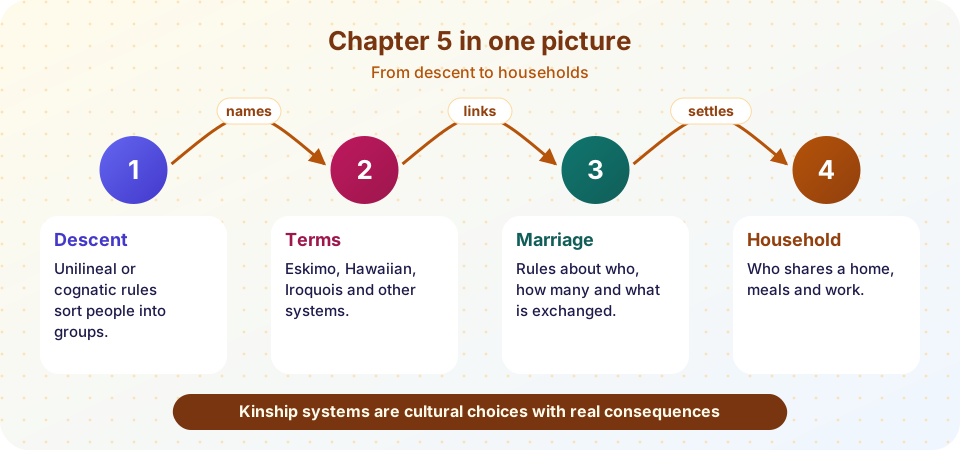
The chapter in a table
| Topic | Key idea | Example or person |
|---|---|---|
| Descent | Rules assign people to groups | Nuer (patrilineal), Minangkabau (matrilineal), Yakö (double) |
| Lineage and clan | Known versus claimed common ancestry | Segmentary lineages, Evans-Pritchard |
| Matrilineal puzzle | Authority often sits with the mother's brother | Audrey Richards, the Bemba |
| Terminology | Languages sort relatives differently | Morgan; Eskimo, Hawaiian, Iroquois, Crow, Omaha, Sudanese |
| Cousins | Parallel (FB, MZ children) versus cross (FZ, MB children) | Iroquois: cross cousins are marriageable |
| Marriage | A bundle of rights; alliance between groups | Leach, Lévi-Strauss |
| Payments | Bridewealth, dowry, brideservice | Nuer cattle, South Asian dowry, Ju/'hoansi service |
| Households | Shared home and budget, not always the family | Laslett and the Cambridge Group |
| New kinship studies | Kinship as made through acts of relatedness | Schneider, Carsten |
Try it
Use this tracker to find weak spots. It is a simple study tool, not a test of ability. Change the numbers to the number of quiz questions you got right out of those listed for each lesson.
Press Run (or Ctrl + Enter) to see the result here.
Program input · what you'd type while the program runs
Type the answers before you press Run, one per line. Each time the program reads a line (with input()), it gets the next line from this box.
Check your understanding
Quick check · 10 questions
of 10 answered You scored / 10 · perfect!
-
1. A society where a person belongs to their mother's descent group is
In matrilineal descent, membership passes through women. -
2. The Nuer are the classic example of which kind of order?
Evans-Pritchard described lineages splitting and uniting without a government. -
3. What is a moiety?
Moieties are the two halves into which a society can be divided. -
4. Which kin type is a cross cousin of Ego?
MBD is the daughter of the mother's brother, an opposite-sex sibling of Ego's parent. -
5. Hawaiian kinship terminology mostly sorts relatives by
All relatives of a generation share terms, so cousins are called brothers and sisters. -
6. According to Lévi-Strauss, the incest taboo mainly serves to
He saw the taboo as the root of exchange between groups. -
7. Which payment moves from the groom's side to the bride's kin?
Bridewealth is given by the groom's side, often in cattle or goods. -
8. What did Laslett's research on English parish records indicate?
The data challenged the story that industry created the nuclear household. -
9. Which statement about polygyny is accurate?
Permission is widespread, but few men can afford several wives. -
10. Why do anthropologists use 'relatedness'?
Relatedness captures kinship that is made by acts as well as by birth.
Summary
- Descent rules assign group membership, and groups often own land and require exogamy.
- Kinship terms differ across languages and relate loosely to social structure.
- Marriage is a bundle of rights and often an alliance between groups.
- Households are shaped by economy and politics, not by a single historical path.
- Kinship is made through relatedness as well as birth.
Track your progress
Create a free account to tick off lessons and pick up where you left off on any device.
of Anthropology lessons completed