


















Lesson 14 of 45 · Human Evolution and Archaeology
From Foraging to Farming to Cities
Explore how people shifted from foraging to farming and then to cities and states, with regional examples, health and inequality debates, and why none of it was inevitable.
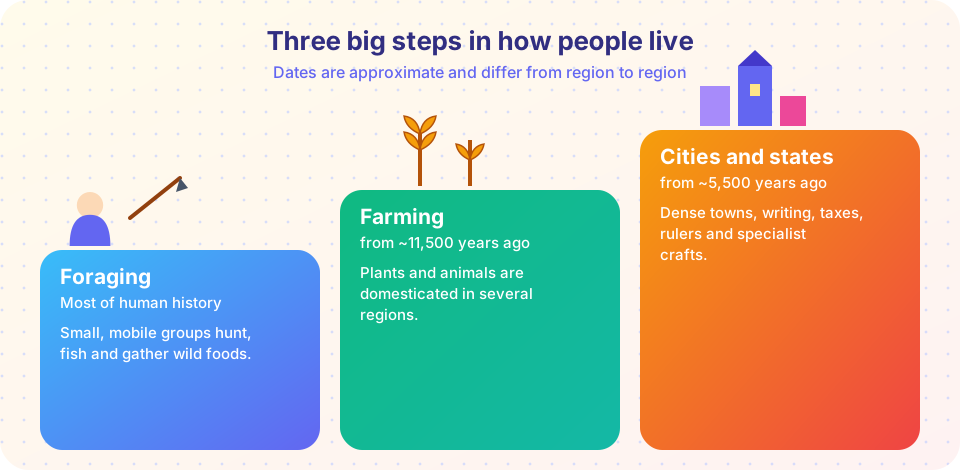
For most of our species' history, people lived by foraging: hunting animals, fishing and gathering wild plants. Then, beginning about 11,500 years ago and in several places independently, people began to grow crops and keep herds. A few thousand years later came cities, rulers, writing and tax collectors. Today most of us live in a world those changes made.
It is tempting to see this as a story of steady progress. The evidence is more interesting. The shift brought new foods and new monuments, and also new diseases, new inequalities and hard work. This lesson explains what happened, what the evidence is and what is still argued about.
What you will learn
- What foraging societies were like, and the dangers of stereotyping them.
- Where and when farming began, with several independent origins.
- Why people adopted farming, and what it cost.
- How cities and states arose and what they added.
- Why "progress" is the wrong frame.
Key terms
Foraging (hunter-gatherer) society: a society that lives mainly on wild foods.
Sedentism: living in one place year-round.
Domestication: changing plants or animals over generations through human selection until they depend on care.
Neolithic: the "New Stone Age", when farming begins in a region.
State: a society with centralized government, a ruling class and specialist institutions such as tax collection and armies.
Foraging lifeways
Foragers lived in every environment, from deserts to Arctic coasts, and their societies were not alike. Even so, anthropologists studying recent foragers, such as the San of southern Africa and the Hadza of Tanzania, found common features: small, flexible groups, much movement, detailed knowledge of plants and animals, strong norms of sharing food, and relatively little formal difference in wealth between people. A conference volume called Man the Hunter (1966) brought these studies to wide attention, and Marshall Sahlins called foragers "the original affluent society" because their needs were few and easily met.
Treat that picture with caution. The present-day foragers are not "living fossils": they have long histories and contacts with farmers, traders and states. Some foragers in the past built permanent settlements, stored food and had marked social differences. Foraging is a way of making a living, not a single kind of society.
Before farming: settling down and monuments
Hints of change are visible before farming. In the Levant, the Natufian people (about 15,000 to 11,500 years ago) lived in semi-permanent villages, harvested wild cereals with stone sickles and used grinding stones. At Göbekli Tepe in southeastern Turkey, huge carved stone pillars were put up about 11,000 years ago, probably by communities that were still mostly foragers. Large gatherings and shared ritual may have come before, not after, a fully farming economy.
Independent origins of farming
Farming did not start in one place and spread everywhere. It arose independently in several regions, each with its own crops and animals. Dates are approximate and keep being refined.
| Region | Early crops and animals | Roughly when |
|---|---|---|
| Southwest Asia (Fertile Crescent) | Wheat, barley, lentils, peas; sheep, goats, cattle, pigs | From about 11,500 years ago |
| East Asia (Yangtze and Yellow River valleys) | Rice, millet; pigs | About 9,000 years ago |
| Mesoamerica | Maize (from the wild grass teosinte), squash, beans | About 9,000 years ago for the first signs of domesticating maize |
| Andes and Amazon | Potatoes, quinoa, manioc; llamas, alpacas | Several thousand years ago, with earlier plant management |
| New Guinea highlands | Taro, bananas, sugar cane | At least several thousand years ago |
| Sub-Saharan Africa | Sorghum, millet, yams | About 5,000 to 4,000 years ago |
| Eastern North America | Squash, sunflower, goosefoot | About 4,000 to 5,000 years ago |
In some regions, early farmers spread by migration and took their crops with them. In others, neighbors adopted crops without large movements of people. Ancient DNA is now helping to tell which was which, region by region.
Why farm, and what did it cost?
The archaeologist V. Gordon Childe called the change the "Neolithic Revolution" in 1936. Today most researchers see it as a slow, uneven transition lasting thousands of years. Why did it happen? Candidates include:
- Climate: the end of the last Ice Age, about 11,700 years ago, brought warmer, more stable weather that favored plant growth.
- Population and resources: growing groups in rich areas may have needed more food from the land.
- Social reasons: feasting, competition and ritual could have encouraged people to produce a surplus.
Most scholars think no single cause explains every case.
The costs are clearer in some places than in others. Skeletons of early farmers in several regions show more tooth decay, more signs of nutritional stress and shorter average height than those of nearby foragers, though results vary. Farming also tied people to fields and stores, increased the risk of crop failure and brought them close to animals, which let diseases cross to humans. Many researchers also link farming to growing social inequality: stored grain can be owned, taxed or stolen. Others point out that farming fed many more mouths, so populations grew even if individual health did not always improve.
Cities and states
The first cities arose a few thousand years after the start of farming. In southern Mesopotamia (today's Iraq), Uruk grew about 5,500 years ago into one of the largest settlements in the world, with monumental temples, workshops and a large population. In the same region, bookkeeping marks on clay developed into cuneiform writing around 3300 BCE: much early writing was used for accounting.
Cities and states appeared independently in other places too, including Egypt, the Indus Valley (for instance Mohenjo-daro), northern China, the Andes (Caral, on the coast of Peru) and Mesoamerica. They had features in common:
- dense populations, often with tens of thousands of people;
- specialists: potters, metalworkers, scribes, priests, soldiers;
- rulers and tax or tribute collected from farmers;
- public buildings and long-distance trade;
- inequality in wealth and power.
The anthropologist James C. Scott argues in Against the Grain (2017) that early states relied on grain because it can be counted, stored and taxed, and that many people lived in the "wild" edges of states by choice. His view is debated, but it makes the point that states are not just a stage of progress.
Not inevitable, not progress
Foragers kept living alongside farmers in many parts of the world, some societies moved back and forth between farming and herding, and some large settlements were not governed by kings. These complexities caution against a "ladder" where every society climbs from foraging to cities. The better picture is one of many routes, with costs and benefits at every turn.
Common misconceptions
"Farming was an obvious improvement." For many people, early farming meant harder work and worse health. It also allowed more people to be fed, so it spread.
"Foragers are people from the past." Contemporary foraging peoples live in the present and have their own long histories.
"Farming began once and spread." It began independently in several regions.
"Cities appeared suddenly." They grew over centuries from earlier villages and towns.
Try it
First, a toy model of population growth. In it, a farming economy supports a larger number of people than foraging in the same land (a higher "carrying capacity"). The numbers are invented to show the shape of the idea, not real populations.
Press Run (or Ctrl + Enter) to see the result here.
Program input · what you'd type while the program runs
Type the answers before you press Run, one per line. Each time the program reads a line (with input()), it gets the next line from this box.
Second, choose a region and see its early crops. The dates repeat the approximate ones in the table.
Check your understanding
Quick check · 5 questions
of 5 answered You scored / 5 · perfect!
-
1. Which statement about the origin of farming is correct?
Southwest Asia, East Asia, Mesoamerica, the Andes, New Guinea, Africa and North America all have independent origins. -
2. What did Göbekli Tepe show?
Monumental building and gathering may have come before a fully farming economy. -
3. Which is a documented cost of early farming in some regions?
Evidence is mixed, but many early farming skeletons show more stress than nearby foragers. -
4. Early cuneiform writing in Mesopotamia was largely used for
Many early tablets record goods, rations and tallies. -
5. Why is 'progress' a misleading way to describe this history?
The transition had winners and losers and no single path.
Summary
- Foragers lived in diverse societies; modern foragers are not "living fossils".
- Farming arose independently in at least half a dozen regions starting about 11,500 years ago.
- Reasons for farming included climate, population and social factors; costs included health and inequality.
- Cities and states arose from about 5,500 years ago, with writing used first for accounting.
- The story is one of many routes, not a ladder.
Next: Chapter 3 Review
Track your progress
Create a free account to tick off lessons and pick up where you left off on any device.
of Anthropology lessons completed