


















Lesson 30 of 45 · Economy, Politics and Power
Chapter 6 Review: Economy, Politics and Power
Review chapter 6 with a one-picture summary, a recap table, a self-check tool and a ten-question quiz on exchange, political types, inequality and resistance.
Chapter 6 asked how people make a living, how they decide things together and how they handle differences in wealth and power. Use this page to check what stuck. Read the picture, scan the table, then try the quiz before you look back.
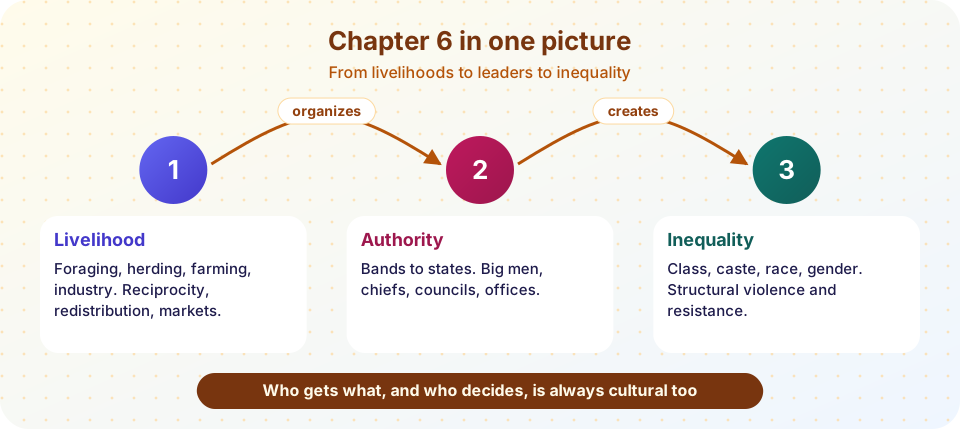
The chapter in a table
| Topic | Key idea | Names and cases |
|---|---|---|
| Subsistence | Foraging, herding, horticulture, agriculture, industry | Ju/'hoansi, Nuer, Tsembaga |
| Gifts | Giving creates relationships; three obligations | Malinowski (kula), Mauss, Gregory |
| Reciprocity | Generalized, balanced, negative | Sahlins |
| Modes of exchange | Reciprocity, redistribution, markets; embeddedness | Polanyi |
| Authority | Traditional, charismatic, legal-rational; state as monopoly of legitimate force | Weber |
| Political types | Band, tribe, chiefdom, state; critiques of the ladder | Service, Fried, Scott, Graeber and Wengrow |
| Leaders | Big men versus chiefs; leveling and reverse dominance | Sahlins, Lee, Boehm |
| Inequality | Class, caste, race, gender, intersectionality | Dumont, Boas, Crenshaw |
| Maintenance | Structural violence, hegemony, symbolic violence | Farmer, Gramsci, Bourdieu |
| Resistance | Everyday and open; do not romanticize | J. C. Scott, Abu-Lughod |
Try it
A short self-check tool. Enter how many questions you got right on each lesson's quiz and see which to revisit. It is a simple study aid.
Press Run (or Ctrl + Enter) to see the result here.
Program input · what you'd type while the program runs
Type the answers before you press Run, one per line. Each time the program reads a line (with input()), it gets the next line from this box.
Check your understanding
Quick check · 10 questions
of 10 answered You scored / 10 · perfect!
-
1. Which describes generalized reciprocity?
Generalized reciprocity is open-ended giving typical of close relationships. -
2. In the kula ring, necklaces and armbands traveled
Necklaces went clockwise and armbands counterclockwise, linking partners over long distances. -
3. Polanyi's idea of embeddedness means
Economic life is organized through social and cultural institutions. -
4. Weber's definition of the state centers on
The monopoly of legitimate force is the core of the definition. -
5. A 'big man' gains status mainly by
Big-man status is achieved and must be maintained through generosity. -
6. What is a leveling mechanism?
Teasing, sharing demands and ostracism keep egalitarian societies egalitarian. -
7. Which statement about race matches the AAA's 1998 view?
Race is a social category, and racism has real effects. -
8. Structural violence refers to
It names preventable harm built into social arrangements. -
9. What did Scott's 'weapons of the weak' describe?
Everyday resistance is low-profile and hard to punish. -
10. Why is the band-tribe-chiefdom-state ladder criticized?
Archaeology and history show many paths and mixed forms.
Summary
- Livelihood and exchange are embedded in social relationships: gifts, reciprocity, redistribution and markets.
- Authority ranges from consensus to states; the ladder is a vocabulary, not a law.
- Inequality takes many forms and is kept going by structure, hegemony and symbolic power.
- Resistance takes everyday and open forms and should be analyzed carefully.
Track your progress
Create a free account to tick off lessons and pick up where you left off on any device.
of Anthropology lessons completed