


















Lesson 5 of 45 · What Is Anthropology
Chapter 2 Overview: What Is Anthropology?
A clear definition of anthropology, how it differs from sociology, psychology and history, and a map of the four fields and the lessons in chapter two.
The word comes from two Greek roots: anthropos (human being) and logos (study or reasoning). Put together, anthropology is the study of humans. That sounds like every other subject in the humanities and sciences, and in a way it is. What makes anthropology distinct is how it studies humans: across all of human time, across all places, and across both body and culture.
This overview gives you a working definition, shows how anthropology relates to its neighbors, and previews the four fields and the three big habits of mind (holism, comparison and relativism) that the rest of the chapter explores.
What you will learn
- A one-sentence definition of anthropology and its three kinds of range.
- How anthropology differs from sociology, psychology and history.
- A first look at the four fields and the habits of mind they share.
- What each lesson in this chapter covers.
Key terms
Anthropology: the study of humans across time, place and ways of life, in biology and culture together.
Discipline: an organized field of study with its own methods and questions.
Subfield: one of the main branches of a discipline.
Fieldwork: research done among the people or at the place being studied.
Theory: a connected set of ideas that explains patterns in evidence.
A working definition
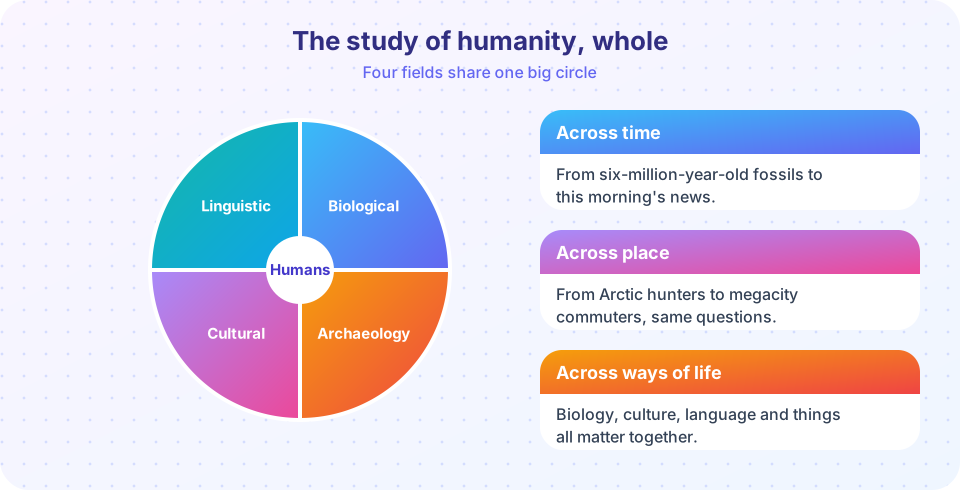
Here is a definition you can keep: anthropology is the study of humans in all times and places, in their biological and cultural variety. Three kinds of range are packed into it.
- Across time. Anthropologists look at fossils millions of years old, at cities of a few thousand years ago and at what people did this morning.
- Across place. They work among Arctic hunters, farmers in tropical forests, office workers in megacities and migrants on the move.
- Across ways of life. They consider bodies and genes, tools and houses, words and stories, rules and rituals.
No other discipline stretches this wide. That range is both the strength of anthropology and the reason it is sometimes hard to define.
How anthropology differs from its neighbors
Anthropology overlaps with many fields. Here are the main contrasts. Each is a tendency, not a wall.
| Neighbor | Usually focuses on | Anthropology adds |
|---|---|---|
| Sociology | Patterns in modern societies, often with surveys and statistics | Long fieldwork, many non-Western societies, and a long time depth |
| Psychology | Individual minds and behavior, often in labs | How the setting and culture shape what counts as normal |
| History | Written records of past societies | Societies without writing, objects, and living memory |
| Biology | Life in general | Humans as both biological and cultural beings |
| Economics | Choices and markets | Gift exchange, sharing, and the meanings attached to goods |
The overlaps are productive. Many researchers move between fields; an anthropologist may use surveys, a sociologist may do long fieldwork and a historian may use oral histories.
The four fields at a glance
In the tradition that grew up in North America, anthropology has four fields. In some countries the labels differ (social anthropology in Britain, ethnology in much of Europe), but the topics are similar.
Four fields, one discipline
They share one question: what is it to be human?
Three habits of mind
These habits come up in every chapter.
Two ways to describe
Good work moves between both.
You will study these in detail in the four fields. Briefly, biological anthropology studies human evolution, variation and our primate relatives. Archaeology reconstructs the human past from material remains. Cultural anthropology (also called social anthropology) studies how people live today through fieldwork. Linguistic anthropology studies how language works in social life.
The three habits of mind
- Holism: connecting the parts of life instead of studying them in isolation.
- Comparison: testing ideas against many societies, so conclusions are not accidents of one place.
- Relativism: trying to understand a practice in its own setting before judging it.
You will practice them in holism and comparison, and you will see how they developed in the history of anthropology.
What is in this chapter
- The four fields: what each field studies and how they fit together.
- Holism, comparison and the insider's view: the core habits of mind, with the emic/etic distinction.
- A short history of anthropology: from nineteenth-century theories to today's critical reflection.
- Chapter review: a cheat sheet and a ten-question quiz.
Common misconceptions
"Anthropology is the study of 'primitive' people." The word and the idea are outdated. Anthropology studies all humans, and it rejects the ranking of societies on a ladder of progress.
"There are four separate sciences under one name." The fields are linked by shared questions, and many projects cross them, such as studying diet through bones, tools and food customs.
"Anthropologists just describe, they never explain." Description is the first step. Anthropologists also build and test explanations, compare cases and revise theories.
Try it
Choose a question and the demonstration will suggest which field would lead the investigation. It is a lookup table, to give you a feel for the four fields.
Next, a chart of the four fields. The bar heights are not data; they are equal on purpose, to show that the fields are partners, not ranked.
Press Run (or Ctrl + Enter) to see the result here.
Program input · what you'd type while the program runs
Type the answers before you press Run, one per line. Each time the program reads a line (with input()), it gets the next line from this box.
Check your understanding
Quick check · 4 questions
of 4 answered You scored / 4 · perfect!
-
1. Which phrase best defines anthropology?
Anthropology's range covers time, place and ways of life. -
2. Which neighbor discipline focuses mostly on written records of the past?
History relies mainly on written records; anthropology adds objects, oral accounts and long fieldwork. -
3. Cultural anthropology studies
It uses long-term fieldwork to understand ways of life. -
4. Which is NOT one of the three habits of mind listed in this lesson?
Anthropology avoids ranking societies on a ladder of progress.
Summary
- Anthropology studies humans across time, place and ways of life.
- It differs from sociology, psychology and history in range, method and time depth.
- Four fields (biological, archaeology, cultural, linguistic) share three habits: holism, comparison and relativism.
- This chapter covers the fields, the habits of mind and the history of the discipline.
Track your progress
Create a free account to tick off lessons and pick up where you left off on any device.
of Anthropology lessons completed