


















Lesson 20 of 45 · Culture and Fieldwork
Chapter 4 Review: Culture and Fieldwork
Review chapter four: the culture concept, enculturation, participant observation, rapport, field notes and fieldwork ethics, with a cheat sheet, flashcards and a ten-question quiz.
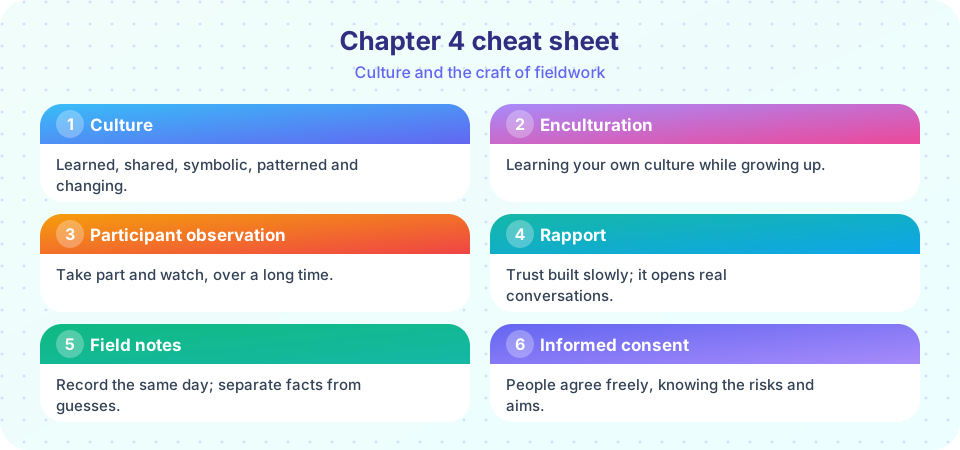
This chapter introduced anthropology's central concept and its central method. Culture is what people learn and share and give meaning to; fieldwork is how anthropologists learn about it from the inside, honestly and with care. This review puts the pieces on one page, lets you drill the vocabulary and tests the whole chapter.
Recap table
| Lesson | What to remember |
|---|---|
| Overview | Culture is learned, shared and meaningful; fieldwork is a loop of arrive, observe, interview, record, analyze, write |
| The culture concept | Five pillars: learned, shared, symbolic, patterned, changing; enculturation versus acculturation; critiques of the concept |
| Participant observation | Gold's four roles; access, rapport, key informants; describe before you interpret |
| Ethics and writing | Informed consent, do no harm, confidentiality; jottings, full notes, memos; sharing back |
The chapter in five sentences
- Culture is the learned, shared, symbolic, patterned and changing way of life of a group.
- The capacity for culture is biological, but differences between cultures are learned.
- Participant observation means joining in and watching closely over a long time.
- Ethics (consent, no harm, confidentiality, sharing back) is part of method, not an afterthought.
- Notes move from jottings to full notes to memos to an argued ethnography.
Common misconceptions
"Culture is a set of fixed rules." People interpret, argue about and change cultural rules, and cultures overlap.
"Fieldwork is just talking to people." It is structured, long-term observation and participation, with careful records, cross-checking and ethical oversight.
"The researcher's presence does not matter." It always matters, which is why reflexivity is part of good writing.
"Ethical review is red tape." It protects people and the quality of the research.
Try it
First, flashcards for the chapter's vocabulary.
Second, a self-check of your own field notes. Paste a few sentences of your own notes into the code (the sample uses an invented line), and it flags sentences that contain interpretive words so you can rewrite them as plain description. The word list is a crude teaching aid.
Press Run (or Ctrl + Enter) to see the result here.
Program input · what you'd type while the program runs
Type the answers before you press Run, one per line. Each time the program reads a line (with input()), it gets the next line from this box.
Check your understanding
Quick check · 10 questions
of 10 answered You scored / 10 · perfect!
-
1. Which is NOT one of the five features of culture in this chapter?
The five pillars are learned, shared, symbolic, patterned and changing. -
2. Enculturation is
Acculturation is change from contact. -
3. Which method is anthropology's signature approach to studying living cultures?
Ethnography is built on participant observation, usually over a long time. -
4. In Gold's typology, a researcher who takes part openly and is known as a researcher is a
That is the participant-as-observer role. -
5. Which describes triangulation?
Different methods can confirm or challenge each other. -
6. 'She seemed annoyed with him' is best classified as
'Seemed' marks a reading of behavior; the observation would be what she said or did. -
7. Why is a pseudonym not always enough to protect people in a small community?
Locations, jobs and events can reveal the person. -
8. What did Whiten and colleagues' 1999 chimpanzee comparison suggest?
Differences between communities that environment alone cannot explain suggest social learning. -
9. Which is the best statement of the criticism of 'a culture' by Lila Abu-Lughod and others?
The critique urges attention to variation, change and power. -
10. Informed consent means
Consent is a process and can be withdrawn.
Summary
- Culture is learned, shared, symbolic, patterned and changing; the capacity is biological but the content is learned.
- Participant observation, rapport, key informants and triangulation produce deep, checked understanding.
- Ethics (consent, no harm, confidentiality, sharing back) shapes every stage, from notes to the finished account.
- This closes the first four chapters; the rest of the course applies these ideas to kinship, economy, power, language, religion and globalization.
Next: continue with the rest of the course on the Anthropology course page.
Track your progress
Create a free account to tick off lessons and pick up where you left off on any device.
of Anthropology lessons completed