


















Lesson 45 of 45 · Projects and Practice
Further Study: Where to Go After This Anthropology Course
Plan your next steps in anthropology: classic ethnographies to read, neighboring subjects on this site, careers and a small fieldwork project you can start now.
You now have a map of the discipline: what anthropologists study, how they work and what they have found about kinship, power, meaning and global change. This final lesson suggests ways to go deeper. The best next step is to choose one question that interests you and follow it.
What you will learn
- How to read whole ethnographies and where to start.
- Which neighboring subjects on this site connect to anthropology.
- What careers use anthropological skills.
- How to run a small, ethical practice project.
Key terms
Interdisciplinary: combining methods and ideas from more than one field.
Primary source: a first-hand account or record, such as field notes or an original ethnography.
Pilot study: a small trial project used to test a question and method.
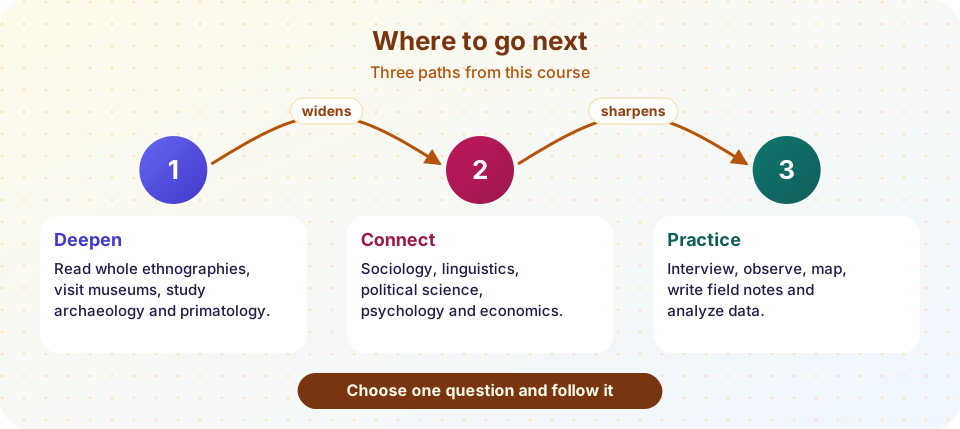
Path 1: Deepen
Reading whole ethnographies is the best way to learn how anthropologists think. A starting list, each connected to a chapter of this course:
- Bronislaw Malinowski, Argonauts of the Western Pacific (1922), on exchange.
- E. E. Evans-Pritchard, The Nuer (1940), on descent and political order, and Witchcraft, Oracles and Magic among the Azande (1937).
- Marcel Mauss, The Gift (1925).
- Mary Douglas, Purity and Danger (1966), on classification and ritual.
- Clifford Geertz, The Interpretation of Cultures (1973), including the essay on thick description.
- Sidney Mintz, Sweetness and Power (1985).
- James C. Scott, Weapons of the Weak (1985).
- Anna Tsing, Friction (2005).
- Linda Tuhiwai Smith, Decolonizing Methodologies (1999).
Read critically. Several classic works are contested, and reading the critiques alongside them is part of learning. Look at a museum collection, a local archive or a language-revitalization project near you.
Path 2: Connect
Anthropology overlaps with many fields. On this site you can continue with:
- Sociology for institutions, inequality and social change at larger scales.
- Linguistics for the structure of languages that linguistic anthropology builds on.
- Political science for states, governments and international relations.
- Introduction to psychology and cognitive science for how minds and cultures shape each other.
- Behavioral economics for how people actually make decisions about exchange.
Each field has different methods and strengths. Anthropology often contributes long-term, close observation of everyday life.
Path 3: Practice
You can try anthropological methods on a small scale. A sensible first project:
- Choose a limited setting you know and have access to, such as a class, a sports club or a family gathering tradition. Avoid places where people could be put at risk.
- Ask a specific question, such as "How do members decide who leads?" or "What do people exchange here, and what does it mean?"
- Plan ethics first. Get permission, explain your purpose, protect identities and let people say no.
- Observe and write field notes for several weeks, separating observation from interpretation.
- Interview a few people and listen more than you speak.
- Code and write. Use the one-page analysis outline from the reading project.
Treat it as a pilot, and be honest about its limits.
Careers and uses
Anthropological training is used in museums and heritage work, public health and global health, international development, user research and design, education, human rights and forensic work, government policy, journalism and archaeology firms. Skills include listening, careful observation, qualitative analysis, cross-cultural communication and critical thinking about assumptions.
Try it
A small chooser that suggests a next step from your interests. Edit the list of interests and see the suggestion. It is a teaching sketch, not a career test.
Press Run (or Ctrl + Enter) to see the console output here.
No output.
Press Run (or Ctrl + Enter) to see the console output here.
No output.
Check your understanding
Quick check · 4 questions
of 4 answered You scored / 4 · perfect!
-
1. What is a good first step in a small ethnographic project?
Ethics comes first, before any observation or interview. -
2. Why read critiques alongside classic ethnographies?
Critical reading is part of understanding how knowledge is made. -
3. Which skill is central to anthropological training?
Careful observation and listening support all anthropological methods. -
4. What is a pilot study?
Pilots help find problems before a larger project.
Summary
- Deepen with whole ethnographies and critical reading.
- Connect to sociology, linguistics, political science, psychology and economics.
- Practice with a small, ethical pilot project.
- Anthropological skills apply in health, design, development, heritage, education and policy.
You have reached the end of the course. Return to the Anthropology track page to review any lesson.
Track your progress
Create a free account to tick off lessons and pick up where you left off on any device.
of Anthropology lessons completed