


















Lesson 44 of 45 · Projects and Practice
Anthropology Cheat Sheet: The Whole Course on One Page
A one-page anthropology cheat sheet with a poster of nine core ideas, a chapter-by-chapter recap, key names and a spaced-review planner for revision.
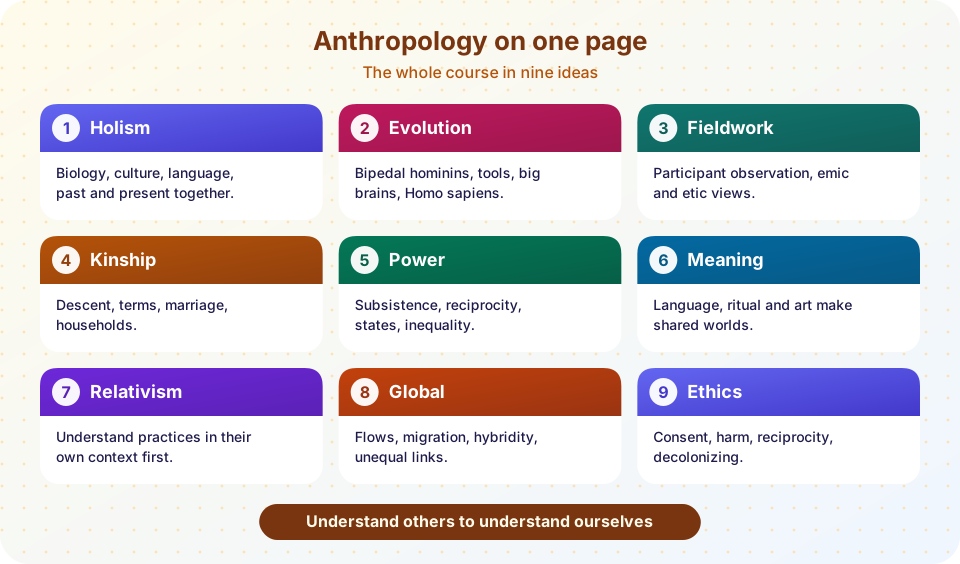
This page is a revision tool. The poster below shows the course in nine ideas. The recap lists the main points of each chapter in a line or two, and the planner at the end helps you schedule review so you remember it. Use it a week before an exam, before starting a research project or whenever you need to refresh your memory.
What you will learn
- The central ideas of the course in a single view.
- Which names and cases go with which idea.
- How to plan review sessions with spaced repetition.
Key terms
Holism: studying humans through biology, culture, language and the past together.
Cultural relativism: understanding practices in their own context before judging them.
Spaced repetition: reviewing material at growing intervals to strengthen memory.
Chapter-by-chapter recap
Chapters 1 to 4: foundations. Anthropology studies humans in all their variety through cultural, biological, archaeological and linguistic work. It uses holism (the whole picture), comparison and fieldwork. Human evolution and archaeology trace our biological and material past; culture and fieldwork introduce culture as learned and shared, participant observation, and the emic and etic views.
Chapter 5: kinship, family and social organization.
- Descent: patrilineal (Nuer), matrilineal (Minangkabau, Trobriand), double (Yakö), bilateral. Lineage, clan, moiety.
- Terminology: Eskimo, Hawaiian, Iroquois, Crow, Omaha, Sudanese; parallel versus cross cousins.
- Marriage: bundle of rights (Leach), alliance (Lévi-Strauss), bridewealth, dowry, brideservice, plural marriage.
- Households are not the same as families; relatedness is something people do.
Chapter 6: economy, politics and power.
- Subsistence: foraging, herding, horticulture, agriculture, industry.
- Exchange: kula, gift (Mauss), reciprocity (Sahlins), reciprocity-redistribution-markets (Polanyi).
- Authority: Weber's three types; band, tribe, chiefdom, state, and the criticism of the ladder; big men and chiefs; leveling.
- Inequality: class, caste, race, gender; structural violence, hegemony, everyday resistance.
Chapter 7: language, religion and art.
- Language: weak relativity, color terms, absolute directions, register and code-switching, endangered languages and revival.
- Religion: Durkheim, Malinowski, Evans-Pritchard, van Gennep and Turner, Geertz.
- Art: Boas, Gell, object biographies, tourist art, repatriation (NAGPRA, Benin Bronzes).
Chapter 8: globalization and applied anthropology.
- Scapes (Appadurai), commodity chains (Mintz, Tsing), transnationalism, hybridity.
- Medical anthropology: disease versus illness, explanatory models, structural violence. Development critiques (Ferguson, Scott).
- Ethics: do no harm, consent, benefit-sharing, decolonizing, indigenous data principles.
Ten questions to ask of any case
- Who are the people, where and when?
- How do they make a living and share what they have?
- How are they related, and who counts as kin?
- Who decides, and how is that power kept or challenged?
- What do symbols, rituals and objects mean to them?
- How are they connected to the wider world?
- Whose voice is in the account, and whose is missing?
- Is the explanation about culture, or about structure and history?
- What would a different framework say?
- What are the ethical obligations to the people involved?
Try it
Spaced review beats cramming. This planner takes a start day and prints review dates at growing intervals. The intervals (1, 3, 7, 14 and 30 days) are one common pattern, not a law. Edit them to suit you.
Press Run (or Ctrl + Enter) to see the console output here.
No output.
Press Run (or Ctrl + Enter) to see the console output here.
No output.
Check your understanding
Quick check · 4 questions
of 4 answered You scored / 4 · perfect!
-
1. Which idea means studying biology, culture, language and the past together?
Holism is anthropology's integrative approach. -
2. Which pair of names goes with exchange?
Mauss wrote on the gift and Sahlins on reciprocity. -
3. Which pair of names goes with rites of passage?
Van Gennep described the three phases; Turner developed liminality and communitas. -
4. Why use spaced review?
Spacing reviews improves retention compared with one long session.
Summary
- The course moves from foundations through kinship, economy and power, meaning, and global and applied work.
- Ten questions help you analyze any case.
- Use spaced review and confidence ratings to plan revision.
Next: Further study
Track your progress
Create a free account to tick off lessons and pick up where you left off on any device.
of Anthropology lessons completed