


















Lesson 1 of 45 · Getting Started
Course Map: Welcome to Anthropology
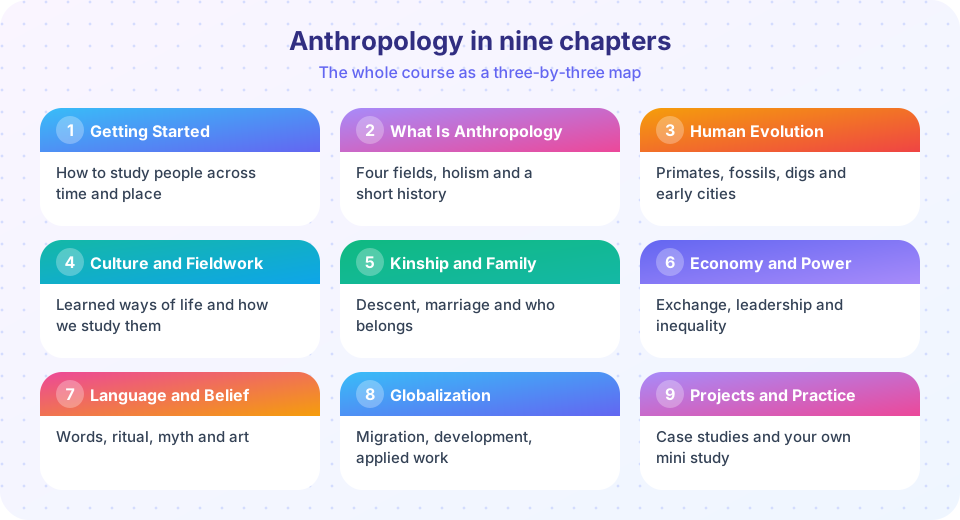
Start here: who this free anthropology course is for, what its nine chapters cover, how to study it, and a short warm-up to see how you already think like an anthropologist.
Why do some people greet each other with a handshake, others with a bow, and others by pressing noses? Why did our ancestors start walking on two legs? Why do some societies trace family through mothers and others through fathers? Why can a word mean "friend" in one language and "guest" in another? These questions look different, but they share one root: what does it mean to be human, and why are humans so varied?
Anthropology is the discipline built around that question. It studies people everywhere, in the deep past and today, as bodies, as makers of tools, as speakers of languages and as members of cultures. This course is a free, complete introduction that follows the common core of first-year university and upper-secondary courses around the world. It suits students aged about 15 and up, first-year university students and curious adults.
This course is educational information about human societies and human history. It does not give medical, legal or personal advice, and it describes real peoples with care: you will learn how anthropologists try to be accurate, fair and humble about the lives of others.
What you will learn
- What anthropology is, which questions it asks and how it differs from related subjects.
- How scientists reconstruct human evolution from fossils, genes and archaeology.
- What "culture" means and how fieldwork turns daily life into evidence.
- How societies organize kinship, economy, power, language, religion and art (chapters 5 to 7).
- How anthropology is used today, from migration to health programs, and how to run a small study of your own.
Key terms
Anthropology: the study of humans across time and place, in their biological and cultural variety.
Culture: the learned and shared ways of thinking, speaking and acting of a group of people.
Ethnography: a written account of a way of life, based on long fieldwork.
Archaeology: the study of the human past through the things people made and left behind.
Holism: looking at the whole of human life instead of one slice of it.
The nine chapters at a glance
Each chapter opens with an overview lesson and closes with a review. Here is the path, in short slides.
Chapters 1 and 2: the toolkit
You learn the vocabulary and the habits of mind.
Chapter 3: the long past
Millions of years in one chapter.
Chapter 4: culture and fieldwork
Where the discipline's signature method lives.
Chapters 5 to 7: how societies work
Cross-cultural comparison at its best.
Chapters 8 and 9: today and you
From theory to your own small study.
Chapter 1 (this one) has four lessons: this map, the big questions of anthropology, how to study anthropology, and a chapter review. Chapter 2 starts with what anthropology is. Chapter 3 begins at human evolution and chapter 4 at culture and fieldwork. The other chapters are listed on the course page.
How to use this course
A good pace is one lesson per sitting, two or three sittings a week. Every content lesson has the same shape: outcomes, key terms, explanation, common misconceptions, a Try it section with small interactive demonstrations, a short quiz and a summary. The demonstrations are teaching toys: they show an idea with invented or simplified numbers and say so. They are never real data about real peoples.
Three habits make the biggest difference:
- Write your own examples. After each lesson, think of one example from your own life or country.
- Compare. Ask "what would this look like in another society?" That question is the heart of the subject.
- Hold judgments loosely. Anthropology trains you to understand before you evaluate.
Prerequisites
None. You do not need biology, statistics or a particular language. Where a lesson uses a little arithmetic (for example in dating methods), it explains every step. A few demonstrations use Python or JavaScript, but you only need to press Run and read the output; you can change numbers to see what happens.
Common misconceptions
"Anthropology is about dinosaurs and fossils." Dinosaurs belong to paleontology. Anthropology is about humans and their close relatives. Fossils are one of several kinds of evidence.
"Anthropologists study only faraway, small societies." Early anthropologists often did. Today anthropologists also study hospitals, offices, online communities, airports and cities in their own countries.
"There is one correct way to be human." The main finding of the field is the opposite: humans share a lot biologically, and they have built an astonishing variety of ways of life.
Try it
First, a study planner. Move the slider to the number of weeks you have; the page spreads the nine chapters over them.
Second, a small calculator that turns your weekly study time into a finish date. It only does arithmetic; change the numbers and run it again.
Press Run (or Ctrl + Enter) to see the result here.
Program input · what you'd type while the program runs
Type the answers before you press Run, one per line. Each time the program reads a line (with input()), it gets the next line from this box.
Check your understanding
Quick check · 4 questions
of 4 answered You scored / 4 · perfect!
-
1. Which question best captures what anthropology is about?
Anthropology studies humans across time and place, in both biology and culture. Dinosaurs belong to paleontology. -
2. What is an ethnography?
Ethnography is both the method (fieldwork) and the written result describing a way of life. -
3. Which habit does this course recommend for each lesson?
Examples and comparison build understanding; anthropology also asks you to understand before you judge. -
4. The demonstrations in the Try it sections are best described as
They use invented or simplified numbers to show an idea. They are always labelled.
Summary
- Anthropology studies humans across time and place, in biology and culture.
- The course has nine chapters: toolkit, evolution, culture and fieldwork, three chapters on how societies work, then today's world and projects.
- Study in short sittings, write your own examples and compare societies.
- Demonstrations are simplified models; nothing here is medical or legal advice.
Track your progress
Create a free account to tick off lessons and pick up where you left off on any device.
of Anthropology lessons completed