


















Lesson 4 of 45 · Getting Started
Chapter 1 Review: Getting Started
Review the first chapter of the anthropology course: the big questions, universals and variations, and the study habits you need, with flashcards and a ten-question quiz.
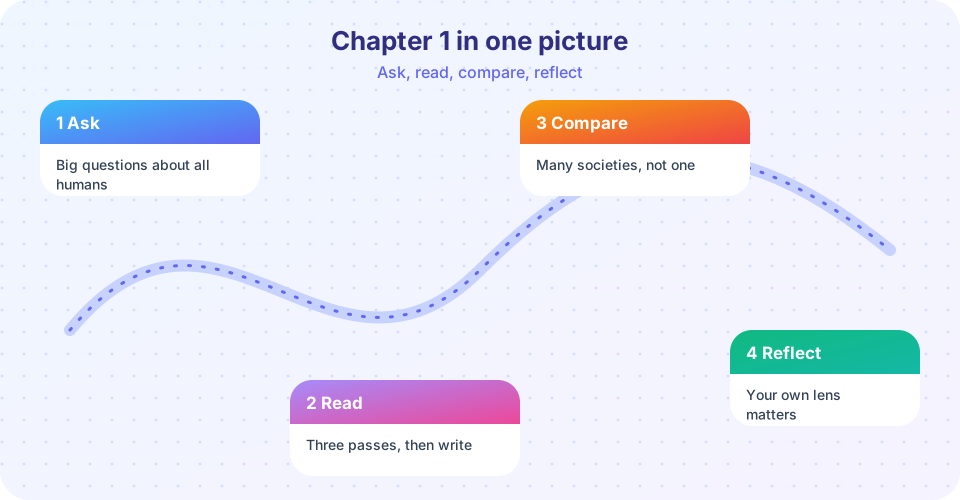
You have finished the opening chapter. You met the field's big questions, learned how to read and take notes, and saw why anthropologists compare societies instead of judging them. This review pulls it all together, lets you practice with flashcards, and ends with a ten-question quiz that mixes the whole chapter.
The chapter in a table
| Lesson | Core idea | One thing to remember |
|---|---|---|
| Course map | Nine chapters, from toolkit to projects | Demonstrations are simplified models, not real data |
| Big questions | Origins, difference, living together, meaning | Universals show what we share; variations show how much life can differ |
| How to study | Three passes, claim-evidence-context, spaced review | Respectful, precise language and honest sources |
Three ideas to carry forward
1. Humans are one species and many ways of life. Everyone shares the same biology and the same basic needs, yet people have created thousands of languages and countless customs. Anthropology exists to explain both facts at once.
2. Evidence comes first. Whether the evidence is a fossil, a field note or a recorded conversation, a good anthropologist says what it is, what it shows and how sure she or he is. When unsure, they hedge instead of guessing.
3. Understand before you judge. The habit of asking "what does this mean to the people who do it?" comes before any comparison or evaluation. It is the discipline's most distinctive habit of mind and the one you will practice most.
Common misconceptions to fix now
"Anthropology is only about exotic, faraway peoples." It also studies cities, workplaces, clinics and online communities, including those of the researcher's own society.
"If a trait is universal it must be genetic." Universal can mean shared biology, shared needs or shared invention. Evidence decides which.
"Respectful language is just politeness." It is also accuracy: specific names and non-ranking words describe people better.
Try it
Flip through flashcards on the chapter's key terms. Press Show answer, then Next. This is a self-testing aid with no scoring.
Now track your own confidence on each lesson. Replace the ratings (1 to 5) with your honest numbers and see which lesson deserves a second look.
Press Run (or Ctrl + Enter) to see the result here.
Program input · what you'd type while the program runs
Type the answers before you press Run, one per line. Each time the program reads a line (with input()), it gets the next line from this box.
Check your understanding
Quick check · 10 questions
of 10 answered You scored / 10 · perfect!
-
1. Which pair correctly matches a big question with its main evidence?
Origins are reconstructed from physical evidence; cultural questions use fieldwork and comparison. -
2. A universal is
Language is the standard example. -
3. 'Holism' means
Holism keeps history, economy, kinship, language and environment together. -
4. Pass 2 of the three-pass method is for
Pass 1 skims, pass 2 reads, pass 3 questions. -
5. Which statement is evidence about behavior, not just intentions?
Recorded loans show what people did. -
6. Which spacing is recommended for reviewing a lesson?
Spaced, short reviews build durable memory. -
7. The best reason to avoid the word 'primitive' is that it
It implies a ladder of progress that anthropology rejects; describe what people do instead. -
8. What is the comparative method?
Comparison tests universals against variations. -
9. A source that records original material such as field notes is called
Primary sources are original; textbooks and reviews are secondary. -
10. Which of these is a good anthropological question?
It is specific, open and does not rank people.
Summary
- Chapter 1 gave you the questions (origins, difference, living together, meaning), the study habits and the language habits of anthropology.
- Universals and variations both need explaining; evidence comes first; understand before you judge.
- Use flashcards and spaced review to keep the vocabulary alive.
Track your progress
Create a free account to tick off lessons and pick up where you left off on any device.
of Anthropology lessons completed