


















Lesson 34 of 45 · Language, Religion and Art
Art and Material Culture: Objects, Meaning and Ownership
Learn how anthropologists study art and objects: Boas on form, Gell on agency, cultural biographies, tourist art, museums, NAGPRA and repatriation, with live demos.
Look around the room you are in. Almost everything was made by someone and chosen by someone. A mug, a jacket and a framed photo all carry meanings about taste, class, memory and belonging. Anthropologists study this world of made things under the label material culture, and they treat art as one important part of it.
The study of art raises hard questions. Is "art" a universal category or a Western one? What does an object do in the life of a community? And when museums hold objects taken under colonial rule, who should own them now?
What you will learn
- Why anthropologists avoid a narrow definition of art.
- Boas on skill and form, and Gell on art as action.
- How objects have "biographies" as they pass between people.
- How tourism and markets change art.
- The debates over museums, NAGPRA and repatriation.
Key terms
Material culture: the objects people make, use and value, together with the meanings attached to them.
Aesthetics: ideas about what is beautiful, skilled or well made.
Agency (of objects): Alfred Gell's idea that art objects can act as social agents by affecting people.
Cultural biography: the life story of an object as it is made, used, exchanged and reinterpreted.
Repatriation: returning cultural objects or human remains to descendant communities.
Is "art" universal?
The Western idea of "fine art", displayed in galleries for its own sake, is only a few centuries old. Many languages have no word that matches it. Objects that look like art to a visitor may be tools, religious devices or political documents to their makers. Franz Boas, in Primitive Art (1927), argued that every society has standards of skill and form and that these are worth studying as seriously as any gallery tradition. The oldest known art is very old: engraved ochre from Blombos Cave in South Africa and cave paintings in Indonesia and Europe date back many tens of thousands of years.
What art does
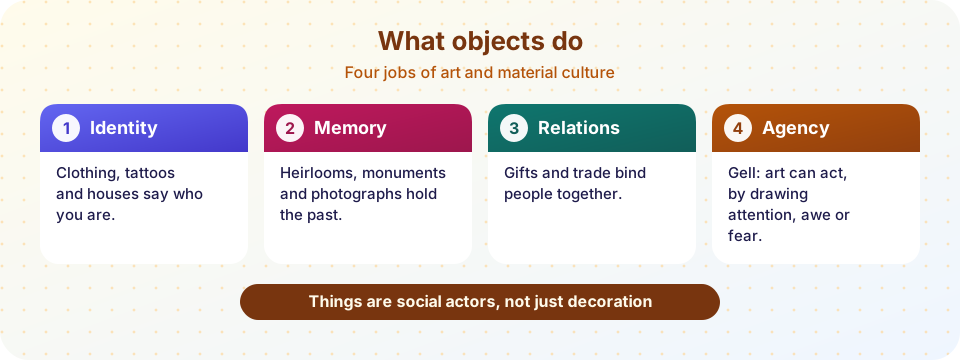
Alfred Gell, in Art and Agency (1998), argued that anthropologists should stop asking what art means and ask what it does. An object can capture attention, awe or fear, for instance a carved war god, a mask that frightens or a beautifully made canoe prow that wins admiration and intimidates rivals. Gell called such work a "technology of enchantment". Other approaches stress four roles.
- Identity. Clothing, tattoos, hairstyles and house decoration say who you are. The English word "tattoo" comes from a Polynesian word (tatau), and tattoos in many Pacific societies record lineage and rank.
- Memory. Heirlooms, monuments, photographs and memorials hold the past.
- Relations. Gifts, wedding objects and exchanged valuables create bonds, as in the kula of the previous lesson.
- Politics and belief. Flags, thrones, icons and sacred paintings show or challenge authority.
Anthropologists also study music and dance (ethnomusicology), storytelling and cooking as artistic traditions.
The lives of objects
Igor Kopytoff suggested in 1986 that we ask of an object, as we would of a person: where was it made, who used it, how did its value change? Arjun Appadurai edited a volume that year titled The Social Life of Things making the same point: things move between gift and commodity states. A family quilt may be a gift, then a keepsake, then an auction item and then a museum piece. Daniel Miller's studies of homes and possessions show how ordinary objects carry relationships. An object can also be treated as sacred in one setting and as decoration in another.
Tourist art and authenticity
When visitors buy local crafts, the products change: sizes shrink, designs shift and new forms appear. Nelson Graburn's Ethnic and Tourist Arts (1976) described how such art can express identity and bring income even as it adapts. "Authenticity" is a tricky measure. Cultures always change, and artists in many places have created new genres. At the same time, communities can have sacred designs they do not want sold. Aboriginal painters at Papunya in central Australia began painting on boards and canvas in the early 1970s, and elders debated which designs could be shown publicly and which were restricted.
Museums, ownership and repatriation
Many collections in Europe and North America were built under colonial conditions. In 1897 a British military expedition took thousands of brass and ivory objects from the Kingdom of Benin, in present-day Nigeria; these "Benin Bronzes" are now in museums around the world, and a number of institutions have begun returning them. In the United States, the Native American Graves Protection and Repatriation Act (NAGPRA) of 1990 requires museums and federal agencies to consult with tribes and return human remains and certain cultural items. Many countries now debate similar laws.
The arguments are practical and moral. Supporters of return stress colonial theft, community ownership and living ritual use. Some museums argue that sharing collections educates a global audience, though many have shifted toward loans, joint curation and returns. Anthropologists increasingly work with source communities as partners.
Common misconceptions
"Art in small societies is only decoration." It is often part of religion, law, politics and economy, and carries knowledge.
"Tourist art is fake." It is real art made for a new audience, and it often shows how makers adapt and thrive. The ethical question is who controls it and who gets paid.
"Returning objects means museums will be empty." Repatriation involves negotiation about specific items and often leads to partnerships, loans and shared research.
Try it
Many textile and pottery traditions use repeated, symmetrical motifs. This demonstration builds a rotation pattern. Use the slider to change the number of identical petals and the button to create a new random motif. It is an illustration of symmetry, not a model of any tradition.
The next demonstration writes the "life story" of an imagined object, following Kopytoff's question. The object and events are invented.
Press Run (or Ctrl + Enter) to see the console output here.
No output.
Check your understanding
Quick check · 5 questions
of 5 answered You scored / 5 · perfect!
-
1. What question did Alfred Gell encourage anthropologists to ask about art?
Gell's Art and Agency focused on how objects act on people. -
2. What is a cultural biography of an object?
Kopytoff suggested treating objects like people with changing lives. -
3. What does NAGPRA require?
The 1990 US law set rules for repatriation of Native American remains and cultural items. -
4. Boas argued that 'primitive' art
He stressed technical skill and style in all societies. -
5. Why is 'authenticity' a problematic test for tourist art?
Treating a static past as the only real culture ignores creativity and change.
Summary
- "Art" is not a universal category; anthropologists study objects and aesthetics wherever they appear.
- Gell: art acts on people. Objects express identity, hold memory, link people and carry politics.
- Objects have biographies, shifting between gift, commodity, sacred and art.
- Tourist art shows adaptation, not fakeness; authenticity is a complicated test.
- Museums and repatriation raise ethical questions about colonial collections.
Next: Chapter 7 review
Track your progress
Create a free account to tick off lessons and pick up where you left off on any device.
of Anthropology lessons completed