


















Lesson 42 of 45 · Projects and Practice
Project: Build a Kinship Explorer
Build a small kinship explorer in Python: read kin-type strings, tell parallel from cross cousins, translate terms in three systems and test the moiety rule with code.
In this project you turn chapter 5 into working code. You will write a function that reads a kin-type string such as MBD, works out what kind of relative it is and finds the word three different terminology systems would use. Then you will prove, by running a small model, why parallel cousins end up in the same descent group and cross cousins in the other when a society has two exogamous halves.
Writing code is a good test of understanding: if you cannot make the program say it, you may not yet have the idea clear.
What you will learn
- How to represent kin types as strings and parse them.
- How to compute generation level and cousin type.
- How to look up kin terms in several systems.
- How to test a structural claim about moieties with a short model.
Key terms
Kin type: an exact relationship written as letters, such as MZS (mother's sister's son).
Ego: the person from whose viewpoint relationships are described.
Parallel cousin: child of father's brother or mother's sister.
Cross cousin: child of father's sister or mother's brother.
Moiety: one of two descent-based halves of a society.
Part 1: Parsing kin types
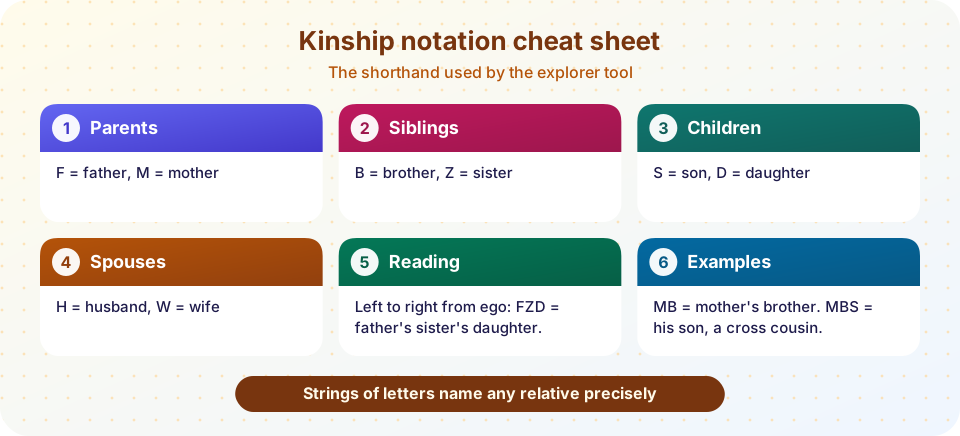
A kin type is a string of letters read left to right from Ego. For this project we look at two shapes: single steps (F, M, B, Z, S, D) and cousin strings made of a parent, that parent's sibling and the sibling's child (for example FBS). The code first checks the pattern. A cousin string has three letters: the first is F or M, the second B or Z, the third S or D.
- Parallel: the parent and the sibling have the same sex (
FB,MZ). - Cross: they differ (
FZ,MB).
The explorer reports the generation difference as well: going up to a parent is +1, to a child is -1. A cousin is at level 0, the same generation as Ego.
Part 2: Terms in three systems
The program stores the terms for a male Ego (the same simplified tables you saw in the terminology lesson) and prints what Eskimo, Hawaiian and Iroquois speakers would say. It also flags whether the Iroquois-type system treats the person as a potential marriage partner, since cross cousins are often considered suitable in societies with that terminology (a pattern, not a rule).
Try it
Press Run (or Ctrl + Enter) to see the result here.
Program input · what you'd type while the program runs
Type the answers before you press Run, one per line. Each time the program reads a line (with input()), it gets the next line from this box.
Run it, then extend it. Ideas: add the remaining terms for sister's and brother's children, accept longer strings such as FFB, or add the Crow and Omaha systems from the terminology lesson.
Part 3: Why moieties make cross cousins marriageable
Imagine a society split into two exogamous halves, A and B. Everyone marries someone from the other half. If descent is patrilineal, a child belongs to the father's half. If it is matrilineal, a child belongs to the mother's half. Where do the four kinds of cousins fall? The code below works it out by following the rules, and prints whether each cousin type is in Ego's half or the other half.
Press Run (or Ctrl + Enter) to see the result here.
Program input · what you'd type while the program runs
Type the answers before you press Run, one per line. Each time the program reads a line (with input()), it gets the next line from this box.
Both rules give the same result: parallel cousins fall in Ego's own half, cross cousins in the other. That is why many societies with moieties treat parallel cousins as siblings and cross cousins as the natural pool of spouses. It is a logical consequence of the rules, not a law of nature, and societies with other arrangements (such as the English-speaking world) draw different lines.
Reflect and extend
- Which of the three terminology systems would you expect in a moiety society, and why?
- Add a "Sudanese" system that gives each kin type a unique term. What does your program need that the other systems did not?
- Use what you learned about the matrilineal puzzle: where in the model would the mother's brother's authority appear?
Common misconceptions
"A model proves how real people marry." A model shows what follows from stated rules. Real marriages involve choice, politics and exceptions.
"Cross-cousin marriage is common everywhere." It is preferred in some regions, such as parts of South Asia and Australia, and forbidden in others.
Check your understanding
Quick check · 4 questions
of 4 answered You scored / 4 · perfect!
-
1. In the string MBD, who is Ego related to?
M, B, D read left to right. The parent (mother) and her sibling (brother) are of different sexes, so the cousin is cross. -
2. Under patrilineal moieties, which cousins belong to Ego's own half?
FBC and MZC both end up in Ego's moiety, while FZC and MBC belong to the other half. -
3. Why does the generation level of a cousin equal 0?
You go up one generation and down one generation, which cancels out. -
4. What does this project show about models?
The result depends on the assumptions; real societies need field evidence.
Summary
- Kin-type strings give a precise language for relatives; you can parse them with code.
- Parallel and cross cousins are distinguished by whether the parent and sibling share a sex.
- Terminology systems group the same relatives differently.
- With two exogamous moieties, parallel cousins share Ego's half and cross cousins belong to the other half, whether descent runs through fathers or mothers.
Next: Glossary
Track your progress
Create a free account to tick off lessons and pick up where you left off on any device.
of Anthropology lessons completed