


















Lesson 27 of 45 · Economy, Politics and Power
Subsistence and Exchange: From Foraging to the Kula Ring
Compare foraging, herding, farming and industry, then study reciprocity, redistribution and markets through the kula ring, Mauss's gift and Sahlins's spectrum.
An economy is the way a society produces, shares, uses and exchanges what people need and value. Economists often start with scarce resources and individual choices. Anthropologists start with people, relationships and meanings. A meal, a bag of rice or a canoe has a price, but it also has a story: who gave it, who owes whom and what the gift says about their relationship.
This lesson covers two questions. First, what are the main ways societies make a living? Second, how do goods move between people, and why does the same object mean different things in different exchanges?
What you will learn
- The main subsistence strategies and how they link to settlement and social life.
- Malinowski's kula, Mauss's theory of the gift and the potlatch.
- Sahlins's three kinds of reciprocity.
- Polanyi's reciprocity, redistribution and market exchange.
- Why sharing can work as insurance.
Key terms
Foraging: getting food by hunting, fishing and gathering wild resources.
Pastoralism: a livelihood based on herding animals, often with seasonal movement.
Horticulture: small-scale cultivation with hand tools, often shifting fields.
Gift: a transfer that creates or confirms a social relationship and carries an expectation of return.
Embeddedness: Polanyi's idea that economies are part of social institutions, not separate from them.
Ways of making a living
Anthropologists group societies by their main subsistence strategy. The groups overlap and many societies mix them.
| Strategy | Core activity | Typical features | Examples |
|---|---|---|---|
| Foraging | Hunt, fish, gather | Small mobile groups, sharing, few possessions | Ju/'hoansi (Kalahari), Hadza (Tanzania), Inuit |
| Pastoralism | Herd animals | Mobility, herd ownership, kin-based groups | Nuer, Maasai, Mongolian herders |
| Horticulture | Hand-tool gardening | Shifting fields, villages, kin or clan land | Tsembaga Maring (New Guinea), Yanomami |
| Intensive agriculture | Plow, irrigation | Dense population, towns, rulers, peasants | Rice and wheat societies of Asia and Europe |
| Industry and services | Wages, factories, offices | Cities, markets, specialization | Most of today's world |
Foragers have often been described as "simple", but that is a mistake: they use detailed knowledge of plants, animals and weather, and sharing networks are sophisticated. In 1966 Marshall Sahlins called foragers "the original affluent society", arguing that they wanted little and had it. Richard Lee's measurements of Ju/'hoansi work hours were influential and suggested a modest work week. Later critics said the counts left out food preparation and other tasks and that conditions in the Kalahari had been changing. The debate shows that how you measure matters.
The kula ring and the gift
Bronislaw Malinowski described the kula in Argonauts of the Western Pacific (1922). Trobriand Islanders and neighbors sailed long distances to exchange two kinds of valuables. Red shell necklaces (soulava) traveled around the ring clockwise and white shell armbands (mwali) counterclockwise. Nobody kept the items; they were held for a time, then passed to a partner. Holding a famous piece brought prestige, and the trading partnerships lasted for years. Everyday goods were bartered alongside. The kula was not about utility; it was about relationships and reputation.
Marcel Mauss, in The Gift (1925), compared such systems and argued that gifts carry three obligations: to give, to receive and to return. Refusing a gift can insult. The return is usually delayed and not exactly equal, which keeps the relationship alive. Later writers, such as Chris Gregory, contrasted gifts, which create bonds between people, with commodities, which are exchanged between strangers with no lasting tie.
Among Native peoples of the Pacific Northwest Coast, such as the Kwakwaka'wakw, the potlatch was a feast in which hosts gave away or destroyed wealth to confirm rank and honor guests. Canada banned the potlatch from 1885 until 1951, a policy that damaged ceremonial life and is now widely recognized as an injustice.
Sahlins's spectrum
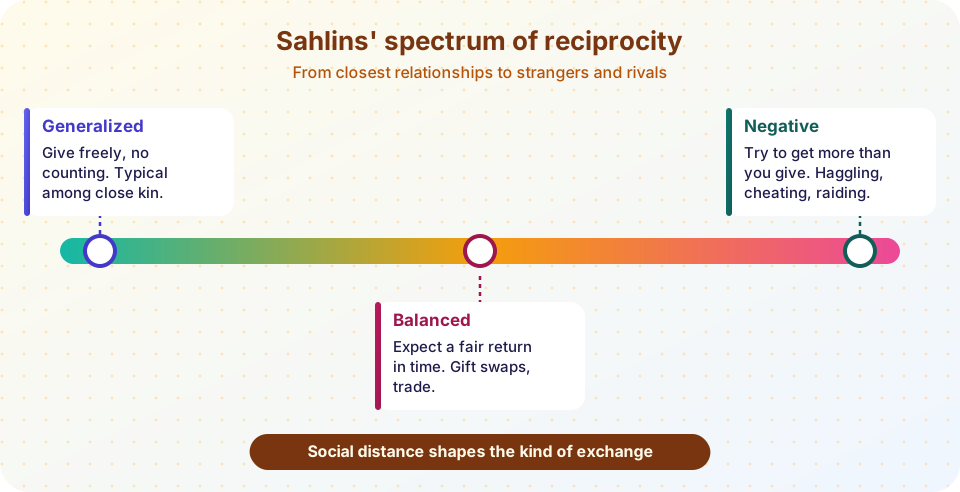
In Stone Age Economics (1972) Sahlins arranged exchange by social distance.
- Generalized reciprocity: giving with no counting, as parents feed children or neighbors share. Returns are vague and may never come.
- Balanced reciprocity: an equal return within a reasonable time, as with gift swaps or trade between allies.
- Negative reciprocity: trying to get something for nothing, as in hard bargaining, cheating or raiding. It happens most with strangers or enemies.
The spectrum is a tool, not a law, and the same people can use different types at different times.
Reciprocity, redistribution and markets
Karl Polanyi, in The Great Transformation (1944) and later work, named three patterns that appear across history. Reciprocity moves goods between people of equal standing. Redistribution moves goods to a center and back out, as when a chief collects tribute for feasts or a state collects taxes. Market exchange sets prices by supply and demand. Societies mix them. Polanyi argued that before modern markets, economies were embedded in social relationships; the market society is the unusual case. "Formalist" economists argued that standard economic theory applies everywhere, while "substantivist" followers of Polanyi disagreed. Modern anthropologists often treat both as partly right.
Sharing as insurance
Why share meat? One idea is insurance. A hunter's luck is uneven, and meat cannot be stored without refrigeration. If success is random, sharing means that on a bad day you eat from someone else's good day. Studies of foragers such as the Hadza of Tanzania and the Ache of Paraguay have tested this and other explanations, including status and the reduction of conflict. Evidence suggests several reasons operate together.
Common misconceptions
"A gift is free." Gifts in many societies carry strong expectations of return and create a bond. That is why a gift can be a way of starting or ending a relationship.
"Barter came first and money followed." Anthropologists found little evidence for a pure barter stage; much early exchange was gift exchange and credit. Barter appears mainly between strangers and in crises.
"Foragers constantly starve." Foraging life has hardships, but many foraging societies have been well fed and use careful food-sharing norms.
Try it
First, a simulation of the kula ring. This is a simplified model of six places on a ring. Necklaces move one step clockwise each round and armbands one step counterclockwise. It illustrates the circulating pattern; real kula partnerships were negotiated and slower.
Press Run (or Ctrl + Enter) to see the console output here.
No output.
Second, a simulation of sharing as insurance. Each hunter has a day's success with a fixed chance, meat cannot be stored and a person needs one unit a day. The numbers are invented to show the logic, not to measure real foragers.
Press Run (or Ctrl + Enter) to see the result here.
Program input · what you'd type while the program runs
Type the answers before you press Run, one per line. Each time the program reads a line (with input()), it gets the next line from this box.
Notice how sharing lowers the chance of going hungry even though the average catch does not change. Real sharing is more complicated, but the logic helps explain why norms of generosity can be useful.
Check your understanding
Quick check · 5 questions
of 5 answered You scored / 5 · perfect!
-
1. In the kula ring, which direction did red shell necklaces (soulava) traditionally travel?
Necklaces circulated clockwise and armbands counterclockwise. -
2. According to Mauss, a gift carries which three obligations?
Giving, receiving and returning make gifts social ties. -
3. Which type of reciprocity fits giving between close family without counting?
Generalized reciprocity has no strict accounting and is typical of close kin. -
4. Polanyi's three patterns of exchange are
Polanyi grouped economic integration into reciprocity, redistribution and market exchange. -
5. What does the sharing simulation illustrate?
When success is random and food cannot be stored, pooling smooths out bad days.
Summary
- Societies make a living by foraging, herding, gardening, farming and industry, often in combination.
- The kula and the potlatch show that exchange creates prestige and relationships, not just goods.
- Mauss: gifts involve giving, receiving and returning. Gifts bond people; commodities link strangers.
- Sahlins: generalized, balanced and negative reciprocity vary with social distance.
- Polanyi: reciprocity, redistribution and markets coexist; economies are embedded in society.
- Sharing can act as insurance, among other reasons.
Next: Authority and states
Track your progress
Create a free account to tick off lessons and pick up where you left off on any device.
of Anthropology lessons completed