


















Lesson 41 of 45 · Projects and Practice
Project: Reading an Ethnography and Coding Field Notes
A hands-on project: read an ethnography with four questions, then code an invented field-note excerpt for themes with a small Python tool and write a one-page analysis.
An ethnography is a long, detailed description of a way of life, written by someone who spent months or years in it. Reading one well is a skill. Beginners often read for the story and miss the argument, or accept every claim without asking what evidence supports it. This project teaches a method in three steps: read with four questions, code a short set of field notes by hand and by tool, and write a one-page analysis that connects evidence to ideas from the course.
What you will learn
- A four-question method for reading any ethnography.
- How to take field notes that separate observation from interpretation.
- How coding turns notes into themes, and why computers only help a little.
- How to write a short analysis that links evidence to concepts from chapters 5 to 8.
Key terms
Field notes: the researcher's written record of observations, conversations and reflections.
Thick description: Clifford Geertz's phrase for describing not only what people do but what it means to them.
Coding: labeling parts of notes or interviews with themes so patterns can be found.
Emic and etic: insiders' categories versus the analyst's categories.
Triangulation: checking a claim against different kinds of evidence or sources.
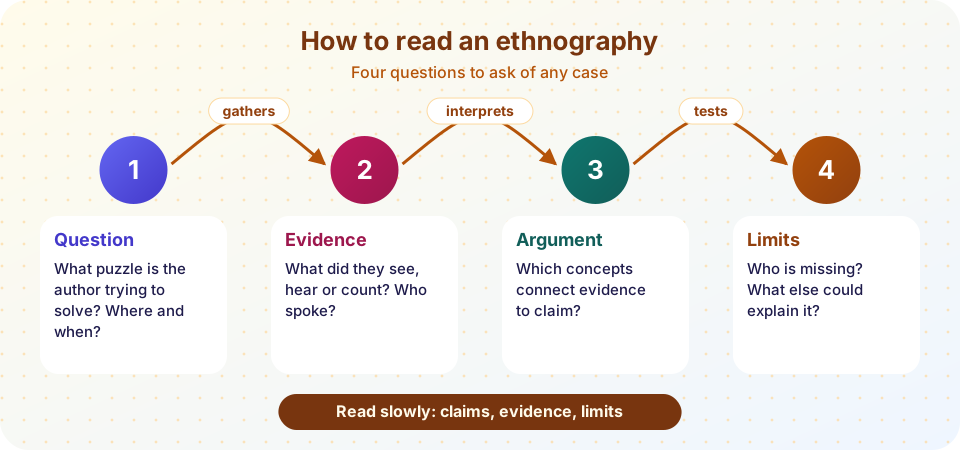
Step 1: Read with four questions
Take any ethnography, for example Evans-Pritchard on the Nuer, Mintz on sugar or Malinowski on the kula, and ask:
- Question. What puzzle or problem is the author trying to explain? Where and when was the research done, and for how long?
- Evidence. What did the author see, hear, count or collect? Who are the informants? Are voices from different positions represented, such as women, young people and outsiders?
- Argument. Which concepts connect the evidence to the claim? Does the author use kinship, exchange, power, ritual or another framework?
- Limits. Who is missing? What else could explain the findings? How might the author's position, funding or era have shaped the account?
Write a two-sentence answer to each. If you cannot, reread that part.
Step 2: Separate observation from interpretation
Good field notes keep three things apart: what happened (descriptive notes), what you think it means (analytic notes) and how you felt or what you might be missing (personal notes). Compare:
- Observation: "Three women handed coins to Mariam, who wrote in a notebook."
- Interpretation: "This is a rotating savings group based on trust."
The first can be checked by anyone who was there. The second is a hypothesis to test against more evidence.
Step 3: Code a sample
Here is an invented excerpt of field notes about a rotating savings group in an imagined market town. It is not from any real study. Read it, then run the coder below.
Week 6. Dawn at the market. Mariam opens her stall and her cousin Joy arrives with the coin bag. Each woman in the group puts in the same amount every week, and one takes the whole pot. Today it is Aunt Dede's turn. Mariam says she trusts the group because everyone knows each other's families. The leader, a retired teacher, keeps the notebook and decides the order. Last month a member missed a payment and was fined; her sister paid it and said she would be returned the money next month. Another woman said her reputation in the market would suffer if she broke a promise.
The coder searches for keywords for four themes: kinship, exchange, authority and trust. This is a deliberately simple tool. Real coding is done by a person who reads, and the computer only helps count and find.
Try it
Press Run (or Ctrl + Enter) to see the result here.
Program input · what you'd type while the program runs
Type the answers before you press Run, one per line. Each time the program reads a line (with input()), it gets the next line from this box.
Look at the results. Did the tool miss anything a person would catch? For example, "everyone knows each other's families" is about kinship and trust at once. Real coding allows several codes per passage.
Now check your own reading notes. This small checker tells you which of the four questions your notes leave unanswered.
Press Run (or Ctrl + Enter) to see the console output here.
No output.
Step 4: Write the one-page analysis
Use this outline and aim for about 400 words.
- Claim (one sentence): what the case shows.
- Evidence (three short observations from the notes).
- Concept (link to a course idea, such as reciprocity, kinship obligation, authority or hegemony).
- Limits (one thing the notes cannot tell you and one alternative explanation).
For the invented notes above, one possible claim is that the group runs on mixed incentives: kin ties, a reputation that matters in a shared market and a leader with limited authority. A good paper also says what is missing, such as whether women who are not kin are included.
Common misconceptions
"Ethnography is just opinion." It is systematic: long engagement, many sources, notes kept at the time and cross-checking. Its claims can be wrong or limited, but it is not random opinion.
"One case cannot show anything." A single case cannot show how common something is, but it can show how something works and raise questions to test elsewhere.
"Software can code for you." Tools find keywords. Meaning requires a reader who knows the context.
Check your understanding
Quick check · 5 questions
of 5 answered You scored / 5 · perfect!
-
1. Which is the best example of an observation, not an interpretation?
An observation describes what happened and can be checked by others who were present. -
2. In the four-question method, 'Limits' asks
Limits means weighing evidence and alternatives critically. -
3. What is 'thick description'?
Geertz used the phrase for description that includes meaning and context. -
4. Why is a keyword coder only partly useful?
People read context; software matches strings. -
5. What does triangulation mean in ethnography?
Combining interviews, observation and documents makes findings sturdier.
Summary
- Read ethnography with four questions: question, evidence, argument and limits.
- Keep observation, interpretation and personal reflection apart in field notes.
- Coding labels notes with themes; tools help, but people interpret.
- A one-page analysis states a claim, supports it with evidence, links to a concept and names its limits.
Track your progress
Create a free account to tick off lessons and pick up where you left off on any device.
of Anthropology lessons completed