


















Lesson 29 of 45 · Economy, Politics and Power
Inequality and Resistance: Class, Caste, Race, Gender and Power
Study how anthropologists explain inequality: class, caste, race and gender, plus structural violence, hegemony and everyday resistance, with a Lorenz curve demo.
Every society differs in how people are ranked, who gets resources and whose voice counts. Some differences are small, such as respect for elders. Others are large and lasting, such as caste, slavery or extreme wealth gaps. Anthropologists ask two connected questions: how do inequalities arise and last, and how do people live with them, question them and push back?
This lesson introduces the main axes of inequality, then three concepts that help explain how unequal systems keep going: structural violence, hegemony and everyday resistance.
What you will learn
- The main kinds of social inequality: class and status, caste, race, gender.
- Why anthropologists see race and gender as social constructions without denying their real effects.
- Structural violence, hegemony and symbolic violence.
- Scott's "weapons of the weak" and the limits of the idea of resistance.
Key terms
Stratification: a system that ranks groups in layers with unequal access to resources.
Caste: a hereditary, endogamous ranking tied to occupation and ritual purity, best known from South Asia.
Structural violence: harm caused by the way social structures distribute resources and risk.
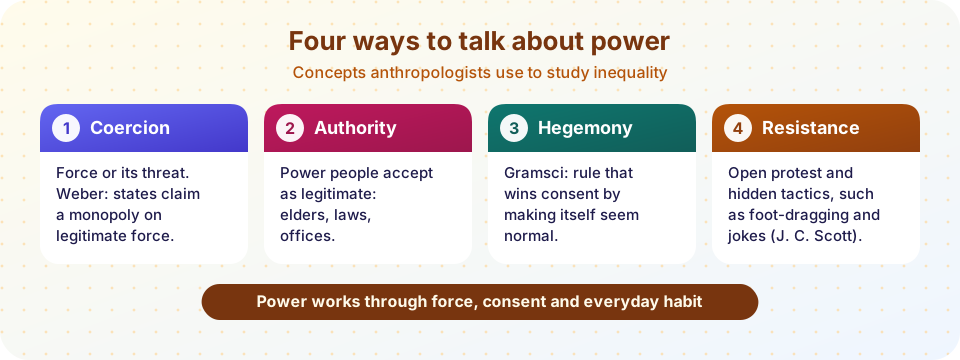
Hegemony: Antonio Gramsci's term for rule maintained through consent, by making a social order seem natural.
Intersectionality: the idea that forms of disadvantage such as race, class and gender combine in specific ways.
Axes of inequality
Class and status. Karl Marx defined class by relation to the means of production: owners and workers. Weber added status (prestige) and party (organized power) as separate dimensions. A wealthy newcomer may have money but lack status. Anthropologists study how class is lived: through housing, speech, taste, schooling and kinship networks.
Caste. In South Asia, caste (jati and the older fourfold varna scheme) ranks groups by hereditary occupation and ritual purity, with Dalits, historically called "untouchables," at the bottom and subject to severe exclusion. Louis Dumont's Homo Hierarchicus (1966) argued that the idea of purity and pollution organizes the whole system. Critics such as Nicholas Dirks argued that colonial rule hardened caste into a rigid census category. B. R. Ambedkar, himself a Dalit leader and scholar, fought for abolition and legal protections. Caste discrimination is banned in India's constitution but persists.
Race. Human biological variation exists, but it does not sort into clear, separate "races". Variation changes gradually across regions and most of it occurs within any one population. Race is nevertheless a powerful social category: people have been classified, treated and ranked by it, with real effects on wealth, health and safety. Franz Boas's early twentieth-century studies of immigrants' children showed that body measurements once used to define "types" changed with environment. The American Anthropological Association's 1998 statement on race says that race is a social construct, not a biological classification. Studying race in anthropology means studying racism and its structures.
Gender. Societies divide tasks, rights and expectations by gender in different ways. Margaret Mead's New Guinea studies were used to argue that temperament is cultural; later scholars criticized her methods and conclusions while the broader point that gender varies remained. Sherry Ortner's 1974 essay asked whether women were devalued everywhere because of an association with nature, and was widely debated. Many scholars now study gender along with class, race and other categories at once. The legal scholar Kimberlé Crenshaw's term intersectionality (1989) is widely used for that.
How inequality is maintained
Structural violence is a term associated with Johan Galtung and applied by the physician-anthropologist Paul Farmer. It means harm that no one person inflicts but that arises from social arrangements: poor people dying of treatable disease because of how medicine, trade and politics are organized. Farmer's work in rural Haiti linked individual illness to history and global economy.
Hegemony. Gramsci argued that ruling groups keep power not only through force but by shaping common sense, so their rule looks natural and fair. Symbolic violence, a term from Pierre Bourdieu, names the way people come to accept the judgment that their own tastes, speech or bodies are inferior.
Resistance
If power only worked by force, rebellion would be easy to spot. Anthropologist James C. Scott studied a Malaysian village in Weapons of the Weak (1985) and described everyday resistance: foot-dragging, feigned ignorance, small theft, gossip and slow work. In Domination and the Arts of Resistance (1990) he described "hidden transcripts", the critical talk that subordinates share out of earshot of the powerful, and public "transcripts" in which everyone plays along.
Open resistance includes strikes, petitions, protests and social movements. Lila Abu-Lughod's essay "The Romance of Resistance" (1990) warned against treating every act as resistance: sometimes small acts reveal how power works but do not change it, and some acts that look like resistance may reinforce the system. Resistance is a question to examine, not an assumption.
Common misconceptions
"Race is biological, but it is not real to talk about." Race is not a biological classification, but racism has real consequences, so race must be studied as a social fact.
"Inequality is natural, so no explanation is needed." Wealth, rank and status are produced by institutions, laws, history and decisions, and they change.
"Anything people do in defiance is resistance." Some acts have little effect on the structure; careful ethnography asks what an act actually changes.
Try it
The Lorenz curve plots the share of total wealth held by the poorest share of the population. A straight diagonal means perfect equality, and a deeper curve means more inequality. The three distributions below are invented teaching examples.
Press Run (or Ctrl + Enter) to see the result here.
Program input · what you'd type while the program runs
Type the answers before you press Run, one per line. Each time the program reads a line (with input()), it gets the next line from this box.
The second demo shows cumulative advantage: when having more makes it easier to gain more, even equal starting points drift apart. This is a toy model, not a claim about any real society.
Press Run (or Ctrl + Enter) to see the result here.
Program input · what you'd type while the program runs
Type the answers before you press Run, one per line. Each time the program reads a line (with input()), it gets the next line from this box.
Check your understanding
Quick check · 5 questions
of 5 answered You scored / 5 · perfect!
-
1. What is structural violence?
Structural violence means preventable harm built into how a society is organized. -
2. What does the American Anthropological Association's 1998 statement say about race?
Race is a social category with real effects, which is why anthropologists study racism. -
3. Gramsci's hegemony refers to
Hegemony is power maintained through shared common sense and consent. -
4. In Scott's study, 'weapons of the weak' include
Scott described everyday, low-profile resistance. -
5. What did Abu-Lughod warn against?
She cautioned against romanticizing resistance.
Summary
- Inequality appears as class and status, caste, race and gender, often in combination.
- Race and gender are social constructions with real effects; anthropologists study racism and gender systems.
- Structural violence, hegemony and symbolic violence explain how unequal systems last without constant force.
- Everyday resistance and open protest are both important, but we should ask what they change.
Next: Chapter 6 review
Track your progress
Create a free account to tick off lessons and pick up where you left off on any device.
of Anthropology lessons completed