


















Lesson 6 of 45 · What Is Anthropology
The Four Fields of Anthropology
Learn what biological anthropology, archaeology, cultural anthropology and linguistic anthropology study, what evidence each uses, and how they work together on one question.
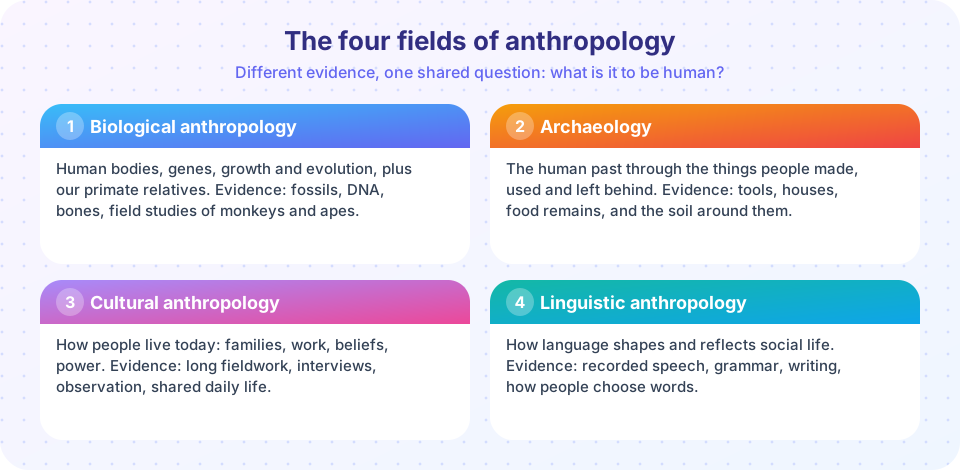
A single anthropologist rarely does everything. Instead the discipline is divided into four fields, each with its own methods, but all asking about the same subject: humans. The four-field idea is especially strong in North America, where it was championed by Franz Boas in the early twentieth century. Elsewhere you will find a similar split under other names.
This lesson explains each field with real examples, shows the kind of evidence it uses, and ends with one question that needs all four.
What you will learn
- What each of the four fields studies and which methods it uses.
- Some subfields and a landmark example from each field.
- What "applied" anthropology is.
- How the fields combine to answer one question.
Key terms
Primatology: the study of monkeys, apes and other primates.
Bioarchaeology: the study of human remains from archaeological sites.
Ethnography: a detailed written account of a way of life.
Sociolinguistics: the study of how language varies with social groups and situations.
Applied anthropology: using anthropological knowledge to help solve practical problems.
Biological (physical) anthropology
Biological anthropology studies the biology of humans and our relatives, past and present. Major subareas:
- Paleoanthropology: reconstructing human evolution from fossils and stone tools (more in chapter 3).
- Primatology: observing monkeys and apes to understand behavior and what we share with them. A famous example is Jane Goodall's work with chimpanzees at Gombe in Tanzania, which began in 1960 and showed that chimpanzees make and use tools.
- Human biology and variation: how bodies adapt to altitude, climate and diet, and how traits vary within and between populations.
- Forensic anthropology: identifying human remains for legal purposes.
- Bioarchaeology: reading health, diet and stress from ancient skeletons.
The evidence: bones, teeth, DNA, measurements and field observations. The questions: how did we evolve, how do bodies vary, and how do biology and environment interact?
Archaeology
Archaeologists reconstruct the human past from material remains: tools, pottery, houses, burials, food waste and the layers of soil that hold them. Some study the very distant past (prehistoric archaeology); some study periods with writing (historical archaeology); some study modern life, including the garbage of a living neighborhood.
Their method is careful: survey a landscape, dig in controlled layers, record where every object lay, and analyze it in a laboratory. Archaeologists say context matters more than the object itself: a beautiful pot torn from the ground without records has lost most of its meaning. You will see how this works in archaeological methods and dating.
Cultural (social) anthropology
This is the field most people picture first. Cultural anthropologists study how people live today: how they organize families, make a living, govern themselves, worship, play and make sense of the world. Their signature method is ethnography, which centers on long fieldwork and participant observation: living among people, learning their language, and joining daily life, often for a year or more.
Subfields follow topics: medical anthropology (health and illness), economic anthropology, political anthropology, the anthropology of religion, kinship and gender, urban anthropology, and digital anthropology. A landmark example is Bronislaw Malinowski's work in the Trobriand Islands during the 1910s, which helped make long, language-based fieldwork the standard.
British and many European traditions call this field social anthropology or ethnology, but the activity is similar.
Linguistic anthropology
Linguistic anthropologists ask how language works in social life: how children learn it, how speakers choose words to build friendship or distance, how languages change and how they die. The method is to record real speech, transcribe it carefully and analyze the choices speakers make. Boas and his student Edward Sapir documented many Indigenous languages of North America at a time when few outsiders had written them down.
Today a major concern is language endangerment: many linguists estimate that a large share of the world's roughly 7,000 languages are at risk, and documenting them while speakers are alive is urgent work. Another long-running topic is linguistic relativity, the idea that the language you speak may nudge how you think. The strong version (language determines thought) has been rejected, while weaker versions, where language influences attention or memory in small ways, continue to be tested.
The fifth "field": applied and public anthropology
Many anthropologists use their skills outside universities: in hospitals designing culturally sensitive care, in museums, in development projects, in companies studying how people use products, in courts helping identify remains, and in cultural heritage protection. This is called applied anthropology. A related idea is public anthropology: writing and speaking to a general audience about human questions. You will meet both in chapter 8.
One question, four fields
Take a question that looks simple: why can some adults drink milk without trouble?
| Field | Contribution |
|---|---|
| Biological | Most mammals stop making the enzyme lactase after infancy. In some human populations a genetic variant keeps it active into adulthood, a trait called lactase persistence. It appears to have spread independently in several parts of the world where dairying mattered. |
| Archaeology | Chemical traces of milk fat in ancient pottery show that people were handling dairy thousands of years ago. Animal bones can show whether herds were kept for milk or meat. |
| Cultural | How do families use milk, cheese or yogurt today? What foods are taboo? How do people who cannot digest fresh milk handle fermented products? |
| Linguistic | What words and names do people use for dairy foods, and how do those words spread with the animals? |
No field alone gives the full answer. Together they produce a story about genes, history, food, meanings and words.
Common misconceptions
"Archaeology is treasure hunting." Archaeologists care about context and information, not valuable objects. Looting destroys the information.
"Cultural anthropologists only study small, remote communities." They also study hospitals, factories, schools and online worlds.
"Biological anthropology is about races." Modern biological anthropology studies human variation and rejects the idea that humans divide into biologically distinct races. Variation is gradual and mostly found within every population.
Try it
Match each piece of evidence to the field that would normally lead. Click an evidence item and then a field.
Now count which fields a small set of research projects draws on. The projects are invented for practice.
Press Run (or Ctrl + Enter) to see the result here.
Program input · what you'd type while the program runs
Type the answers before you press Run, one per line. Each time the program reads a line (with input()), it gets the next line from this box.
Check your understanding
Quick check · 5 questions
of 5 answered You scored / 5 · perfect!
-
1. Which field studies human remains from archaeological sites to learn about health and diet?
Bioarchaeology links biological anthropology and archaeology. -
2. Why do archaeologists record exactly where each object was found?
Without context, an object loses its age, use and relationship to other finds. -
3. Participant observation is most closely linked with
Cultural anthropologists live among people and take part in daily life. -
4. The strong form of linguistic relativity (language fully determines thought) is
Evidence supports at most modest influences of language on attention and memory. -
5. Lactase persistence is an example of a question that needs
Genes, ancient pottery residues, food customs and word histories all contribute.
Summary
- Biological anthropology studies human evolution and variation; archaeology the human past through things; cultural anthropology living ways of life through fieldwork; linguistic anthropology language in social life.
- Applied and public anthropology use the discipline's knowledge for practical problems and for wider audiences.
- Real questions, such as why some adults digest milk, often draw on all four fields.
- Modern biological anthropology rejects biological "races".
Track your progress
Create a free account to tick off lessons and pick up where you left off on any device.
of Anthropology lessons completed