


















Lesson 10 of 45 · Human Evolution and Archaeology
Chapter 3 Overview: Human Evolution and Archaeology
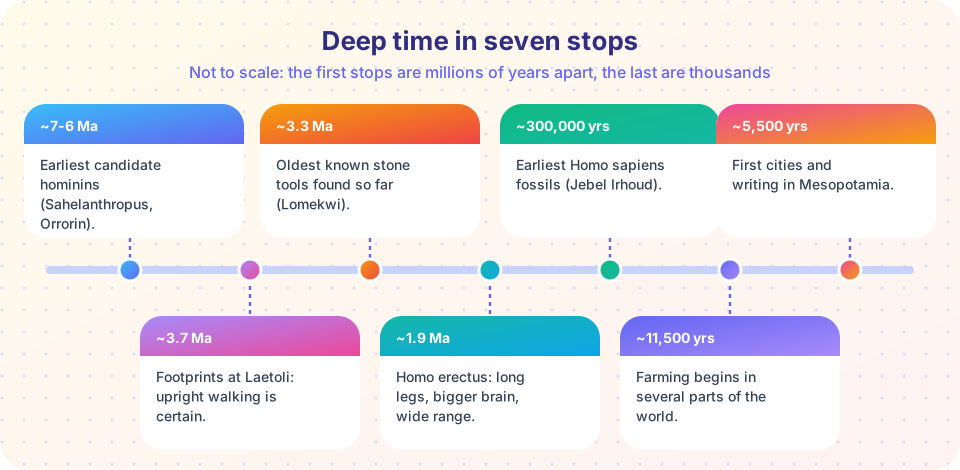
A map of deep human time: from the first upright walkers through stone tools and Homo erectus to our species, farming and the first cities, plus a guide to chapter three.
Humans have been on Earth for a very long time, and for most of that time nobody wrote anything down. Our knowledge of the first millions of years comes from bones in rock, stones shaped by hand, ash from ancient fires and, increasingly, DNA. Reading that record is the job of biological anthropologists and archaeologists, and this chapter shows how they do it.
This overview gives you the big timeline and the vocabulary for the five lessons that follow. As you read, keep one rule in mind: the story is built from evidence, and it changes when new evidence arrives.
What you will learn
- The major milestones of human evolution and early history, with approximate dates.
- How scientists date events millions and thousands of years ago.
- What "hominin", "Ma" and "ka" mean.
- What each lesson in this chapter covers.
Key terms
Hominin: a member of the human lineage after it split from the lineage leading to chimpanzees and bonobos; includes us and extinct relatives such as the australopiths.
Fossil: preserved remains or traces of a once-living thing, usually mineralized.
Ma: millions of years ago. ka: thousands of years ago.
Artifact: an object made or modified by people.
Domestication: changing plants or animals, over generations, so they depend on human care.
The seven stops
Here is the whole story in a paragraph. Roughly 6 to 7 million years ago (Ma), one line of African apes began to diverge from the line leading to chimpanzees and bonobos. Fossils such as Sahelanthropus and Orrorin are candidates for the earliest members of the human line. By 3.7 Ma, hominins were walking upright, as footprints preserved in volcanic ash at Laetoli in Tanzania show. By about 3.3 Ma, someone at Lomekwi in Kenya was making stone tools. About 1.9 Ma, Homo erectus appears: tall, long-legged and widely traveled, soon found far outside Africa. The earliest fossils of our own species, Homo sapiens, date to about 300,000 years ago (the Jebel Irhoud site in Morocco). From about 11,500 years ago, farming began in several parts of the world, and by about 5,500 years ago the first cities and writing appeared in Mesopotamia.
Each of those sentences is the result of years of work, and many details are debated. For example, scientists argue about whether Sahelanthropus walked upright and about exactly where our species arose within Africa.
How scientists know
Three kinds of tools produce the dates and stories:
- Fossils and artifacts give direct physical evidence: what bodies looked like, what tools were made.
- Dating methods put them in order and give them ages. Relative methods (like soil layers) say which is older; absolute methods (like radiocarbon and others) give a number of years. See archaeological methods and dating.
- Genetics compares DNA from living people, and increasingly from ancient bones, to trace relationships and migrations.
No single tool settles a question. Reliable conclusions come from several lines of evidence that agree.
Chapter 3 in five lessons
Each lesson adds a tool for reading deep time.
How to read a fossil story
New finds often change the story.
What is in this chapter
- Natural selection and primates: how evolution works and where humans sit in the primate tree.
- Hominin evolution: upright walking, stone tools, Homo erectus, Neanderthals and our own species.
- Archaeological methods and dating: digging, layers, context and the clocks used to date the past.
- From foraging to farming to cities: the big changes in how people lived.
- Chapter review: a cheat sheet and a ten-question quiz.
Common misconceptions
"Humans evolved from chimpanzees." Humans and chimpanzees share a common ancestor that was neither. Both lineages have evolved since the split.
"Evolution is a ladder leading to us." It is a branching bush. Many hominin species lived at the same time, and most left no descendants.
"There is a single missing link." The fossil record contains many intermediate forms, and every new find fills a gap and creates new questions.
Try it
Drag the slider to choose a time and see which milestone is the most recent one at that date. The dates are the approximate ones in the lesson.
Now the same milestones on a logarithmic axis, which is the only way to see all of them on one chart. The dates are approximate.
Press Run (or Ctrl + Enter) to see the result here.
Program input · what you'd type while the program runs
Type the answers before you press Run, one per line. Each time the program reads a line (with input()), it gets the next line from this box.
Check your understanding
Quick check · 4 questions
of 4 answered You scored / 4 · perfect!
-
1. What is a hominin?
Hominins include our species and extinct relatives such as the australopiths. -
2. The Laetoli footprints show that around 3.7 million years ago, hominins
The prints preserved in volcanic ash are strong evidence for upright walking. -
3. What does 'ka' mean?
Ma is millions of years ago; ka is thousands. -
4. Which statement about human evolution is correct?
Both lineages continued to evolve after they split.
Summary
- Human history is long: about 6 to 7 million years of hominin evolution, 300,000 years of our own species, and just 11,500 years of farming.
- Fossils, artifacts, dating methods and genetics work together.
- Evolution branches like a bush, and many hominin species coexisted.
- This chapter's lessons cover primates, hominins, archaeology and the rise of farming and cities.
Track your progress
Create a free account to tick off lessons and pick up where you left off on any device.
of Anthropology lessons completed