


















Lesson 18 of 45 · Culture and Fieldwork
Participant Observation: Joining In and Watching Closely
Learn how participant observation works: the observer-participant spectrum, gaining access and rapport, key informants, interviews, sampling observations and the limits of the method.
If you wanted to learn how a football team works, you could read about its tactics, interview the coach, or join training for a season. The third way would teach you things the first two cannot: who talks to whom, who is ignored, which rules are written and which are not, and what the team means when it says "good attitude". Participant observation is the anthropologist's version of joining training.
It is a deceptively simple method. You take part in the life of a community and watch it carefully, over a long time. This lesson shows how to do it, what choices it involves and what its limits are.
What you will learn
- The four roles on the observer-participant spectrum.
- How researchers gain access, build rapport and work with key informants.
- Types of interviews and other methods used alongside observation.
- How to observe systematically, and how to sample observations.
- What biases and limits to watch for.
Key terms
Participant observation: taking part in daily activities while watching and recording what happens.
Gatekeeper: a person who controls access to a group or place.
Key informant (interlocutor): a person who knows the community well and helps the researcher understand it.
Rapport: mutual trust that grows over time.
Positionality: the researcher's social position, such as age, gender, nationality and language, and how it shapes the research.
The spectrum of roles
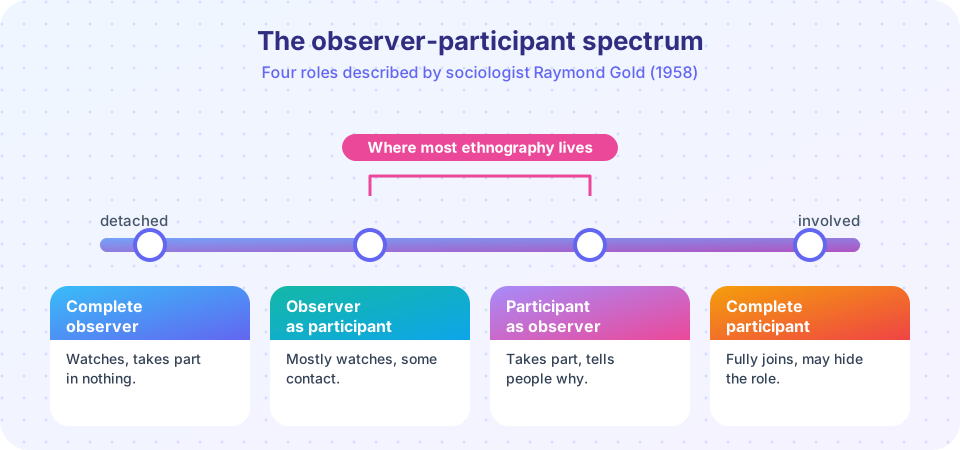
In 1958 the sociologist Raymond Gold described four roles a field researcher can take:
- Complete observer: watches without any involvement, for example counting people in a public square. Little risk of changing the scene, but little understanding of meaning.
- Observer as participant: is mostly an observer, with some brief contact such as a short interview.
- Participant as observer: takes part in activities, and people know that the person is a researcher.
- Complete participant: joins fully, sometimes hiding the research role. This raises serious ethical problems and is rare and heavily restricted today.
Most anthropological fieldwork sits at stops 2 and 3. You are an open guest who helps with chores, attends events and asks questions, and people know why you are there. The balance shifts from day to day: on a quiet morning you might mostly watch, while at a funeral you might be pressed into serving food.
Getting in: access, gatekeepers and trust
A researcher needs permission from authorities (a village head, a clinic director, a school board) and, more importantly, consent from the people who will actually be studied (see fieldwork ethics and writing). Gatekeepers can open doors, but they can also steer you toward their own circle, so good fieldworkers meet people beyond the first friends.
Rapport is built through small, repeated acts: showing up, learning names, helping, listening, keeping promises and admitting mistakes. It cannot be rushed. Language learning matters greatly: speaking even imperfectly in people's own language shows respect and gives access to jokes, gossip and nuance that a translator would miss.
Early on, many fieldworkers experience culture shock: a period of tiredness, irritation and loneliness. Bronislaw Malinowski's private diary, published after his death in 1967, shows him complaining and homesick during his Trobriand fieldwork. It surprised readers who had assumed a calm, confident scientist, and it reminded everyone that fieldwork is done by real people.
Learning from key informants
A key informant is someone who teaches the researcher about local life: a respected elder, a shopkeeper, a teenager who loves explaining. Marcel Griaule's Conversations with Ogotemmêli (1948) records long conversations with a blind Dogon elder about cosmology, and is a famous example of working closely with one teacher, though it has also been debated for relying so much on one voice.
The risks of relying on a few informants are obvious: they have their own views, positions and interests. A strong study cross-checks stories with many people and with observation.
Other methods used alongside
Participant observation seldom stands alone. Fieldworkers combine it with:
- Interviews. Unstructured (like a conversation), semi-structured (a list of topics) or structured (the same questions for everyone). Life histories follow one person's story.
- Genealogical method. W. H. R. Rivers developed this on the Torres Strait expedition in 1898: collecting detailed family trees, which reveal kinship and marriage patterns (chapter 5 covers kinship).
- Mapping and censuses. Drawing who lives where, and counting households.
- Surveys. Short questionnaires, usually after the researcher knows the community well enough to ask meaningful questions.
- Documents and media. Letters, records, social media and photographs.
Using several methods to look at the same question is called triangulation, and it helps to catch mistakes.
Learning to observe
Observation is a trained skill. Beginners tend to notice only what surprises them; experienced observers also notice what is routine. Useful habits:
- Describe before you interpret: "The woman stood up, picked up the bowl and handed it to the man" rather than "She served him respectfully".
- Notice the five Ws: who, what, where, when and with whom. Add "what is not happening?".
- Look at physical settings: seating, who sits near the door, who holds the keys.
- Observe the same place at different times.
Sampling observations
You cannot watch everything. Researchers sometimes use structured sampling. In scan sampling, you note what everyone in view is doing at set intervals. In focal sampling, you follow one person for a fixed period. Both help avoid a bias toward the dramatic or the memorable. You will try a toy version below.
Limits and biases
- Observer effect: people may act differently when watched, though this usually fades as they get used to you.
- Selective perception: you notice what fits your expectations.
- Positionality: your age, gender, nationality and appearance open some doors and close others. A male researcher may have no access to women's gatherings in some places; an outsider may be given the polite, public version of events.
- "Going native": an old term for losing critical distance. Many anthropologists reject the idea that deep involvement spoils research, but they still ask how to remain reflective.
- Ethical limits: some situations (illegal activity, violence) pose dilemmas about what to do and what to report.
Researchers who study their own society, sometimes called insider researchers, gain trust and nuance but may miss what is "obvious". Today fieldwork can also be multi-sited, following people, objects or ideas across several places (an approach set out by George Marcus in 1995), or digital, studying online communities.
Common misconceptions
"Participant observation means pretending to be one of the group." In ordinary ethnography the researcher's role is open and people know why they are there.
"It is not scientific because it is not numbers." It uses systematic methods, cross-checking and clear records; it answers different questions from surveys.
"More involvement is always better." Depth brings understanding, and also risks, such as losing distance or being drawn into disputes.
Try it
First, explore the trade-offs along the spectrum. Move the slider from detached to involved and watch how access to meaning and risk of influencing people change. The scores are rough teaching values, not measurements.
Second, scan sampling in a simulated public square. The simulation has a true share of people who are using a phone at any moment; the researcher takes a few scans. More scans give estimates closer to the truth. All numbers are invented.
Press Run (or Ctrl + Enter) to see the result here.
Program input · what you'd type while the program runs
Type the answers before you press Run, one per line. Each time the program reads a line (with input()), it gets the next line from this box.
Check your understanding
Quick check · 6 questions
of 6 answered You scored / 6 · perfect!
-
1. Which role means taking part in activities while people know you are a researcher?
Gold's third role: you participate, and your research role is open. -
2. What is a gatekeeper?
Gatekeepers can open doors but may also steer the researcher. -
3. Why do researchers combine several methods on the same question?
Different methods give different views, and they can confirm or challenge one another. -
4. Who developed the genealogical method on the Torres Strait expedition in 1898?
Rivers collected detailed family trees to reveal kinship patterns. -
5. Which statement is a description rather than an interpretation?
A description says what happened; an interpretation adds meaning. -
6. Why is complete participation with a hidden research role heavily restricted today?
People cannot consent to be studied if they do not know about it.
Summary
- Participant observation means taking part in daily life while observing closely over a long time.
- Gold's four roles run from complete observer to complete participant; most anthropology uses the middle two.
- Access, gatekeepers, rapport, language and key informants shape what you can learn.
- Combine interviews, genealogies, maps, surveys and documents, and describe before you interpret.
- Watch for observer effect, selective perception and positionality.
Track your progress
Create a free account to tick off lessons and pick up where you left off on any device.
of Anthropology lessons completed