


















Lesson 19 of 45 · Culture and Fieldwork
Fieldwork Ethics, Field Notes and Writing Ethnography
Learn the ethics of anthropological fieldwork (informed consent, doing no harm, confidentiality), how to write field notes, and how raw observations become an ethnography.
Anthropologists enter people's homes, hear their stories and write about them for strangers. That is a privilege and a risk. A careless sentence in a published book can embarrass a family, or worse, put someone in danger. The craft of fieldwork therefore has two halves: doing careful research, and doing it responsibly.
This lesson covers the ethical rules that guide fieldwork, then follows your data on its journey from scribbled jottings to a finished ethnography.
What you will learn
- The core ethical principles of anthropological research and where they come from.
- What counts as informed consent, and how confidentiality works (and fails).
- Why some research projects have been criticized, and what changed.
- How to write field notes that separate observation from interpretation.
- How an ethnography is built and shared.
Key terms
Informed consent: a person's free agreement to take part after learning what the research is, what is asked of them and what the risks are.
Confidentiality: protecting information that could identify participants.
Pseudonym: a made-up name used in place of a real one.
Field notes: the researcher's written record of observations, conversations and reflections.
Memo: a short analytic note linking observations to ideas.
Where research ethics comes from
Modern rules grew out of abuses in other fields. After the Second World War, the Nuremberg Code (1947) insisted that human subjects must voluntarily consent to research. In the United States, the Belmont Report (1979) named three principles: respect for persons, beneficence (doing good and avoiding harm) and justice (fair distribution of risks and benefits). Universities now have review boards that check research plans in advance.
Anthropology has its own history of ethical lessons. In the 1960s, Project Camelot, a US Army-funded study of social unrest in Latin America, was cancelled after it became public, partly because many scholars and governments saw it as a use of research for political intelligence. In the 2000s, the Human Terrain System embedded social scientists with US military units; the American Anthropological Association criticized it in 2007. These controversies shaped the discipline's rule: research should not be used to harm the people studied.
The American Anthropological Association's Principles of Professional Responsibility (2012) sets out the modern standard. In summary:
- Do no harm. Weigh the possible harm to people, communities and records against the benefits.
- Be open and honest about the research.
- Obtain informed consent and respect the right to refuse or withdraw.
- Weigh competing ethical obligations: to participants, to the community, to the public, to colleagues.
- Make your results accessible and share them with the people concerned.
- Protect and preserve your records.
- Maintain respectful relationships with those you study and those you work with.
Informed consent in practice
Consent is a process, not a signature. Before you start you explain, in language people understand:
- who you are and who funds you;
- what the study is about and what you will do (observe, interview, record);
- what risks and benefits there may be;
- how you will protect information;
- that taking part is voluntary and that people can say no or stop at any time.
Consent may be written, oral or ongoing. In communities where signing documents is unusual or frightening, oral consent recorded with the person's agreement may be better. In many places, community consent from leaders is not enough: individuals must still choose for themselves. Special care is needed with children, patients, prisoners or others who may find it hard to refuse.
Researchers also think about reciprocity: what will people get in return for their time? It may be payment, help with chores, advocacy, a copy of the final work or sharing results at a community meeting.
Confidentiality and its limits
The usual tool is a pseudonym for people and often for small places. But small communities are hard to disguise: if you write about the only bakery in a village of 300 people, everyone will know whom you mean. Researchers therefore change or blur details (ages, occupations, dates), sometimes combining several people into one composite character, and tell readers they have done so. They also need to think about their notes: store them securely, encrypt files and decide in advance what will happen to them.
Sometimes information must stay out of the account even though it is fascinating, because publishing it could harm someone: illegal activity, secrets that put people at risk, sacred knowledge that people do not want shared. Deciding is a judgment call, best made with community advice.
Field notes
You cannot trust memory. Fieldworkers write notes almost every day, usually in stages.
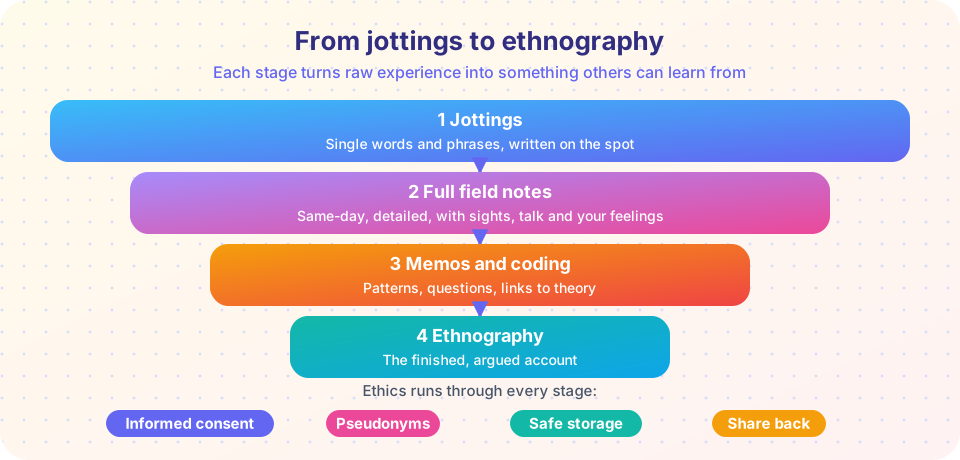
- Jottings: quick words and phrases written on the spot or in a bathroom break, so you can reconstruct events later.
- Full field notes: written the same day, in as much detail as you can recall: who, where, when, what was said (as close to exact words as possible), what you saw, smelled and felt. Robert Emerson, Rachel Fretz and Linda Shaw's Writing Ethnographic Fieldnotes (1995) is a well-known guide.
- Memos and coding: separate short notes that connect observations to ideas ("Today's greeting seems linked to age rank: check with others"), and labels (codes) that group passages by theme.
A good habit is to keep four kinds of material visibly separate: observation (what happened), interpretation (what you think it means), methodological notes (how you collected it) and personal reactions (how you felt). That keeps your own feelings from being mistaken for facts, and it lets you notice your biases later.
From notes to ethnography
Writing an ethnography is a process of selection and argument. Typical steps:
- Read your notes repeatedly and code them for themes.
- Find a puzzle: something that does not fit existing explanations.
- Choose scenes and quotations that show the pattern, using thick description that explains the context behind an action.
- Make an argument: not just "here is what they do" but "here is what this means and why it matters".
- Place yourself honestly in the text: who you are and how you came to know what you report.
- Show drafts to participants and listen; some disagreements will change the text, others will be noted.
Voice matters. Since the Writing Culture debate of the 1980s (see the history of anthropology), many ethnographers quote participants at length, share authorship or write in forms that let multiple voices appear. And, as in how to study anthropology, they separate claim, evidence and context for the reader.
Sharing back
Good fieldwork ends with giving something back: a plain-language summary, a community meeting, a book in the local language, a deposit of recordings in an archive controlled by the community. Many communities now run their own research review processes and expect researchers to follow them.
Common misconceptions
"A signed form means consent is done." Consent is ongoing. People can change their minds, and understanding must be real.
"Pseudonyms make people anonymous." In small communities, details can identify people even when names are changed.
"Ethics slows science down." Ethical practice builds trust, which is the basis of access and good data.
"My notes are private, so nothing can go wrong." Notes can be lost, stolen or demanded by authorities, so storage and security matter.
Try it
First, test your sense of consent. Each invented scenario hides a consent problem. Click a scenario to see which principle is at stake.
Second, a simple pseudonymizer. It replaces names with consistent pseudonyms and then prints what it changed. It is a teaching sketch: real projects also blur other details and store the key separately and securely.
Press Run (or Ctrl + Enter) to see the result here.
Program input · what you'd type while the program runs
Type the answers before you press Run, one per line. Each time the program reads a line (with input()), it gets the next line from this box.
Check your understanding
Quick check · 6 questions
of 6 answered You scored / 6 · perfect!
-
1. Which principle means doing good and avoiding harm?
The Belmont Report names beneficence alongside respect for persons and justice. -
2. Why is informed consent described as a process rather than a signature?
Consent can be oral or written, and participants can withdraw at any time. -
3. Why can a pseudonym fail to protect someone in a small community?
Identifying details can reveal the person even when the name is changed. -
4. Which entry belongs in the 'interpretation' column of your notes?
'Seems to be avoiding' is your reading of the behavior, not the behavior itself. -
5. What was one reason Project Camelot was criticized?
It was seen as using social science for intelligence purposes. -
6. Good fieldwork usually ends with
Sharing back is part of reciprocity and respect.
Summary
- Research ethics grew from historical abuses; the main principles are respect for persons, beneficence and justice.
- Anthropologists follow principles such as do no harm, honesty, informed consent, accessibility and protecting records.
- Consent is ongoing; pseudonyms have limits in small places.
- Field notes progress from jottings to full notes to memos, keeping observation separate from interpretation.
- An ethnography is an argued, thickly described account that ideally is shared back with the community.
Next: Chapter 4 Review
Track your progress
Create a free account to tick off lessons and pick up where you left off on any device.
of Anthropology lessons completed