


















Lesson 7 of 45 · What Is Anthropology
Holism, Comparison and the Insider's View
Understand holism, the comparative method, cultural relativism, ethnocentrism and the emic versus etic distinction, with examples and limits that every anthropologist faces.
If you remember only three ideas from anthropology, make them these. Holism says: look at the connections. Comparison says: look at many societies, not one. Relativism says: understand a practice in its own setting before you judge it. Together they make the discipline's way of thinking.
They also come with traps. Comparison can flatten differences. Relativism can be mistaken for "anything goes". Holism can become an endless list of everything. This lesson explains each idea, the people who shaped it and the limits that anthropologists openly discuss.
What you will learn
- What holism is and how it shapes research.
- How the comparative method works and what can go wrong (Galton's problem).
- What cultural relativism claims, and what it does not.
- What ethnocentrism is and how to catch it.
- The emic/etic distinction and why both views are needed.
Key terms
Holism: studying the connections among parts of a way of life, such as economy, belief and family.
Cultural relativism: the method of understanding a belief or practice within its own cultural context.
Ethnocentrism: judging other ways of life by the standards of your own.
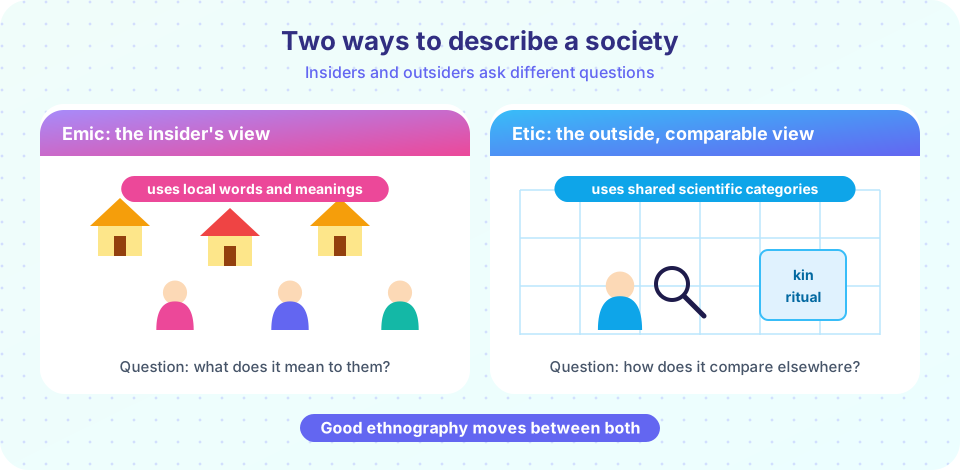
Emic: a description using the categories and meanings of the people studied.
Etic: a description using outside categories that can be compared across societies.
Reflexivity: examining how your own position and assumptions shape your research.
Holism: seeing the connections
Imagine trying to understand a wedding by looking only at the ceremony. You would miss the months of food preparation, the exchange of gifts between families, the negotiations over land or money, the songs with their local history and the way relatives cope with distances. A holistic account follows those threads because the parts explain each other.
Holism works at several levels.
- Across domains of life: economy, kinship, religion and politics are linked. A harvest ritual may also be a market, a family reunion and a political event.
- Across time: the present of a society cannot be understood without its history.
- Across body and culture: how people eat, sleep and grow reflects both biology and custom.
Holism does not mean writing about everything. It means asking: what else does this connect to, and what changes if I follow that connection?
Comparison: testing ideas across societies
One society cannot tell you what is general. If you study a single case, you cannot tell which features are accidents of that place. Comparison tests ideas against many cases.
Anthropologists compare in different ways. Some carry out a small, deep comparison of two or three societies. Others use large databases. The Human Relations Area Files, started at Yale in 1949, organize ethnographic texts about hundreds of cultures by topic so researchers can search them. George Peter Murdock's Standard Cross-Cultural Sample (1969) selected 186 societies to avoid over-representing neighboring peoples.
That brings us to Galton's problem, named after Francis Galton's remark in 1889 on a paper by Edward Tylor: if two neighboring societies share a custom, did they independently develop it, or did one borrow it, or did both inherit it from a common ancestor? If you count borrowed customs as independent cases, your statistics are inflated. Modern comparative work tries to handle this by choosing widely spaced societies and using methods that account for history and geography.
Comparison also has a quieter risk: forcing different things into the same box. A word translated as "marriage" or "religion" may mean different things in different places. This is why anthropologists pair comparison with careful, local description.
Cultural relativism
Franz Boas and his students argued strongly in the early twentieth century that you cannot understand a custom outside its setting. Cultural relativism became the discipline's rule of method: suspend judgment until you understand. A practice that looks strange when you pull it out of context often makes sense in a network of beliefs, history and needs.
What relativism does not say
It is not the claim that every practice is equally good, nor that there are no limits to what is acceptable. Anthropologists distinguish:
- Methodological relativism: a research habit. First understand, then evaluate.
- Moral relativism: the philosophical claim that no outside moral standard is valid. Many anthropologists reject it.
In 1947 the American Anthropological Association's executive board issued a statement about human rights, worried about universal claims that ignored cultural variety. The discipline has since discussed the issue for decades and in 1999 adopted a declaration that anthropology and human rights are compatible: understanding a practice does not mean you must approve of it, and anthropologists often work alongside communities to protect rights.
Ethnocentrism
The American sociologist William Graham Sumner coined ethnocentrism in 1906: the habit of treating your own group's ways as the natural center and measuring others by them. It is everywhere, including in scholars. Early anthropologists often described societies on a supposed ladder from "savage" to "civilized". That ranking was an ethnocentric projection of the researchers' own assumptions, and it was used to justify colonial rule.
A good way to catch ethnocentrism is to swap the roles. Would a visitor to your daily routine find it strange? Probably yes: a person from elsewhere might find your habit of staring at screens at dinner or lining up numbered tickets for service equally puzzling.
Emic and etic
The linguist Kenneth Pike coined the pair in 1954 by shortening phonemic and phonetic. Think of it as two cameras.
- Emic (insider): how people themselves classify and explain their world. In a village, an exchange of gifts might be described by a local term that carries moral meaning about trust and obligation.
- Etic (outsider): categories used by researchers, such as "reciprocity" or "kinship terminology", that can be compared across societies.
Neither is the "true" one. Emic accounts keep local meaning; etic accounts allow comparison. Good ethnography starts with emic description and then translates into etic terms without losing the first. Anthropologist Marvin Harris later argued that etic explanations should be primary, while others such as Clifford Geertz insisted on the importance of local meaning; the debate is still alive.
Reflexivity: the researcher is part of the picture
From the 1970s and 1980s many anthropologists stressed reflexivity: the habit of asking how your age, gender, nationality, language skills and relationship to the community affect what people tell you and what you notice. Reflexive writing says who the researcher is, which makes the account more honest and easier to evaluate.
Common misconceptions
"Relativism means you can never criticize anything." Methodological relativism is about understanding first. Many anthropologists criticize harmful practices, often alongside people in the community who are doing the same.
"Holism means including everything." It means tracing the relevant connections, not listing every fact.
"Emic means 'correct' and etic means 'outside'." Both are descriptions with different aims; neither is automatically right.
Try it
This demonstration describes one everyday action, a greeting, from emic and etic points of view. Toggle the view to see how the description changes. The "villages" are invented.
Next, a toy comparative sample. The twelve societies below are invented. The code counts how often a feature appears in each region, which is the simplest cross-cultural comparison.
Press Run (or Ctrl + Enter) to see the result here.
Program input · what you'd type while the program runs
Type the answers before you press Run, one per line. Each time the program reads a line (with input()), it gets the next line from this box.
Check your understanding
Quick check · 6 questions
of 6 answered You scored / 6 · perfect!
-
1. What does holism ask an anthropologist to do?
Holism means following connections that help explain a practice. -
2. What is Galton's problem?
Counting related societies as independent inflates evidence for a pattern. -
3. Methodological cultural relativism means
It is a research habit, not a claim that nothing can be criticized. -
4. Who coined the term ethnocentrism?
Sumner used it in his 1906 book Folkways. -
5. An 'etic' description is
Etic categories, such as 'reciprocity', allow comparison; emic categories keep local meaning. -
6. Reflexivity means
Reflexive writing says who the researcher is and how that may affect results.
Summary
- Holism traces connections; comparison tests ideas across many societies; relativism understands before judging.
- Galton's problem warns that neighboring societies are not independent cases.
- Relativism as method is different from moral relativism.
- Emic descriptions keep local meaning; etic descriptions allow comparison; good work uses both.
- Reflexivity admits that the researcher is part of the picture.
Track your progress
Create a free account to tick off lessons and pick up where you left off on any device.
of Anthropology lessons completed