


















Lesson 12 of 45 · Human Evolution and Archaeology
Hominin Evolution: From Upright Walkers to Us
Follow human evolution from the first upright walkers and Lucy to Homo erectus, Neanderthals, Denisovans and Homo sapiens, with the evidence and the debates behind each step.
The human story is not a single line from ape to person. It is a bush with many branches: over the last several million years, a number of upright-walking species lived in Africa, and later in Europe and Asia, sometimes at the same time. Only one of those branches, our own, survives.
This lesson walks through the main groups, the evidence for each and the points still under debate. Keep two cautions in mind. Dates and names change as new fossils turn up; and a species name is a scientist's label for a cluster of fossils, not a clean box that nature drew.
What you will learn
- What evidence shows upright walking and why it matters.
- The main hominin groups: early hominins, australopiths, early Homo, Homo erectus, Neanderthals and Denisovans, and Homo sapiens.
- How stone tools and fire fit the story.
- What ancient DNA has changed.
- Why the picture is a bush, not a ladder.
Key terms
Bipedalism: walking on two legs.
Australopith: a member of the genus Australopithecus and related forms: small-brained, upright-walking hominins of Africa.
Oldowan: the oldest widespread stone tool tradition, simple flakes and choppers.
Acheulean: a later tradition known for teardrop-shaped hand axes.
Ancient DNA: genetic material recovered from fossil bones.
Upright walking comes first
Chimpanzees walk upright only briefly. Habitual two-legged walking is the earliest signature of the hominin line. Evidence for it comes from:
- the foramen magnum, the hole where the spinal cord leaves the skull, which sits underneath the skull in upright walkers and further back in quadrupeds;
- a short, broad pelvis and an S-curved spine that balance the trunk over the hips;
- leg bones angled inward at the knee, so the feet fall under the body;
- footprints, such as the ones at Laetoli (Tanzania), preserved in volcanic ash about 3.7 million years ago.
Why walk upright? Several ideas exist: it frees the hands, saves energy when crossing open ground, helps carry food or infants, and may help in hot sun by reducing the body surface exposed. Researchers think several of these may have mattered together.
Early hominins (about 7 to 4 million years ago)
Sahelanthropus tchadensis (Chad, about 7 Ma), Orrorin (Kenya, about 6 Ma) and Ardipithecus ramidus (Ethiopia, about 4.4 Ma) are the oldest candidates. They are fragmentary and each interpretation is debated, especially whether Sahelanthropus walked upright. Ardipithecus had a grasping big toe for climbing trees but a pelvis suited to walking, a mix that suggests a way of moving not quite like any living ape.
The australopiths (about 4 to 2 million years ago)
Australopithecus afarensis is known from many fossils. In 1974, at Hadar in Ethiopia, Donald Johanson and Tom Gray found a partial skeleton nicknamed "Lucy", dated to about 3.2 million years ago. She stood roughly 1.1 meters tall, had a brain about the size of a chimpanzee's and walked upright, though her arms and shoulders still suited climbing.
Other australopiths include A. africanus in southern Africa and the "robust" forms (Paranthropus) with massive jaws and chewing muscles, adapted to tough plant foods. Several species lived at the same time, a first clue that human evolution was a bush.
Early Homo and stone tools (about 2.5 to 1.5 million years ago)
Stone tools appear in the record by about 3.3 million years ago (Lomekwi, Kenya) and more clearly by about 2.6 million years ago (the Oldowan tradition, named for Olduvai Gorge in Tanzania). Early members of the genus Homo, such as Homo habilis ("handy person"), are associated with such tools, though which species made which tools is not always certain.
Making a sharp flake by striking one stone with another takes planning and skill. Cut marks on animal bones from this period show that hominins were slicing meat from carcasses.
Homo erectus (about 1.9 million to 100,000 years ago)
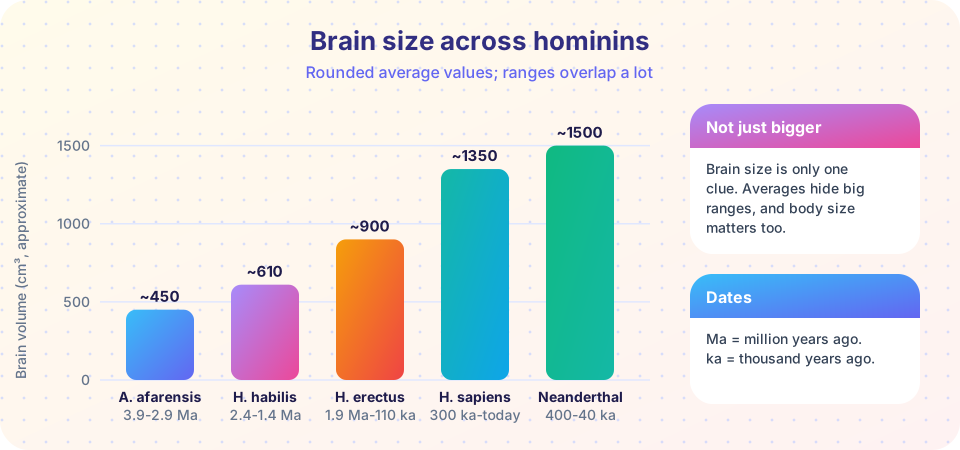
Homo erectus is the first hominin with body proportions like ours: long legs, shorter arms, a body suited to walking and running long distances. The famous "Turkana Boy" skeleton (Nariokotome, Kenya, about 1.5 Ma) is almost complete. Brains were larger (roughly 900 cubic centimeters on average). Fossils appear in Georgia (Dmanisi, about 1.8 Ma), China and Indonesia, so the species spread far beyond Africa.
Homo erectus made Acheulean hand axes, symmetrical teardrop tools used for about a million and a half years. Evidence for controlled fire grows from about 400,000 years ago and appears in some earlier sites, but exactly when regular fire use began remains debated. Cooking would have made food easier to digest and may have supported larger brains.
Neanderthals, Denisovans and other relatives
Neanderthals (Homo neanderthalensis) lived in Europe and western Asia from about 400,000 to about 40,000 years ago. They were stocky, cold-adapted, skilled toolmakers who used fire, buried or handled their dead in some places and made ornaments in others (how symbolic they were remains discussed). The name comes from the Neander Valley in Germany, where a skeleton was found in 1856.
In 2010 a team led by Svante Pääbo reported DNA from a finger bone found in Denisova Cave in Siberia. It belonged to a previously unknown group, now called Denisovans. Other recent finds include Homo naledi (found in the Rising Star cave in South Africa and published in 2015, dated to roughly 335,000 to 236,000 years ago, with a small brain) and Homo floresiensis, a small-bodied hominin from the island of Flores, Indonesia, described in 2004.
Homo sapiens
Our species has the oldest known fossils at Jebel Irhoud in Morocco, about 300,000 years old, with a face like ours but a more elongated braincase. Other early fossils come from Ethiopia and South Africa. Most evidence points to Africa as the original home of our species, and to later movements out of Africa, a view called "Out of Africa". Even within Africa, many researchers now think populations were connected networks rather than one tiny source.
Ancient DNA has shown that, as modern humans spread, they mixed with Neanderthals and Denisovans. People whose ancestors lived outside Africa carry roughly 1 to 2 percent Neanderthal DNA, and some groups in Asia and Oceania carry Denisovan DNA. Mixing is a nice reminder that species boundaries in human evolution were not sharp.
A bush, not a ladder
Picture a time about 100,000 years ago: Homo sapiens in Africa, Neanderthals in Europe, Denisovans in Asia, Homo floresiensis on Flores and possibly others. At earlier times, australopiths of different kinds coexisted. The popular "march of progress" cartoon, an ape straightening into a human, is misleading in two ways: it implies one line, and it implies a goal.
Common misconceptions
"Neanderthals were brutish and stupid." Evidence shows they made complex tools, used fire and cared for their injured. They were not inferior versions of us; they were a different human group.
"Bigger brain means smarter species." Neanderthal brains were on average as big as ours or bigger. Brain structure, body size and social life matter too.
"Lucy was the first human." Lucy is an australopith: an upright walker with a small brain, far from a modern human.
Try it
First, compare approximate brain volumes. The numbers are rounded averages; real fossils vary widely. Change a value to see the chart update.
Press Run (or Ctrl + Enter) to see the result here.
Program input · what you'd type while the program runs
Type the answers before you press Run, one per line. Each time the program reads a line (with input()), it gets the next line from this box.
Second, an explorer for the groups in this lesson. The values are approximate and summarize the text above.
Check your understanding
Quick check · 5 questions
of 5 answered You scored / 5 · perfect!
-
1. Which evidence points to upright walking?
Skull, pelvis, leg bones and footprints all indicate bipedalism. -
2. Lucy (A. afarensis) is best described as
She was found at Hadar, Ethiopia, in 1974. -
3. What is distinctive about Homo erectus?
It spread from Africa to Asia and made Acheulean hand axes. -
4. Ancient DNA has shown that
People with ancestry from outside Africa carry roughly 1 to 2 percent Neanderthal DNA. -
5. Why is a 'bush' a better picture than a 'ladder' for human evolution?
The record shows overlapping, branching lineages.
Summary
- Upright walking is the earliest hominin signature, shown by skull, pelvis, legs and footprints.
- Australopiths were small-brained upright walkers; early Homo made Oldowan tools; Homo erectus spread widely and made hand axes.
- Neanderthals, Denisovans, Homo naledi and others show a branching bush; Homo sapiens appears in Africa about 300,000 years ago.
- Ancient DNA shows mixing among human groups.
- Dates and names are revised as new evidence is found.
Track your progress
Create a free account to tick off lessons and pick up where you left off on any device.
of Anthropology lessons completed