


















Lesson 33 of 45 · Language, Religion and Art
Religion and Ritual: Meaning, Magic and Rites of Passage
Study how anthropologists explain religion and ritual: Durkheim, Malinowski, Evans-Pritchard, van Gennep, Turner and Geertz, with live demos of risk and rites of passage.
Religion appears in every known society, yet what counts as "religion" is contested. Is it belief in gods, a way of organizing community, a source of comfort or a set of practices? Anthropologists avoid deciding which religions are true. They ask what people do, what their symbols mean to them, and how beliefs and rituals fit into the rest of life.
This lesson walks through the classic theories, each of which saw something real: religion as an explanation, as social glue, as a response to uncertainty and as a way to move people through life changes.
What you will learn
- Several definitions of religion and why none is perfect.
- Durkheim on the sacred and collective effervescence.
- Malinowski on magic and uncertainty, and Evans-Pritchard on Azande witchcraft.
- Van Gennep's rites of passage and Turner's liminality and communitas.
- Geertz's idea of religion as a system of symbols.
Key terms
Sacred and profane: Durkheim's contrast between things set apart as special and everyday things.
Ritual: a formal, repeated action with symbolic meaning.
Magic: actions intended to produce results through special powers, often with prescribed words and objects.
Liminality: the in-between phase of a rite, when a person has left one status but not yet entered the next.
Communitas: a feeling of equality and togetherness among people sharing a liminal experience (Victor Turner).
What is religion?
Edward Tylor, in Primitive Culture (1871), offered a "minimum definition": belief in spiritual beings. Critics note that this fits some religions much better than others. Emile Durkheim, in The Elementary Forms of Religious Life (1912), defined religion by function: a system of beliefs and practices about sacred things that unites believers in one moral community. Clifford Geertz, in "Religion as a Cultural System" (1966), described religion as a system of symbols that creates powerful moods and a sense of order about existence. Today many scholars accept that "religion" is a family of overlapping features, not a sharply defined category, and that the very idea of religion as a separate area of life came from particular European history (Talal Asad's argument).
Durkheim: society and the sacred
Durkheim thought that when people worship, they are in a sense worshipping their society. Drawing on reports about Aboriginal Australian clans and their totems, he argued that sacred symbols represent the group. Crowds gathered at rituals feel what he called collective effervescence, a surge of shared emotion that renews bonds. His data on Australian peoples was secondhand and has been criticized, but the idea that ritual builds solidarity remains influential.
Malinowski: magic and uncertainty
Bronislaw Malinowski noticed that Trobriand fishermen used no magic when fishing in the safe lagoon, but performed elaborate magic before sailing the open sea, where danger and luck were high. He concluded that magic appears where outcomes are uncertain and important, and that ritual helps reduce anxiety and organize action. Critics say people also have rational knowledge about danger and that magic has other functions, but the link between uncertainty and ritual is widely cited.
Evans-Pritchard: witchcraft as explanation
In Witchcraft, Oracles and Magic among the Azande (1937), E. E. Evans-Pritchard showed that beliefs about witchcraft in southern Sudan formed a coherent system. If a granary collapses and kills someone sitting beneath it, the Azande know that termites weakened the beams. Witchcraft answers a different question: why did it fall on this person at this time? Oracles, such as poison given to chickens, helped identify the cause and decide action. The study taught anthropologists to treat such beliefs as reasonable in their context rather than as errors.
Rites of passage and liminality
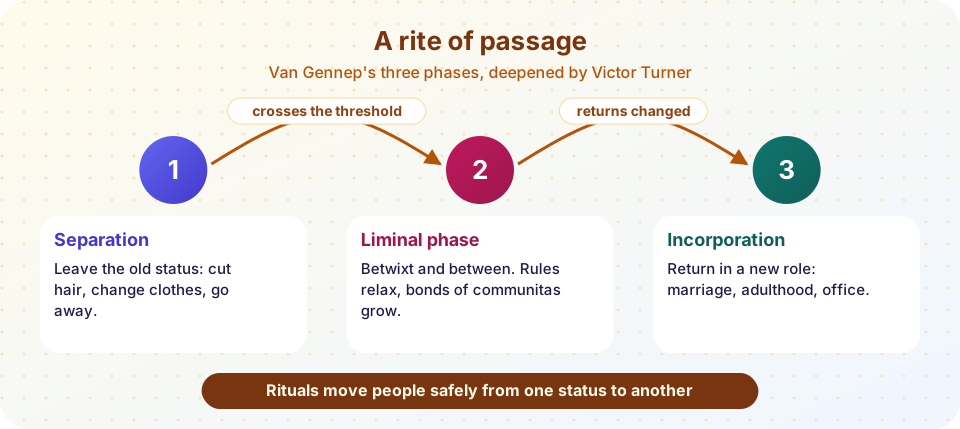
Arnold van Gennep, in The Rites of Passage (1909), observed that rites that mark changes of status, such as birth, initiation, marriage and death, follow three phases. People are separated from their old status, pass through a liminal phase in between and are incorporated into the new one. Victor Turner, who studied the Ndembu of Zambia, described the liminal phase as "betwixt and between": initiates may be stripped of rank, dressed alike, secluded and tested. Out of this equality comes communitas. Modern examples include graduation ceremonies, military boot camp and weddings.
Other ritual forms
- Pilgrimage takes people to a holy place; the Turners saw it as a kind of liminality at scale.
- Spirit possession and shamanism involve mediators who communicate with spirits. The word "shaman" comes from the Evenki language of Siberia; some scholars question whether it names a single phenomenon across the world.
- Ritual regulation of environment: Roy Rappaport argued that the pig festival of the Tsembaga Maring in New Guinea helped balance people, pigs and land, an idea that was influential and heavily debated.
Cognitive scientists of religion, such as Pascal Boyer and Scott Atran, ask why certain ideas, for example agents that are mostly invisible, are easy to remember and spread. Their work complements, rather than replaces, anthropological accounts of meaning.
Common misconceptions
"People in small societies believe in magic because they lack science." The Azande and Trobriand cases show people using practical knowledge alongside ritual. The two answer different questions.
"Ritual is empty habit." Rituals are often highly meaningful to participants and do work: marking status, resolving conflict and building trust.
"All religions are about belief in gods." Many traditions emphasize practice, ethics, ancestors or community more than doctrine.
Try it
First, an illustration of Malinowski's idea. We compare a safe lagoon trip with a risky open-sea trip. The numbers are invented to show the logic: the open sea has a higher average catch but a much higher chance of nothing, which is where uncertainty is greatest. This is a demonstration, not field data.
Press Run (or Ctrl + Enter) to see the result here.
Program input · what you'd type while the program runs
Type the answers before you press Run, one per line. Each time the program reads a line (with input()), it gets the next line from this box.
Second, a simple classifier. It assigns events in an imagined initiation to van Gennep's phases using keywords. It is a classroom demonstration of the structure, not a general tool.
Press Run (or Ctrl + Enter) to see the console output here.
No output.
Check your understanding
Quick check · 5 questions
of 5 answered You scored / 5 · perfect!
-
1. According to Durkheim, what does worship ultimately express?
He argued that sacred symbols stand for the group. -
2. What did Malinowski observe in Trobriand fishing?
He linked magic to uncertainty and danger. -
3. In Evans-Pritchard's Azande example, what does witchcraft explain?
Witchcraft answers the 'why me, why now' question, while natural causes explain the 'how'. -
4. Van Gennep's three phases are
Rites of passage move people from an old status, through an in-between phase, to a new one. -
5. What is communitas?
Victor Turner used it for the bond among people sharing a liminal phase.
Summary
- Religion is hard to define; anthropologists examine what practices and symbols mean and do.
- Durkheim: ritual renews the moral community. Malinowski: magic clusters around uncertainty.
- Evans-Pritchard showed witchcraft beliefs form a coherent system that answers "why me".
- Van Gennep and Turner: rites of passage have three phases; liminality can create communitas.
- Pilgrimage, possession and shamanism are other ritual forms, and categories like "shaman" are debated.
Next: Art and material culture
Track your progress
Create a free account to tick off lessons and pick up where you left off on any device.
of Anthropology lessons completed