


















Lesson 36 of 45 · Globalization and Applied Anthropology
Chapter 8 Overview: Globalization and Applied Anthropology
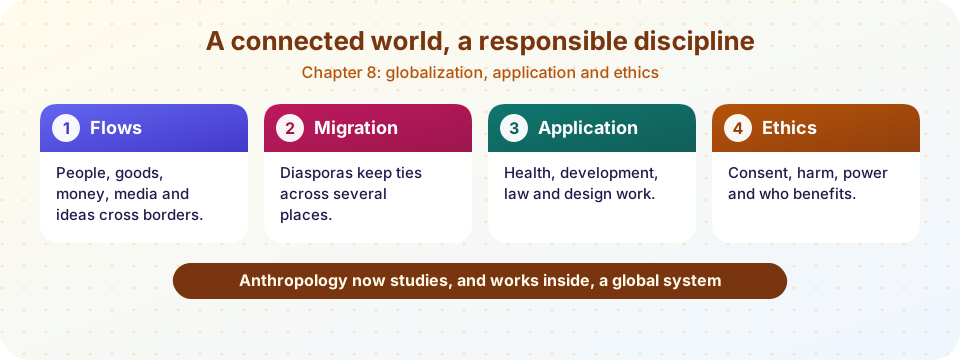
A map of chapter 8: global flows, migration, applied work in health and development, and the ethics of anthropology, with a visual overview and a remittance calculator.
The classic image of anthropology is a researcher in a remote village. Today the village has mobile phones, migrants working abroad and products from distant factories. A farmer in one country may sell crops by phone to a buyer in another; a family may live in three countries at once. Anthropologists follow these connections and ask how people make their lives within them.
This chapter has three parts. First, how global flows of people, goods, money and ideas shape local lives. Second, how anthropologists apply their knowledge in health, development and other fields. Third, the ethical questions that come with the discipline's history and power.
What you will learn
- Why anthropologists study connections between places, not only single communities.
- What "applied anthropology" means and where it is practiced.
- Why ethics and decolonizing questions are central today.
Key terms
Globalization: the growing flow of people, goods, money, media and ideas across borders.
Diaspora: a population living away from its homeland while keeping ties to it.
Applied anthropology: using anthropological methods and knowledge to address practical problems.
Remittances: money that migrants send to family in their home countries.
Decolonizing: examining and changing the colonial legacies in research, institutions and knowledge.
Global flows
Local effects
Applied work
Ethics
What each lesson covers
- Globalization and migration covers Appadurai's scapes, Mintz on sugar, diaspora, hybridity, and a cultural-diffusion model.
- Applied health and development covers medical anthropology, Kleinman's explanatory models, structural violence, development critiques and forensic work.
- Ethics and decolonizing covers codes of ethics, famous controversies, consent, privacy and collaborative research.
- Chapter review pulls it together.
Common misconceptions
"Globalization makes all cultures the same." Global flows are real, but people adapt them locally and create new mixtures. Homogenization and diversity both occur.
"Applied anthropology means telling people what to do." Good applied work starts from local knowledge and priorities and treats communities as partners.
Try it
Remittances are a major flow of money for many families and countries. This calculator compares the yearly cost of transfer fees at different fee rates. The amounts and fee rates are example inputs, not data about any country. (The United Nations Sustainable Development Goals include a target to reduce remittance costs to below 3 percent.)
Press Run (or Ctrl + Enter) to see the console output here.
No output.
Press Run (or Ctrl + Enter) to see the console output here.
No output.
Check your understanding
Quick check · 4 questions
of 4 answered You scored / 4 · perfect!
-
1. What is a diaspora?
Diasporas maintain connections across borders. -
2. What are remittances?
They are a major global money flow. -
3. Which statement about globalization is more accurate?
People adapt global flows locally and create new forms. -
4. Applied anthropology is
Applied work covers health, development, law, business, design and more.
Summary
- Anthropologists now follow connections across places: people, goods, money, media and ideas.
- Globalization both homogenizes and creates new local forms.
- Applied anthropology uses the discipline's methods on practical problems, with communities as partners.
- Ethics and decolonizing questions shape how research is done.
Track your progress
Create a free account to tick off lessons and pick up where you left off on any device.
of Anthropology lessons completed