


















Lesson 38 of 45 · Globalization and Applied Anthropology
Applied Anthropology: Health, Development and Practice
See how anthropology is used in practice: disease versus illness, explanatory models, structural violence, development critiques and forensic work, with an outbreak model.
Anthropology is not only about understanding; it is also used. Applied anthropology means using anthropological concepts and methods, above all long, careful listening and attention to local meaning, to help solve practical problems. Applied anthropologists work in hospitals, aid agencies, schools, technology companies, museums, courts and archaeological firms. The shared claim is that programs fail when they ignore how people actually live.
This lesson covers two major areas, medical anthropology and development, and then looks briefly at forensic work and other practice.
What you will learn
- The difference between disease, illness and sickness.
- Kleinman's explanatory models and eight questions.
- How structural violence explains patterns of ill health.
- Why development projects often fail, according to Ferguson and Scott.
- What forensic and other practice fields look like.
Key terms
Medical anthropology: the study of health, illness and healing in cultural and social context.
Disease: a condition defined by biomedical science.
Illness: the lived experience of being unwell, including meaning and social effects.
Explanatory model: a person's account of what caused an illness and what should be done.
Participatory research: research designed with the people affected as partners.
Disease and illness
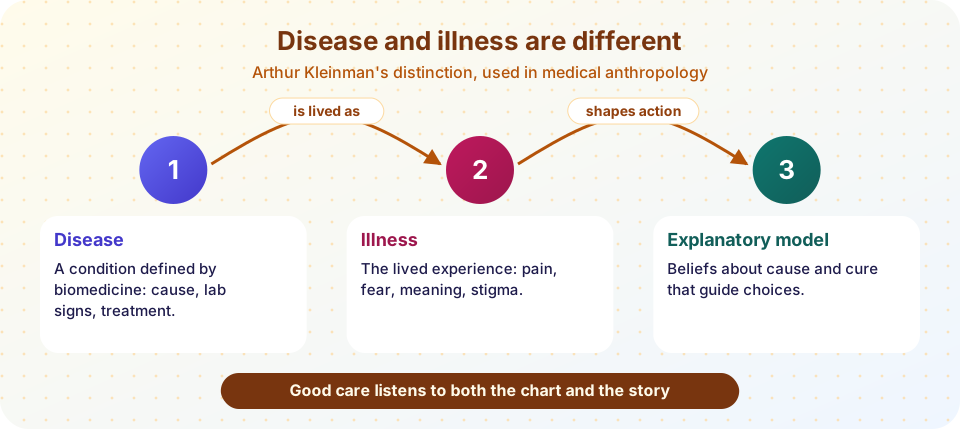
Arthur Kleinman, a psychiatrist and anthropologist, drew a now-classic distinction in the 1970s and 1980s. A disease is what biomedicine identifies, such as a tumor or an infection. An illness is how the sufferer and family perceive, name and cope with the problem. Two people with the same disease can have very different illnesses: one may see it as bad luck, another as a punishment or a family burden. Others added sickness, the social role of a person who is recognized as sick.
Kleinman proposed that clinicians ask about a patient's explanatory model. A short set of questions, adapted from his work, includes: What do you call the problem? What do you think caused it? Why did it start when it did? What does it do to you? How severe is it? What kind of treatment do you think you should receive? What results do you hope for? What are the chief problems it has caused? Even simple versions of these questions reveal why people skip medicines, delay care or mix treatments.
Medical anthropologists also point out that biomedicine itself is a cultural system, with its own beliefs, language and rituals, though it is also built on science that works. This is not a claim that all treatments are equal. It is a claim that care takes place between people, not only between a drug and a body.
Structural violence and global health
Paul Farmer, a physician and anthropologist, worked in rural Haiti and argued that patterns of disease follow patterns of poverty and power. Tuberculosis or HIV may spread because of housing, migration, trade and unequal access to treatment, not because of "culture" alone. He called such preventable harm structural violence. Nancy Scheper-Hughes's Death Without Weeping (1992) described how extreme poverty and loss in a Brazilian shantytown shaped mothers' responses to infant death, a study that provoked debate about interpretation.
Anthropologists also contributed during the 2014 to 2016 Ebola epidemic in West Africa. Funeral practices that involve washing and touching the dead were a route of transmission. Teams that included anthropologists helped health workers understand the meaning of those practices and negotiate safer ways to carry them out with dignity. The lesson often drawn is that people comply when measures respect what matters to them.
Development
Development means programs meant to improve incomes, health, education or infrastructure. Anthropologists have been both practitioners and critics.
James Ferguson's The Anti-Politics Machine (1990), about a development project in Lesotho, argued that the project failed at its stated goal of improving livelihoods yet had other effects: it expanded state bureaucracy and presented poverty as a technical problem instead of a political one. James C. Scott's Seeing Like a State (1998) described how planners simplify complex local life into things they can see and count, and how large schemes based on that simplification, such as forced villagization in Tanzania, can fail badly. Arturo Escobar's Encountering Development (1995) examined "development" itself as a way of speaking that creates its objects.
Many practitioners now use participatory approaches, in which communities help set goals, collect data and judge results. The test of good practice is whether local people can say no, change plans and benefit.
Other practice fields
- Forensic anthropology uses skeletal analysis to identify the dead. In 1984 the Argentine Forensic Anthropology Team began exhumations of people killed during the military dictatorship, an effort that has influenced human rights work elsewhere.
- Business and design anthropology studies how people use products and workplaces. Observation can reveal needs that surveys miss.
- Cultural resource management assesses archaeological sites before construction.
- Expert witness work includes immigration and land-rights cases, where anthropologists describe customs and histories for courts.
- Education and public policy use ethnography to understand schools and programs.
Common misconceptions
"Cultural beliefs are the main reason health programs fail." Poverty, distrust, distance, cost and poor service often matter more. Blaming culture can hide structural causes.
"Applied work is less rigorous than academic work." It uses the same methods but has to answer to the people affected as well as to scholars.
"Development is always good or always bad." Outcomes vary; careful evaluation and local voice decide.
Try it
First, a toy outbreak model. It uses a standard SIR model, in which people are Susceptible, Infected or Removed. We compare a situation with one transmission rate to a situation where culturally appropriate changes, such as safe burials, lower the rate. The numbers are invented for illustration and do not describe any real disease.
Press Run (or Ctrl + Enter) to see the result here.
Program input · what you'd type while the program runs
Type the answers before you press Run, one per line. Each time the program reads a line (with input()), it gets the next line from this box.
Second, a note-taking template based on Kleinman's questions. It prints a blank form that a clinician or researcher could fill in. It is a teaching template.
Press Run (or Ctrl + Enter) to see the console output here.
No output.
Check your understanding
Quick check · 5 questions
of 5 answered You scored / 5 · perfect!
-
1. What distinguishes illness from disease in Kleinman's terms?
Illness includes meaning and social effects; disease is the biomedical condition. -
2. What does 'structural violence' point to?
Farmer used it to explain patterns of illness linked to inequality. -
3. Which was a central argument of Ferguson's Anti-Politics Machine?
Ferguson showed unintended effects of a development project. -
4. What did anthropologists contribute in the West African Ebola epidemic?
Understanding the meaning of burials helped design safer, dignified practices. -
5. In the toy SIR model, lowering the transmission rate
A smaller rate flattens and delays the curve.
Summary
- Applied anthropology uses ethnography and local knowledge to address practical problems.
- Disease, illness and sickness are different; explanatory models help care fit lives.
- Structural violence links ill health to poverty and power.
- Development critiques (Ferguson, Scott, Escobar) warn against simplification and depoliticization; participation is a remedy.
- Forensic, design, resource-management and expert-witness work are other applications.
Track your progress
Create a free account to tick off lessons and pick up where you left off on any device.
of Anthropology lessons completed