


















Lesson 24 of 45 · Kinship, Family and Social Organization
Marriage, Family and Household Across Cultures
Compare marriage rules, incest taboos, alliance theory, bridewealth and dowry, plural marriage, and household types, with the Nayar, Mosuo and Nuer cases.
Marriage looks simple until you ask what it does. Is it a romance, a legal contract, a religious bond, a way to have children, or a treaty between two groups? Societies answer differently, and anthropologists found that no single definition fits everywhere. Edmund Leach suggested in 1955 that marriage is best seen as a bundle of rights that different societies bundle in different ways: sexual access, legitimacy of children, property, labor, residence and in-law relationships.
Once you see marriage as a bundle, many puzzles become easier. A woman can marry another woman among the Nuer and become the legal "father" of her wife's children. In the Himalayas, brothers may share one wife. In parts of South Asia, a bride's family pays a dowry. None of these is strange from within; each solves a local problem about people, property and groups.
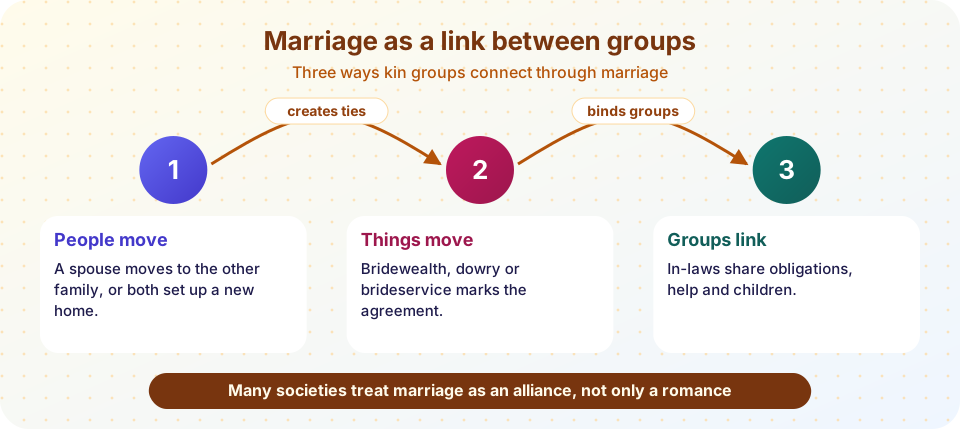
What you will learn
- Exogamy, endogamy and the incest taboo, with the main theories.
- Alliance theory and its critics.
- Bridewealth, dowry and brideservice.
- Monogamy, polygyny and polyandry, and why plural marriage has costs and benefits.
- Household and family types, and what new kinship studies add.
Key terms
Exogamy: marrying outside a defined group (a lineage, clan or village).
Endogamy: marrying inside a defined group (a caste, ethnic group or religion).
Bridewealth: goods or money given by the groom's side to the bride's kin.
Dowry: property given with the bride, by her family, to the couple or the groom's family.
Polygyny / polyandry: one husband with several wives / one wife with several husbands.
Household: people who share a home and daily resources.
Who marries whom
Every society has rules about who is and is not a suitable partner. Exogamy and endogamy work as two sides of one rule: you marry out of one circle (often the descent group) and often within another (the caste or religion).
The strongest rule is the incest taboo, a ban on marriage or sex between close kin that exists in some form in every known society, although who counts as "close" varies. Theories compete.
- Westermarck proposed that people raised together in childhood lose sexual interest in each other. Arthur Wolf's study of Taiwanese "minor marriages," where a girl was raised in her future husband's home, found those couples had fewer children and more divorces, which supports the idea.
- Freud proposed a psychological explanation based on childhood desire. Few anthropologists accept it.
- Lévi-Strauss argued in The Elementary Structures of Kinship (1949) that the taboo is mainly social: it forces families to give away partners and so builds alliances.
Those ideas are not mutually exclusive. Studies of inbreeding depression add a biological reason why avoiding close kin might be favored.
Alliance theory and its critics
For Lévi-Strauss, marriage is exchange between groups. In restricted exchange, two halves swap spouses; in generalized exchange, group A gives to B, B to C and C back to A. Any such cycle ties many groups together.
His description of women as the items exchanged was criticized by feminist anthropologists, who pointed out that women are actors and not only objects of transfer and that many societies describe exchange more evenly. Alliance theory remains a useful idea: marriage creates affines, relatives by marriage, and those links hold a society together.
What passes between families
Bridewealth (also called bride price, though many scholars dislike that term because it suggests purchase) is common in Africa and parts of Oceania. Among the Nuer it is paid in cattle, spread across many kin and often returnable if the marriage ends. Many cultures see it as compensation for the loss of a daughter's labor and as a way to tie families together.
Dowry moves the other way. It is usually found where property is inherited by sons and where marriage is linked to rank, as in parts of South Asia. In India, the dowry system has been illegal for decades yet persists, and has been linked to violence and pressure on brides' families.
Brideservice means the groom works for his wife's family for a period. It is documented among some foraging peoples, such as the Ju/'hoansi (!Kung).
How many spouses
Monogamy is the only legal form in many countries and the most common in practice everywhere. Polygyny is permitted in a large majority of the societies in Murdock's Ethnographic Atlas, but even there most marriages are monogamous because few men can afford several wives. Polyandry is rare. Among the Nyinba of Nepal, described by Nancy Levine, brothers marry one woman, which keeps land from being divided.
A simple count shows why polygyny has limits. When the numbers of men and women are about equal, each man with two wives means another man has none, which feeds competition and later marriage for men.
Beyond the usual cases
The Nayar of Kerala, described by Kathleen Gough, combined ritual marriage with visiting partners, so a child's social father was often unclear. This made scholars question the claim by George Murdock (1949) that the nuclear family is universal. Among the Mosuo of southwestern China, who trace descent through women, adults traditionally stay in their mother's household and have visiting partners at night, a practice often called "walking marriage". Researchers disagree about how to describe their relationships, partly because of tourism and state pressure. Cases like these are why anthropologists look carefully at each society's own terms.
Households and family types
A household is the practical unit: who shares the dwelling, meals and budget. A family is a kin group. They can coincide or not. Common household forms are nuclear (a couple and children, or one parent and children), extended (adding relatives such as grandparents), joint (siblings and their families together), and single-person or non-kin households.
A popular story claims industrialization broke up large families into nuclear ones. Peter Laslett and the Cambridge Group for the History of Population and Social Structure examined parish records and found that nuclear households were already dominant in much of northwestern Europe long before the industrial age. Household forms follow economy, housing and politics, not a single historical line.
New kinship studies
David Schneider's American Kinship (1968) argued that Americans see kinship as "blood" plus "law", and his 1984 critique questioned whether "kinship" is a universal category at all. Janet Carsten and others replaced it with relatedness: the ways people become kin through feeding, living together, sharing substance, adoption or assisted reproduction. This approach helps study adoption, step-families, chosen families and new reproductive technologies.
Common misconceptions
"Bridewealth means women are bought." Most societies that use it treat it as a transfer that creates obligations and recognizes children's rights, and it is often shared across many relatives and can be returned. Participants often reject the "purchase" description.
"Polygyny means men have many wives." Most men in polygynous societies have one wife, and many have none for part of their lives.
"The nuclear family is the natural unit and large families are older." Historical data show that nuclear households were common well before industrialization.
Try it
The first demo does the arithmetic from the "How many spouses" section. If men and women are equal in number and every woman is married, a fraction p of men with two wives leaves p of all men unmarried. This is a simplified model, because real populations have age gaps and delayed marriage.
Press Run (or Ctrl + Enter) to see the console output here.
No output.
The second demo classifies a few invented households into the types above. Each household lists members by their relationship to the head.
Press Run (or Ctrl + Enter) to see the result here.
Program input · what you'd type while the program runs
Type the answers before you press Run, one per line. Each time the program reads a line (with input()), it gets the next line from this box.
Check your understanding
Quick check · 5 questions
of 5 answered You scored / 5 · perfect!
-
1. What did Edmund Leach propose about marriage?
Leach argued no single feature defines marriage everywhere; societies bundle rights such as sexual access, legitimacy and property in different ways. -
2. Which pair describes Lévi-Strauss's view of the incest taboo?
In alliance theory the taboo drives exchange between groups. -
3. Where is dowry most characteristic?
Dowry moves from the bride's family and appears where inheritance and status are tied to sons. -
4. What did the Cambridge Group's research on English households show?
Parish records showed nuclear households were already dominant in much of northwestern Europe. -
5. Why do anthropologists use the term 'relatedness'?
Relatedness widens kinship beyond blood and law to include how people make each other kin.
Summary
- Marriage is a bundle of rights; no single definition covers every society.
- Exogamy and endogamy are circles of eligible partners; the incest taboo has social, psychological and biological explanations.
- Alliance theory sees marriage as exchange between groups, though critics question its focus on women as items.
- Bridewealth, dowry and brideservice move goods or labor and mark relationships.
- Households may be nuclear, extended, joint or non-kin, and they are shaped by economy and politics.
- New kinship studies stress relatedness as something people do.
Next: Chapter 5 review
Track your progress
Create a free account to tick off lessons and pick up where you left off on any device.
of Anthropology lessons completed