


















Lesson 35 of 45 · Language, Religion and Art
Chapter 7 Review: Language, Religion and Art
Review chapter 7 with a one-picture summary, a recap table, a self-check tool and a ten-question quiz on language, ritual, belief, art and material culture.
Chapter 7 followed meaning through three systems: language, ritual and religion, and art and objects. Read the picture, scan the table and take the quiz before you look back at the lessons.
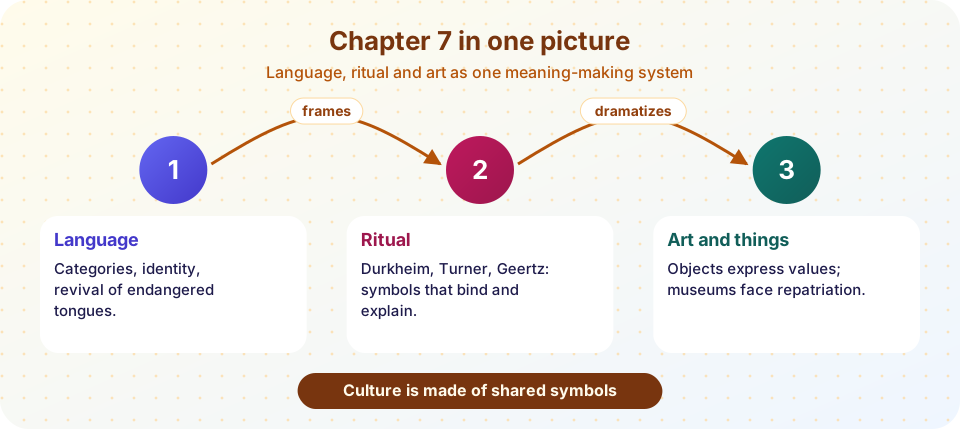
The chapter in a table
| Topic | Key idea | Names and cases |
|---|---|---|
| Linguistic relativity | Weak influence on attention, not a prison | Sapir, Whorf, Malotki |
| Color terms | A proposed sequence of basic terms, later revised | Berlin and Kay |
| Directions | Absolute versus relative frames of reference | Guugu Yimithirr, Levinson |
| Speech in context | Register, code-switching, honorifics | Hymes |
| Language endangerment | Shift and revival | Kōhanga Reo, Pūnana Leo |
| Religion | Social solidarity, uncertainty, explanation, symbols | Durkheim, Malinowski, Evans-Pritchard, Geertz |
| Rites of passage | Separation, liminality, incorporation | Van Gennep, Turner |
| Art | Skill, agency and meaning | Boas, Gell |
| Objects | Biographies, tourist art, repatriation | Kopytoff, Appadurai, NAGPRA |
Try it
Check yourself with a simple tracker. Replace the numbers with your quiz scores.
Press Run (or Ctrl + Enter) to see the result here.
Program input · what you'd type while the program runs
Type the answers before you press Run, one per line. Each time the program reads a line (with input()), it gets the next line from this box.
Check your understanding
Quick check · 10 questions
of 10 answered You scored / 10 · perfect!
-
1. Most researchers today accept which version of linguistic relativity?
Weak relativity has some empirical support; strong determinism does not. -
2. What do Guugu Yimithirr speakers use to describe locations?
They use compass-like terms regardless of which way they face. -
3. What is code-switching?
Speakers shift languages for social and expressive reasons. -
4. According to Durkheim, what does collective effervescence do?
Gathering in ritual produces a feeling of unity that strengthens the group. -
5. Malinowski connected magic with
Magic clustered around risky, uncertain activities such as open-sea fishing. -
6. Which is the correct order of Van Gennep's phases?
People leave an old status, pass through an in-between phase and join the new status. -
7. Evans-Pritchard showed that Azande witchcraft beliefs
They answer 'why me, why now' alongside ordinary causes. -
8. Gell asked of art:
Gell treated art as a system of action that affects people. -
9. What does NAGPRA govern?
The 1990 law created a process for repatriation in the United States. -
10. Language shift is best described as
Shift happens as children stop learning the heritage language.
Summary
- Language shapes attention gently; context, register and ideology shape speech.
- Religion and ritual provide explanation, solidarity, ways to manage uncertainty and change of status.
- Art and objects express identity, hold memory, build relations and can act.
- Debates over repatriation connect meaning to power and ownership.
Next: Chapter 8 Overview: Globalization and Applied Anthropology
Track your progress
Create a free account to tick off lessons and pick up where you left off on any device.
of Anthropology lessons completed