


















Lesson 26 of 45 · Economy, Politics and Power
Chapter 6 Overview: Economy, Politics and Power
A map of chapter 6: how people make a living, exchange goods, organize authority and handle inequality, with a visual overview and a Gini calculator.
People everywhere must answer three practical questions. How do we get food and goods? Who decides when we disagree? Who gets more, and who gets less? Anthropologists study the answers together because they are tangled: a family that shares meat also shares obligations, and a chief who collects tribute also organizes feasts. In small communities the "economy" and "politics" are not separate institutions with their own buildings; they are woven into kinship, religion and daily courtesy.
Chapter 6 looks at livelihoods and exchange, then at authority from bands to states, and finally at inequality and resistance.
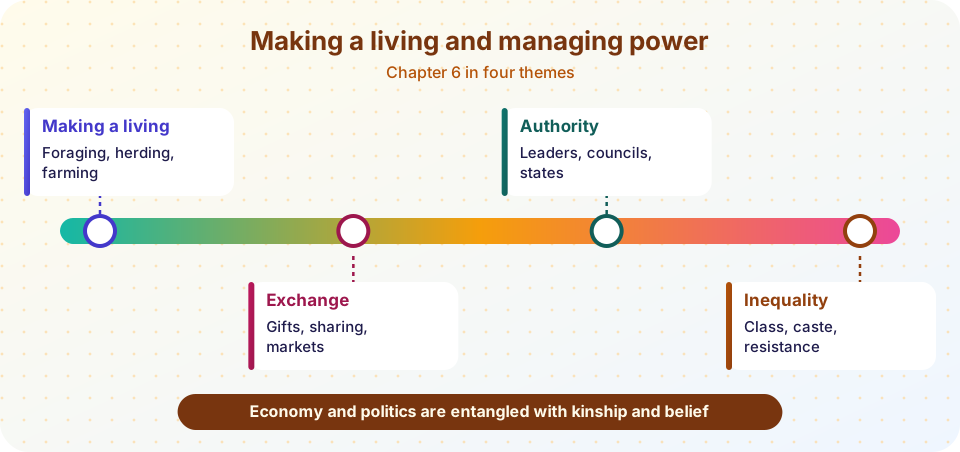
What you will learn
- How anthropologists study economies as social relationships, not only prices.
- The major subsistence strategies and the main modes of exchange.
- How leadership and political organization vary, from consensus to states.
- Why inequality and resistance are central questions.
Key terms
Subsistence strategy: how a society mainly gets food: foraging, herding, horticulture, agriculture, industry.
Reciprocity: giving and returning goods or services within social relationships.
Redistribution: goods collected by a center, such as a chief, then shared out.
Authority: power that people accept as legitimate.
Structural violence: harm built into social structures, such as unequal access to health care.
Making a living
Exchange
Authority
Inequality
What each lesson covers
- Subsistence and exchange covers foraging to farming, Malinowski's kula, Mauss on gifts, Sahlins's reciprocity and Polanyi's modes of exchange.
- Authority and states covers bands, tribes, chiefdoms and states, big men, and the critique of the evolutionary ladder.
- Inequality and resistance covers class, caste, race, gender, hegemony and everyday resistance.
- Chapter review gives the summary and a quiz.
Common misconceptions
"Small-scale societies have no economy or politics." They have both. The institutions are embedded in kinship and ritual rather than separated.
"Societies move up a single ladder from bands to states." The types are useful descriptions, but history shows many routes, reversals and mixtures.
Try it
A common measure of inequality is the Gini coefficient, where 0 means everyone has the same and values near 1 mean one person has almost everything. This calculator applies the formula to lists you supply. The three lists are invented teaching examples, not data about any real group.
Press Run (or Ctrl + Enter) to see the console output here.
No output.
Press Run (or Ctrl + Enter) to see the console output here.
No output.
Check your understanding
Quick check · 4 questions
of 4 answered You scored / 4 · perfect!
-
1. Which pair is a correct example of structural violence?
Structural violence is harm caused by social arrangements, not by an individual attacker. -
2. What does a Gini coefficient of 0 mean?
Zero means every person has the same amount. -
3. Why do anthropologists say economy and politics are 'embedded' in small societies?
Institutions are not separate; exchange and authority work through social relationships. -
4. Redistribution means
A chief, temple or state collects and then distributes goods.
Summary
- Economy, politics and inequality are linked and, in small communities, embedded in kinship and ritual.
- Subsistence strategies and exchange modes shape each other and social life.
- Authority ranges from consensus to states, with many mixed forms.
- Inequality and resistance are central questions of the chapter.
Next: Subsistence and exchange
Track your progress
Create a free account to tick off lessons and pick up where you left off on any device.
of Anthropology lessons completed