


















Lesson 22 of 45 · Kinship, Family and Social Organization
Descent Groups: Lineages, Clans and Descent Rules
Learn how descent rules sort people into lineages and clans, with the Nuer, Trobriand, Minangkabau and Yakö cases, plus a runnable family-tree demonstration.
A descent rule tells you which of your ancestors count for group membership. In a society with strong descent groups, the rule can decide where you may live, whom you may marry, what land you may farm and whose spirits you honor. In the United States and most of Europe the rule is looser: you are related to both sides and no group is handed down. Both patterns are normal human solutions.
This lesson sorts descent systems, introduces the groups they create and looks at two classic problems: how groups hold together without a state, and why matrilineal societies are not the mirror image of patrilineal ones.
What you will learn
- The main descent systems: patrilineal, matrilineal, double, bilateral and ambilineal.
- The difference between a lineage, a clan and a moiety.
- What descent groups do: land, marriage rules, mutual help and ritual.
- Why segmentary lineages can organize a society without rulers.
- Why the "matrilineal puzzle" shows that matriliny is not "women ruling".
Key terms
Unilineal descent: membership passes through one sex only, either the male line (patrilineal) or the female line (matrilineal).
Lineage: a descent group whose members can trace links to a known common ancestor.
Clan: a larger descent group whose members claim common ancestry but often cannot trace every link, sometimes symbolized by a totem.
Moiety: one of two halves into which a whole society is divided.
Cognatic (bilateral) descent: descent traced through both parents with no single line deciding membership.
The main systems
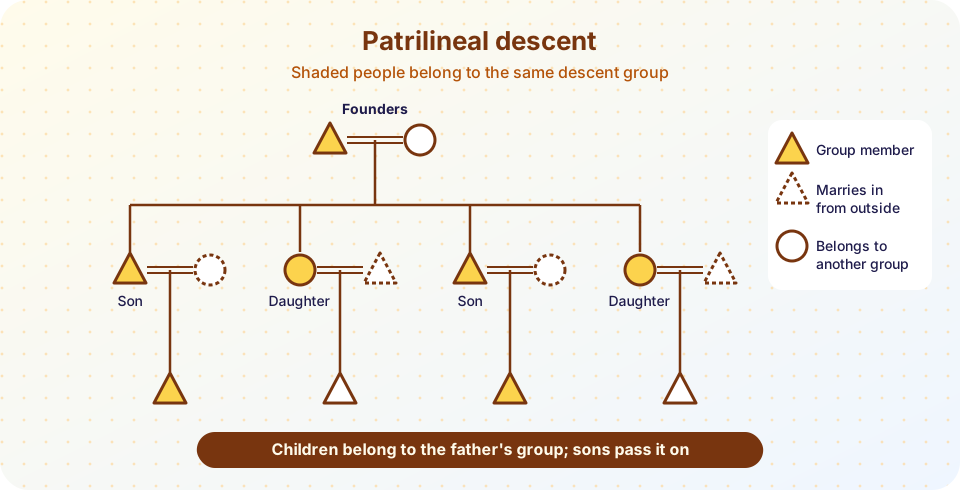
Patrilineal descent follows the male line. You belong to your father's group, he belonged to his father's, and so on. Daughters belong to the group too, but their children join their husbands' groups. The Nuer, cattle herders of the Nile region in South Sudan, are the classic example from E. E. Evans-Pritchard's The Nuer (1940).
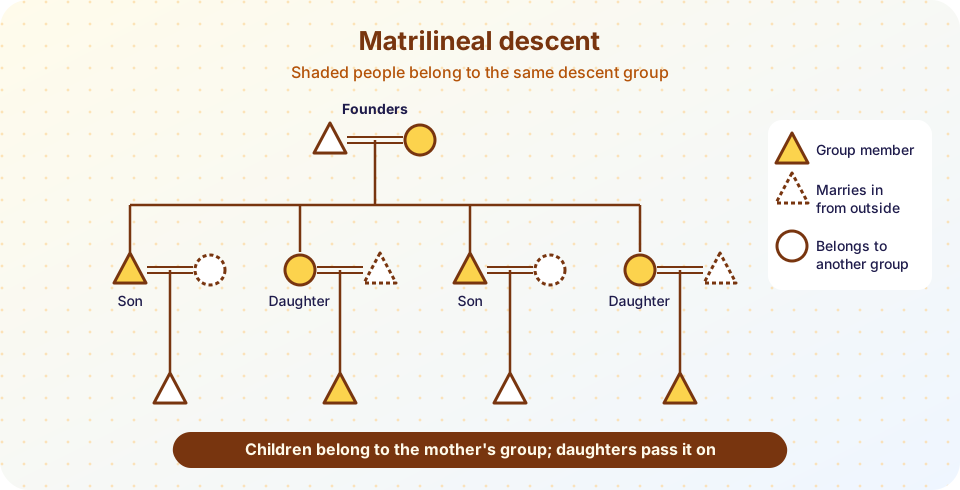
Matrilineal descent follows the female line. You belong to your mother's group, and your mother's brother's children do not. Examples include the Minangkabau of West Sumatra, the Akan (including Asante) of Ghana, the Trobriand Islanders studied by Bronislaw Malinowski, and the Haudenosaunee (Iroquois) with their clan mothers. Look at the matrilineal version of the chart:
Double descent uses both lines for different purposes. Daryll Forde's study of the Yakö of southeastern Nigeria described patrilineal groups for land and matrilineal groups for movable property. A person belongs to both at once.
Bilateral (cognatic) descent counts both parents equally. Each person belongs to a personal kindred, a network that is different for every person except full siblings. This is typical in North America and Europe, and in many foraging societies.
Ambilineal descent lets a person choose to affiliate with the father's or the mother's group. Several Pacific societies have been described this way, though real practice is often flexible and descriptions differ among scholars.
Lineage, clan and moiety
A lineage is a descent group in which members can name every link back to a shared ancestor. Lineages usually reach only a few generations. A clan is a bigger group that believes in descent from a common founder, sometimes a mythical or animal ancestor (a totem), without being able to show all the links. Several clans can form a phratry, and a society split into two halves has moieties.
These groups can be corporate: they own land, cattle or ritual rights as a unit, outlast any single member, and act together. They often require exogamy, which means you must marry outside your group. Then the group stays together by descent and links outward by marriage, a theme the next lessons follow.
Order without a state: segmentary lineages
Evans-Pritchard argued that the Nuer had no chief or government, yet people knew whom to support in a dispute. Lineages split into smaller and smaller branches. Two branches quarrel with each other, but face an outsider as one. An often-quoted Arab proverb sums up the logic: me against my brother, my brother and I against my cousin, and so on out to the tribe against the foreigner. This is called a segmentary lineage system. Paul Bohannan described a similar structure among the Tiv of Nigeria. Later scholars questioned how far real behavior followed the model, since people also used marriage, friendship and political strategy. Treat the idea as a powerful model, not a perfect description.
The matrilineal puzzle
It is tempting to assume that matrilineal societies are the mirror image of patrilineal ones, with women in charge. Audrey Richards, studying the Bemba of Zambia, showed otherwise. In many matrilineal groups, authority over a child belongs to the mother's brother, not the mother and not the father. A man is a husband and father in one household and an uncle and heir in his sister's. Richards called the resulting conflict of loyalties the matrilineal puzzle. Societies solve it in different ways: some move the husband to his wife's village, some let husbands live with their own kin and visit, some blend arrangements.
Matriliny can give women real security and voice in property and ritual. Among the Minangkabau, houses and rice land pass through women, while men often hold religious and political roles and the culture also stresses Islamic law. Authority and descent are separate questions.
Why do societies differ?
Scholars have proposed links between descent rules and livelihoods. Patriliny is often found where men defend herds or land, and matriliny where women's farming is central and men travel or trade. These are tendencies with many exceptions, and nobody has a single theory that explains them all. Be cautious about any simple rule.
Common misconceptions
"Matrilineal means matriarchal." Descent traces group membership; power can remain with men, as with the mother's brother. True matriarchies, where women hold most public authority, are rare or absent in the ethnographic record.
"Descent groups are the same as families." A lineage can include hundreds of people and live in many places. A family or household is a smaller, everyday unit.
"Bilateral means no groups." Bilateral societies still use kindreds, neighborhoods, churches and workplaces. Descent groups are one way to organize, not the only way.
Try it
First, a small demonstration. This family tree uses invented names. The code decides who is in the founder's descent group under three rules. Compare the printed sets with the two charts above.
Press Run (or Ctrl + Enter) to see the result here.
Program input · what you'd type while the program runs
Type the answers before you press Run, one per line. Each time the program reads a line (with input()), it gets the next line from this box.
Second, a model of group growth. Each member has a random number of children and each child is male or female with equal chance. Under a patrilineal rule, only a man's children join the group. Under a matrilineal rule, only a woman's. This is a toy model with invented numbers.
Press Run (or Ctrl + Enter) to see the result here.
Program input · what you'd type while the program runs
Type the answers before you press Run, one per line. Each time the program reads a line (with input()), it gets the next line from this box.
Both rules behave the same on average. The difference is which people carry the line forward. A lineage can die out simply because a founding line had too few children of the carrying sex.
Check your understanding
Quick check · 5 questions
of 5 answered You scored / 5 · perfect!
-
1. In a patrilineal system, which of a man's grandchildren belong to his descent group?
Group membership passes through men, so a son's children belong, while a daughter's children belong to her husband's group. -
2. What distinguishes a lineage from a clan?
Lineages have demonstrated descent, while clans claim common ancestry that can be symbolic or mythical. -
3. What did Audrey Richards call the conflict between a man's roles as husband-father and as uncle-heir in matrilineal societies?
In matrilineal groups, authority often rests with the mother's brother, creating competing loyalties for men. -
4. The Yakö of Nigeria are the classic example of which system?
Forde described Yakö people as belonging to patrilineal and matrilineal groups at the same time, for different kinds of property. -
5. Which statement about matrilineal societies is supported by the evidence discussed here?
Matriliny describes group membership, not who rules.
Summary
- Descent rules decide membership: patrilineal, matrilineal, double, bilateral or ambilineal.
- Lineages trace known links; clans claim shared ancestry; moieties split a society in two.
- Descent groups often own land, require exogamy and organize help and ritual.
- Segmentary lineages can create order without rulers, though real life is messier than the model.
- Matriliny does not mean matriarchy; the matrilineal puzzle shows why.
Track your progress
Create a free account to tick off lessons and pick up where you left off on any device.
of Anthropology lessons completed