


















Lesson 40 of 45 · Globalization and Applied Anthropology
Chapter 8 Review: Globalization and Applied Anthropology
Review chapter 8 with a one-picture summary, a recap table, a self-check tool and a ten-question quiz on global flows, migration, applied work and ethics.
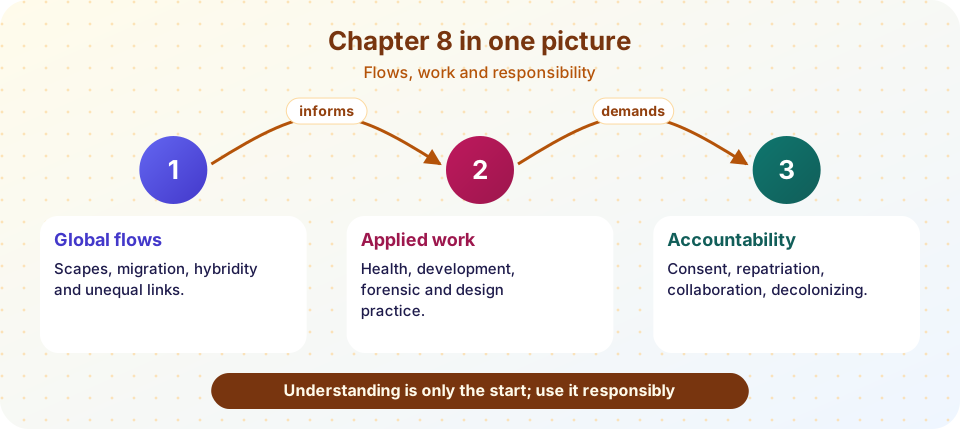
Chapter 8 moved from global connections to practical work and to the ethics of doing research. Use this page to review. Look at the picture, scan the table, then take the quiz before returning to the lessons.
The chapter in a table
| Topic | Key idea | Names and cases |
|---|---|---|
| Old connections | Societies were never isolated | Wolf |
| Scapes | Five channels of global flow | Appadurai |
| Commodity chains | Products link distant lives | Mintz (sugar), Tsing (matsutake) |
| Transnationalism | Ties across borders; remittances | Glick Schiller, Ong |
| Hybridity | Mixing creates new forms; local adaptation | García Canclini, Watson |
| Medical anthropology | Disease versus illness; explanatory models | Kleinman |
| Structural violence | Harm built into social arrangements | Farmer, Scheper-Hughes |
| Development critique | Simplification and depoliticization | Ferguson, Scott, Escobar |
| Ethics | Do no harm, consent, share benefits | AAA codes; Camelot; Yanomami; Havasupai |
| Decolonizing | Community authority and benefit | Asad, Harrison, Smith; OCAP, CARE |
Try it
A short self-check tool. Replace the numbers with your own quiz scores.
Press Run (or Ctrl + Enter) to see the result here.
Program input · what you'd type while the program runs
Type the answers before you press Run, one per line. Each time the program reads a line (with input()), it gets the next line from this box.
Check your understanding
Quick check · 10 questions
of 10 answered You scored / 10 · perfect!
-
1. What was Eric Wolf's point about 'people without history'?
Wolf argued that no society was truly isolated. -
2. Which scape describes the flow of money?
Financescapes cover global capital and currency flows. -
3. Mintz's Sweetness and Power traced
He showed how a commodity linked colonial labor and industrial life. -
4. Hybridity refers to
Cultures borrow and recombine, producing hybrids. -
5. A disease differs from an illness because
Kleinman's distinction separates the biomedical from the experiential. -
6. Ferguson's Anti-Politics Machine argued that a development project in Lesotho
He described unintended effects that depoliticized poverty. -
7. Which case involved blood samples used beyond what participants understood?
The case settled in 2010 and highlighted purpose-specific consent. -
8. Which is a reason anonymity is difficult in small communities?
Even without names, details can single out individuals. -
9. OCAP principles were developed by
They set out ownership, control, access and possession of community data. -
10. Decolonizing research mainly asks for
It changes who sets the questions, who owns the results and who benefits.
Summary
- Global flows are old but now faster; scapes, commodity chains and transnational ties help describe them.
- Hybrid and glocal forms arise as people rework global elements.
- Applied anthropology uses local knowledge in health, development and other fields.
- Ethics rests on harm avoidance, consent, sharing benefits and respecting community authority.
Track your progress
Create a free account to tick off lessons and pick up where you left off on any device.
of Anthropology lessons completed