


















Lesson 16 of 45 · Culture and Fieldwork
Chapter 4 Overview: Culture and Fieldwork
Preview chapter four: what anthropologists mean by culture, how long fieldwork turns daily life into evidence, and the loop of arriving, observing, interviewing, recording, analyzing and writing.
So far you have looked at humans as bodies and as makers of tools. This chapter turns to the part of the discipline most people picture first: culture and the way anthropologists study it, fieldwork. The two belong together. Culture is a very abstract word until you watch how a real person, in a real kitchen or market or classroom, does something that other people around them do too.
This overview introduces both ideas, explains why fieldwork takes so long, and previews the lessons ahead.
What you will learn
- A first working meaning of "culture" and why the word is used with care.
- What fieldwork is and why it usually takes months or years.
- The loop of activities in a field project.
- What each lesson in this chapter covers.
Key terms
Culture: the learned and shared ways of thinking, feeling and acting of a group, along with the meanings they give them.
Fieldwork: research carried out among the people being studied, in the places where they live and work.
Participant observation: taking part in people's daily life while carefully observing it.
Informant (or interlocutor): a person who teaches the researcher about their way of life.
Rapport: a relationship of mutual trust and ease.
Culture, in a first sketch
You will study the concept properly in the culture concept. For now, think of culture as everything you learned from other people rather than from your genes: the language you speak, what you eat for breakfast, how close you stand to a stranger, what you think is funny or holy. Three things make it different from instinct:
- It is learned, usually in childhood but throughout life.
- It is shared: you know that most people around you do the same things and understand the same signals.
- It is meaningful: actions stand for something. A raised hand can be a greeting, a vote or a question.
Cultures are not sealed boxes. They overlap and change, and individuals within them differ. A country does not have one culture, and one person can move between several.
Why fieldwork?
Suppose you wanted to understand how families in a neighborhood decide who looks after an elderly relative. A survey could count how many families do what. But numbers would not tell you why people feel obliged, what words they use for duty, how siblings argue, or what happens when plans break down. For that you need to be there, over time, until you understand the daily life well enough to see what the numbers hide.
Anthropologists therefore spend long periods in a place. The traditional benchmark is a year or more, long enough to see a full cycle of seasons, festivals and ordinary weeks, and to learn the local language. Short projects, multi-site studies and online fieldwork exist too, but they share the same aim: understand people from the inside, in their own terms (the emic view from chapter 2).
The fieldwork loop
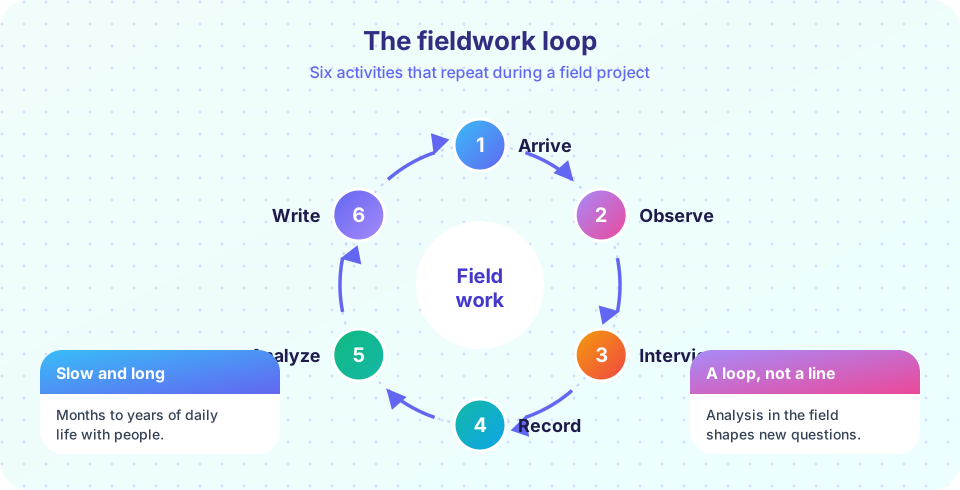
A field project is not a straight line. It is a loop that repeats:
- Arrive: arrange permission, find a place to live and a way in, and learn the basics.
- Observe: watch and take part; see what people do, not only what they say.
- Interview: hold conversations, from casual chat to structured questions.
- Record: write field notes, make recordings and collect documents.
- Analyze: look for patterns and puzzles while still in the field.
- Write: turn it into an account for others, and share it back where possible.
Analysis in step 5 sends you back to step 2 with sharper questions. That is why researchers do not simply collect data and leave.
Chapter 4 at a glance
Four lessons that build on one another.
What makes fieldwork different
Depth beats speed.
What can go wrong
Good researchers name these risks.
What is in this chapter
- The culture concept: five pillars (learned, shared, symbolic, patterned, changing), culture and biology, and cultural transmission.
- Participant observation: the spectrum of roles, building rapport, key informants and interviewing.
- Fieldwork ethics and writing: informed consent, protecting people, field notes and how to write an ethnography.
- Chapter review: a cheat sheet and a ten-question quiz.
Common misconceptions
"Fieldwork means living in a remote jungle village." It can be in a hospital, a factory, a city block or an online community.
"The anthropologist is a neutral camera." Researchers are people: their age, gender, nationality and manner shape what happens. Good fieldworkers think about this openly.
"Culture is the same as nationality." A country contains many cultures and subcultures, and cultures cross borders.
Try it
Step through the fieldwork loop and read a one-line example for each step. The example project is invented: a study of how a neighborhood bakery builds regular customers.
Now a tiny example of the analysis step. These ten short comments are invented. The code counts how often each theme appears, the simplest form of "coding" qualitative notes.
Press Run (or Ctrl + Enter) to see the result here.
Program input · what you'd type while the program runs
Type the answers before you press Run, one per line. Each time the program reads a line (with input()), it gets the next line from this box.
Check your understanding
Quick check · 4 questions
of 4 answered You scored / 4 · perfect!
-
1. What does participant observation mean?
It combines being there and joining in with careful watching. -
2. Why does classic fieldwork usually take a year or more?
Depth of understanding takes time. -
3. Which is the correct order of the first three steps in the fieldwork loop?
You arrive first, then observe and interview; analysis sends you back to observe. -
4. Which statement about culture is correct?
Cultures overlap and change, and they are learned.
Summary
- Culture means learned, shared, meaningful ways of life; it is not nationality or genes.
- Fieldwork is research among people, in their places, usually over a long time.
- The fieldwork loop (arrive, observe, interview, record, analyze, write) repeats, with analysis shaping new questions.
- Researchers' own position shapes fieldwork, so good practice names it.
Next: The Culture Concept
Track your progress
Create a free account to tick off lessons and pick up where you left off on any device.
of Anthropology lessons completed