


















Lesson 39 of 45 · Globalization and Applied Anthropology
Ethics and Decolonizing Anthropology: Consent, Harm and Power
Learn the ethics of anthropological research: do no harm, informed consent, anonymity in small communities, famous controversies, indigenous data principles and decolonizing methods.
Anthropologists enter other people's lives, ask personal questions and write about what they learn. That creates power and responsibility. The discipline also grew up alongside colonial rule: early fieldworkers often depended on colonial officials, collected objects and bones without consent and wrote about people as specimens. Modern anthropology tries to face that history and to change how research is done.
This lesson covers the main ethical principles, a few controversies that shaped them, the special problem of anonymity in small communities and the movement to decolonize research.
What you will learn
- The central ethical principles in anthropology's professional codes.
- Why informed consent in ethnography is ongoing and hard to standardize.
- What the Project Camelot, Human Terrain, Yanomami and Havasupai cases teach.
- Why anonymity is difficult in small communities and online.
- What decolonizing research and indigenous data principles ask for.
Key terms
Informed consent: agreement to take part after understanding what the research involves, which can be withdrawn.
Positionality: a researcher's own background and position, and how it shapes what they see.
Reflexivity: examining how the research process and the researcher affect the results.
Free, prior and informed consent (FPIC): the principle that Indigenous peoples must agree, before a project starts and without pressure, to activities that affect them.
Data sovereignty: a community's right to govern the collection and use of data about it.
Core principles
The American Anthropological Association (AAA) and other professional bodies publish codes of ethics. Their themes are similar.
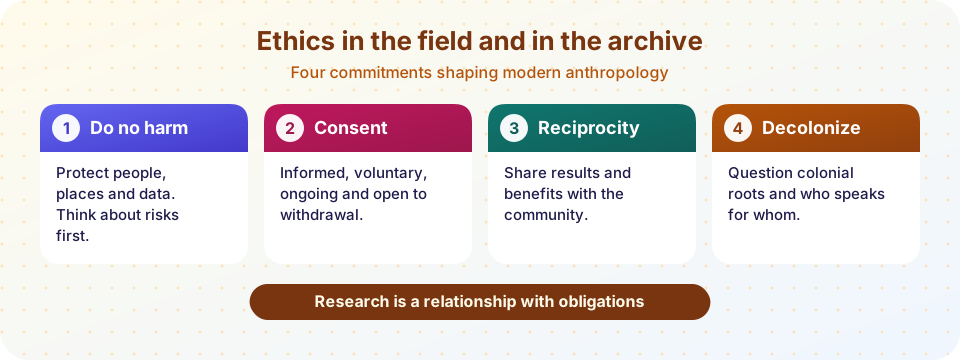
- Do no harm. Researchers must think about risks to participants, communities and the places they study, including safety, reputation, legal trouble and loss of resources. When interests conflict, the participants' safety comes first.
- Be open about your work. Explain who you are, who funds you and what you intend.
- Obtain informed consent. Consent should be voluntary, based on understanding and open to withdrawal. In ethnography it often develops over months in conversation rather than through a single signed form. In places where literacy is limited or a form creates fear, researchers may use spoken consent.
- Weigh obligations. Duties to participants, to the public, to colleagues and to funders can conflict.
- Share results and benefits. Findings should return to the community in useful form.
- Protect records. Notes and recordings must be stored safely.
Professional codes guide but do not replace judgment, and institutional review boards sometimes struggle to apply medical models to ethnography.
Controversies that shaped the field
- Project Camelot (1964 to 1965). The US Army funded a social science study in Latin America, starting in Chile, about the causes of political instability. When the military sponsorship became public, the project was cancelled amid an uproar about social science serving military aims.
- Human Terrain System (2007 to 2014). The US Army embedded social scientists, including some anthropologists, in combat units in Iraq and Afghanistan. The AAA's leadership criticized the program, and anthropologists debated whether it could be reconciled with the principle of avoiding harm.
- The Yanomami debates. Napoleon Chagnon's studies of Yanomami communities in Venezuela and Brazil became famous and sharply disputed. Patrick Tierney's 2000 book Darkness in El Dorado made accusations about research conduct, which led to investigations and years of argument within the AAA. Scholars still disagree over the details, but the case drove closer attention to consent, benefit and how groups are portrayed.
- Havasupai Tribe and genetic research. Members of the Havasupai Tribe in Arizona gave blood samples for diabetes research, and some later learned the samples had been used for other studies, including on migration and schizophrenia, which they had not agreed to. The tribe sued Arizona State University, and the case settled in 2010 with compensation and the return of samples. It became a landmark for the principle that consent covers specific uses.
Anonymity in small communities
Researchers usually protect participants with pseudonyms and by changing details. In a small village, though, a few details such as age, job and household size may identify a person even without a name. Online posts, photographs and location data add more risks. The more unusual a combination of traits is, the easier it is to pick out one person. The demo below makes this concrete.
Decolonizing research
Talal Asad's edited collection Anthropology and the Colonial Encounter (1973) argued that anthropology had been entangled with colonial power. Faye Harrison's Decolonizing Anthropology (1991) called for centering the work of scholars from formerly colonized regions and Black scholars. Linda Tuhiwai Smith, a Māori scholar, wrote Decolonizing Methodologies (1999), which described how "research" has been experienced by Indigenous peoples as extraction and asked what research for communities would look like.
In practice, this means community partnership at the start (the questions should matter to the community), shared authorship or review, return of materials, payment for expertise, citation of local scholars and respect for protocols. Indigenous data principles offer frameworks, such as OCAP (ownership, control, access, possession) developed by First Nations in Canada, and the CARE principles (collective benefit, authority to control, responsibility, ethics) for Indigenous data governance. The UN Declaration on the Rights of Indigenous Peoples (2007) supports free, prior and informed consent.
Reflexivity also matters. The 1986 book Writing Culture, edited by James Clifford and George Marcus, prompted anthropologists to examine how their own writing creates authority. Reflexive researchers say who they are and how it shapes what they see.
Common misconceptions
"A signed form is all that consent needs." Real consent is an ongoing relationship. It can be withdrawn, and understanding matters more than a signature.
"Changing names makes people anonymous." Details can identify people even without names, especially in small communities.
"Decolonizing means abandoning research." It means changing who sets the questions, who benefits and who has authority, and it often produces better research.
Try it
First, a pre-fieldwork ethics checklist. This function reviews a research plan described as a simple object and lists open questions. It is a teaching aid that prompts thinking, not a legal or institutional review.
Press Run (or Ctrl + Enter) to see the console output here.
No output.
Second, a demonstration of how a few details can single out a person. The records are invented. The code counts how many people share each combination of village, age band and job. A group of size 1 means the person is unique and potentially identifiable.
Press Run (or Ctrl + Enter) to see the result here.
Program input · what you'd type while the program runs
Type the answers before you press Run, one per line. Each time the program reads a line (with input()), it gets the next line from this box.
Check your understanding
Quick check · 5 questions
of 5 answered You scored / 5 · perfect!
-
1. Which describes informed consent in ethnography?
Consent is an ongoing relationship based on understanding, not only a signature. -
2. Why did the Havasupai case matter?
Samples were used for studies beyond what participants understood, leading to a settlement. -
3. Who wrote Decolonizing Methodologies (1999)?
Smith, a Māori scholar, examined how research has affected Indigenous peoples. -
4. In small communities, anonymity is hard because
Combined details can single out an individual even without a name. -
5. What does OCAP stand for?
OCAP principles were developed by First Nations in Canada for governing their own data.
Summary
- Professional codes stress harm avoidance, openness, informed consent, balancing duties, sharing benefits and protecting records.
- Camelot, Human Terrain, Yanomami and Havasupai cases shaped current norms.
- Anonymity in small communities needs care because combined details identify people.
- Decolonizing research means shared authority, return of benefit and respect for community protocols.
- Indigenous data principles such as OCAP and CARE support community control of data.
Next: Chapter 8 review
Track your progress
Create a free account to tick off lessons and pick up where you left off on any device.
of Anthropology lessons completed