


















Lesson 32 of 45 · Language, Religion and Art
Language and Culture: Words, Thought and Speech in Context
Explore linguistic anthropology: the Sapir-Whorf debate, color terms, absolute directions, speech in context, code-switching and endangered languages, with live demos.
Language is both a tool for thought and a form of social action. When you greet someone, joke, argue or swear an oath, you do things with words. Linguistic anthropology studies language as part of culture: how people learn to speak, how speech marks identity and rank and how a community's words and grammar relate to how it sees the world.
Franz Boas, who founded American anthropology, insisted that fieldworkers learn the local language and record texts in it. His student Edward Sapir and Sapir's student Benjamin Lee Whorf pushed the question further: does the language we speak shape the way we think?
What you will learn
- What linguistic relativity claims, and which versions have evidence.
- The Berlin and Kay color-term story and its critiques.
- How some languages use absolute directions instead of left and right.
- How speech varies with context: register, code-switching and honorifics.
- Why languages become endangered and how communities revive them.
Key terms
Linguistic relativity: the idea that the structure of a language influences how its speakers think or perceive.
Register: a variety of language used in a particular setting, such as formal or casual speech.
Code-switching: moving between languages or varieties within a conversation.
Communicative competence: knowing not only a language's grammar but also what to say, to whom, when and how (Dell Hymes).
Language shift: a community gradually giving up its language for another.
The relativity debate
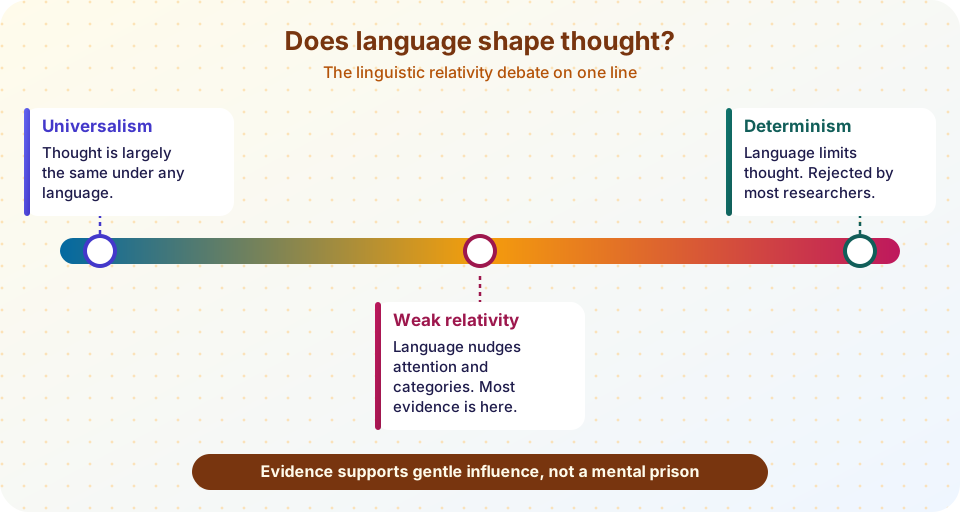
Whorf, an American fire-prevention engineer who studied Native American languages, argued that Hopi grammar shaped a different view of time. His claims were later challenged: Ekkehart Malotki's 1983 study documented Hopi expressions for time that Whorf had said did not exist. The strong version, known as linguistic determinism, holds that language fixes thought. Almost no scholar accepts it, because people can think about things their language has no short word for, and translation is possible.
A weaker version, linguistic relativity, claims that language nudges attention and memory. Evidence supports this in specific areas. People who speak languages that make them mark grammatical gender, color distinctions or spatial frames may attend to those features a little more. The effects are usually small, depend on the task and have sometimes failed to replicate, so treat dramatic headlines with caution.
Color terms
In 1969 Brent Berlin and Paul Kay compared basic color words in about twenty languages and proposed that languages add basic color terms in a fixed order. A language with two terms contrasts dark and light. A third term is red. Next comes green or yellow, then both, then blue, then brown, and finally purple, pink, orange and gray. Later research on a much larger set of languages (the World Color Survey) confirmed broad patterns but revised many details, and critics noted that color naming also depends on a community's practical needs. The case is a good example of universals and variation together.
Directions and space
English speakers say "the cup is to the left of the plate", which depends on which way you face. The Guugu Yimithirr of northern Queensland, studied by John Haviland and Stephen Levinson, use compass-like directions: "the cup is north of the plate". Speakers keep track of their orientation constantly. Levinson and colleagues showed that this habit changes how people remember and gesture. The case is a favorite example of language shaping everyday cognition, though the exact mechanism is still debated.
Speech in context
Dell Hymes argued in the 1960s that we should study language use, not only grammar, in what he called the ethnography of communication. Speakers learn communicative competence: whom to address, which register to use and how to be polite. Languages such as Japanese and Javanese have honorific systems that encode relative rank. Many speakers use code-switching, mixing languages to signal identity, quote others or manage a relationship. A bilingual teenager may use one language at home and another with friends, and the choice carries social meaning. Pidgin languages form when speakers with no common language need to trade; when children grow up speaking a pidgin as their first language, it can become a creole with full grammar.
Language ideologies, shared beliefs about languages and their speakers, also matter: they decide which accents are called "proper" and which are stigmatized.
Endangered languages
Roughly 7,000 languages are spoken today, and perhaps four in ten are classed as endangered. A language is endangered when children stop learning it. The causes are mostly social: migration, schooling in a dominant language, economic pressure and stigma. When a language disappears, the stories, place names, ecological knowledge and ways of talking that it carried can disappear with it.
Revitalization programs show that decline is not inevitable. The Māori "language nests" (Kōhanga Reo), started in 1982, and the Hawaiian "Pūnana Leo" preschools, started in 1983, immersed young children in the heritage language. Such programs rely on community control, teachers and support. Linguists working with communities increasingly document languages on the community's terms.
Common misconceptions
"Some languages are primitive." All languages have complex grammar and can express the concepts their speakers need. Languages differ in vocabulary where needs differ.
"People who lack a word cannot think the idea." They can, and they often use phrases or borrow words. Language shapes habits of attention, not the limits of thought.
"Eskimo has hundreds of words for snow." This claim is exaggerated. Several Inuit and Yupik languages have many word forms built from roots, much as English builds from "snow" and "snowy" and "snowing", but the supposed count is mostly a myth.
Try it
First, a model of the Berlin and Kay sequence. It prints which basic color terms a language is expected to have at each stage. This is the original scheme in simplified form; later work revised it.
Press Run (or Ctrl + Enter) to see the console output here.
No output.
Second, a converter from relative to absolute directions. The facing direction decides what "left" or "right" means.
Press Run (or Ctrl + Enter) to see the console output here.
No output.
Third, a small corpus tool of the kind linguistic anthropologists use. It counts word frequencies in a short text I wrote for the demonstration.
Press Run (or Ctrl + Enter) to see the result here.
Program input · what you'd type while the program runs
Type the answers before you press Run, one per line. Each time the program reads a line (with input()), it gets the next line from this box.
Check your understanding
Quick check · 5 questions
of 5 answered You scored / 5 · perfect!
-
1. Which claim is accepted by most researchers today?
Weak relativity has some support; strong determinism is rejected. -
2. In Berlin and Kay's scheme, which color term typically comes first after dark and light?
The sequence adds red as the third term. -
3. How do Guugu Yimithirr speakers usually describe the location of a cup?
They use cardinal-like directions regardless of which way they face. -
4. What is code-switching?
Bilingual speakers shift languages for social and communicative reasons. -
5. Which is a recognized cause of language shift?
Social and economic pressures lead children to stop learning the heritage language.
Summary
- Linguistic anthropology studies language in social context; Boas, Sapir and Whorf started the relativity debate.
- Strong determinism is rejected; weak relativity has limited, task-specific support.
- Color terms and directions are well-known test cases.
- Speech varies with register, rank, code-switching and language ideologies.
- Many languages are endangered, but community-led revival can work.
Next: Religion and ritual
Track your progress
Create a free account to tick off lessons and pick up where you left off on any device.
of Anthropology lessons completed