


















Lesson 2 of 45 · Getting Started
The Big Questions of Anthropology
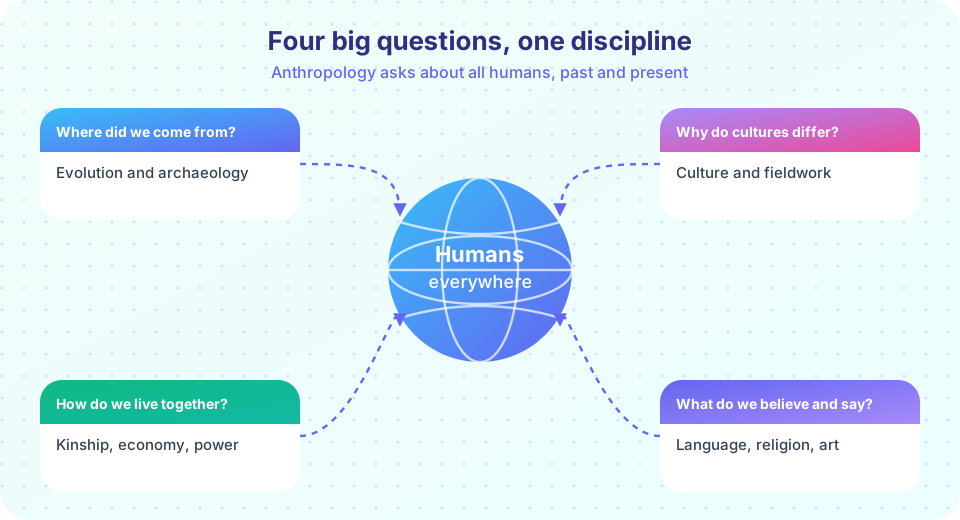
Meet the four big questions that drive anthropology: where we came from, why cultures differ, how we live together, and what we believe and say, with real examples of each.
Imagine you could ask a thousand people, from a hundred countries, one question each. You would soon find yourself asking things that no single school subject can answer. How did our species end up in every climate on Earth? Why do people eat such different foods and still call dinner "a meal"? Why are there marriage rules? Why does almost every society tell stories about the dead?
Anthropology exists to ask questions like these about all people at once. This lesson introduces four big questions that organize the whole course, shows what kind of evidence answers each one, and explains why anthropologists insist on keeping them together.
What you will learn
- The four big questions and which parts of the course answer them.
- Why a human question usually needs more than one kind of evidence.
- The difference between a universal (found everywhere) and a variation (differs between groups).
- How to turn an everyday curiosity into an anthropological question.
Key terms
Human universal: a feature found in all known human societies, such as language, some form of family, and music.
Variation: how a feature differs between societies or over time.
Hominin: a member of the human line after it split from the chimpanzee line, including us and our extinct relatives.
Evidence: observations that can support or weaken a claim.
Comparative method: studying many societies side by side to see what is general and what is local.
Question 1: Where did we come from?
This is the question of origins. Biological anthropologists and archaeologists answer it with bones, teeth, stone tools, hearths and DNA. Fossil footprints at Laetoli in Tanzania, about 3.7 million years old, show that upright walking is very old. Stone tools show that our ancestors were making sharp edges long before our species existed. Ancient and modern DNA show that our species mixed with other kinds of humans, which you will meet in chapter 3.
The key point: origins are reconstructed, not observed. Scientists work like detectives, combining several independent clues and saying how sure they are. New finds can change the picture, and a good anthropologist treats that as normal.
Question 2: Why do cultures differ?
All humans have the same basic biology, yet people speak thousands of languages and live in extremely different ways. Cultural anthropologists explain this by studying how people learn their way of life, what meanings it carries and how history, environment and contact shape it. The answer is rarely one cause. For example, differences in clothing involve climate, but also religion, status, fashion and trade.
The modern view (which you will explore in chapter 4) rejects the old idea that groups differ because of inherited "racial" traits. Differences in culture are learned, and any child can learn any culture. Children adopted into a new country, for instance, grow up speaking the language of their new home.
Question 3: How do we live together?
Every society has to answer practical puzzles: who raises children, who owns land, how goods are shared, who settles disputes, who leads. Anthropologists study kinship (families and descent), economy (making, exchanging and consuming) and politics (decisions and power). There are many solutions. Some societies are organized around large extended families; some around age groups; some around states with courts and taxes. Comparing them shows that none of these arrangements is "natural" in a way that makes the others strange.
Question 4: What do we believe and say?
Humans live in a world of meaning. We talk, tell stories, perform rituals, make art, and care about right and wrong. Linguistic anthropologists study how language is used in real life: who speaks to whom, and how choosing a word creates friendship, respect or distance. Others study religion, myth, ritual and the arts. The question is not whether a belief is true; it is what the belief does for the people who hold it, and how it fits with the rest of their lives.
Why keep the questions together?
Suppose you want to understand a festival in a village. You need history (why it began), economy (who pays), kinship (who attends), language (what songs mean) and the environment (when the harvest comes). Cutting the festival into subjects would lose it. This commitment to seeing the whole is called holism, and you will study it in chapter 2.
Universals and variations
When anthropologists compare societies, they sort findings into two piles. A universal is something found everywhere: every known society has a language, forms of family or household, rules about who may marry whom, and some kind of music. A variation is how it is done: which language, which family shape, which rules. Both piles matter. Universals hint at what is rooted in our shared biology and shared needs. Variations show how much room human life has to differ.
Be careful with the word "universal". It claims a lot. Anthropologists test it by asking: have we really looked at every kind of society? Claims about universals have often been overturned when a new example appeared.
Turning a curiosity into a question
Good anthropological questions are specific and open. Compare:
| Weak question | Better question |
|---|---|
| Why are some people strange? | How do people in different places decide what counts as polite? |
| Is religion good or bad? | What roles do rituals play in family life in one community? |
| Were early humans dumb? | What can stone tools tell us about planning and learning? |
Notice that the better questions avoid judging, name a place or kind of evidence, and can be investigated.
Common misconceptions
"If everyone does it, it must be genetic." Some things found everywhere (like having a language) rest on shared biology, but others (like cooking food) are learned and widespread because they are useful. You need evidence to tell the difference.
"Exotic customs are the real anthropology." Daily life, such as how people queue, greet or share a meal, is just as revealing, and anthropologists study it at home too.
"Asking why cultures differ means ranking them." It does not. Anthropology tries to explain variation without declaring some ways of life better than others.
Try it
Pick a question to see which kind of anthropology would investigate it and what evidence it would use. This is a small lookup demonstration, not a scientific classification.
Now a tiny classifier that sorts questions by keywords. Real research is not done this way; the point is to see how word choices reveal the kind of question being asked.
Press Run (or Ctrl + Enter) to see the result here.
Program input · what you'd type while the program runs
Type the answers before you press Run, one per line. Each time the program reads a line (with input()), it gets the next line from this box.
Check your understanding
Quick check · 5 questions
of 5 answered You scored / 5 · perfect!
-
1. Which type of evidence mostly answers the question 'Where did we come from?'
Origins are reconstructed from physical evidence such as bones, tools and genetic data. -
2. A human universal is
Language is the classic example. Claims of universality must be tested against many societies. -
3. Why do anthropologists keep the big questions together (holism)?
Splitting a lived event into separate subjects loses how the parts connect. -
4. Which is the better anthropological question?
The good question is specific, open and does not rank people. -
5. Cultural differences between groups are mainly explained today by
Any child can learn any culture; differences in culture are learned, not inherited.
Summary
- Four big questions: where we came from, why cultures differ, how we live together, what we believe and say.
- Different evidence answers each one: fossils and digs, fieldwork, comparison, and language recordings.
- Universals show what we share; variations show how much human life can differ.
- Holism keeps the pieces together so lived events are not cut apart.
- Good questions are specific, open and non-judgmental.
Track your progress
Create a free account to tick off lessons and pick up where you left off on any device.
of Anthropology lessons completed