


















Lesson 21 of 45 · Titrations and Gravimetry
Chapter 4 review: titrations and gravimetry
Review titration stoichiometry, acid-base curves, EDTA, permanganate, back titration and gravimetric factors with a cheat sheet, recap table and quiz.
You can now count moles with a burette or a balance. This review ties the four lessons together and gives you a final problem set.
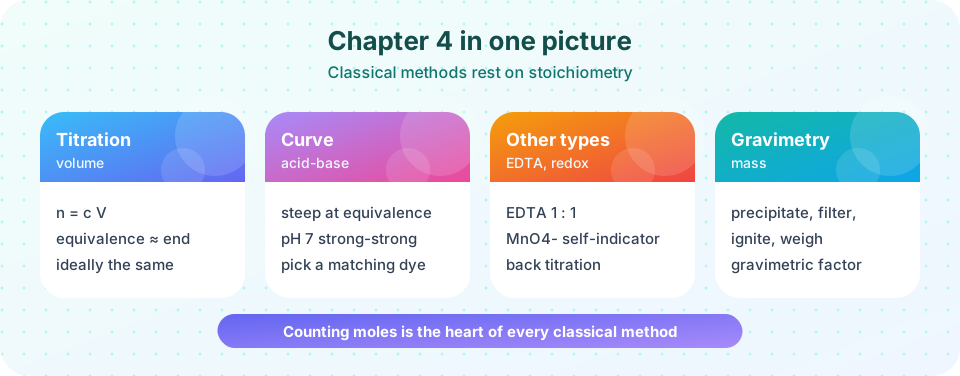
Recap table
| Lesson | Key ideas | Key relations |
|---|---|---|
| Titration basics | equivalence, end point, standards | n = c V, mole ratio from the balanced equation |
| Acid-base titration curves | buffer, half-equivalence, indicators | pH = pK_a at half-equivalence |
| Complexometric and redox titrations | EDTA 1:1, MnO₄⁻ : Fe²⁺ = 1 : 5 | hardness in mg/L as CaCO₃ |
| Gravimetric analysis | precipitate, digest, constant mass | mass A = mass P × GF |
Try it
Press Run (or Ctrl + Enter) to see the result here.
Program input · what you'd type while the program runs
Type the answers before you press Run, one per line. Each time the program reads a line (with input()), it gets the next line from this box.
Check your understanding
Quick check · 10 questions
of 10 answered You scored / 10 · perfect!
-
1. What is the difference between end point and equivalence point?
The indicator reports the end point, which approximates the equivalence point. -
2. 25.00 mL of acid needs 20.00 mL of 0.1500 M NaOH (1:1). The acid concentration is
0.1500 × 20.00 / 25.00 = 0.1200 M. -
3. The pH at the half-equivalence point of a weak acid titration equals
[HA] = [A⁻] there. -
4. Which indicator suits a titration with an equivalence pH of 8.7?
Phenolphthalein's transition (8.2 to 10) covers pH 8.7. -
5. EDTA reacts with metal ions in the mole ratio
EDTA is hexadentate and forms 1:1 complexes with most metals regardless of charge. -
6. 20.00 mL of Fe²⁺ solution needs 16.00 mL of 0.0200 M MnO₄⁻. [Fe²⁺] is
n(MnO₄⁻) = 3.20 × 10⁻⁴ mol, n(Fe²⁺) = 5 × that = 1.60 × 10⁻³ mol, c = 1.60 × 10⁻³ / 0.02000 L = 0.0800 M. -
7. Slow, hot, dilute precipitation produces
Low supersaturation favors crystal growth over nucleation. -
8. A student heats a precipitate once, weighs it and stops. The main risk is
Heating to constant mass is needed to show completeness. -
9. A back titration uses 50.00 mL of 0.1000 M HCl and 12.00 mL of 0.1000 M NaOH for the excess. The HCl consumed by the sample is
5.000 − 1.200 = 3.800 mmol. -
10. Which is NOT a source of positive error in gravimetry?
Dissolving loses precipitate, making the result too low.
Summary
- Titration: moles from
c × Vand the balanced equation; standardize titrants. - The titration curve explains indicator choice; pH = pK_a at half-equivalence.
- EDTA is 1:1 with metals; MnO₄⁻ reacts 1:5 with Fe²⁺; back titrations handle slow reactions.
- Gravimetry: careful precipitation, constant mass, gravimetric factor.
Track your progress
Create a free account to tick off lessons and pick up where you left off on any device.
of Analytical Chemistry lessons completed