


















Lesson 27 of 45 · Spectroscopic Methods
Beer–Lambert law and UV-visible spectrophotometry
Learn the Beer–Lambert law, how a UV-vis spectrophotometer works, how to build a calibration curve and why real measurements deviate from linearity.
Pour a few drops of food dye into water. The more dye you add, the darker the color. A spectrophotometer turns that everyday observation into a number. It shines light of one wavelength through a solution, compares the light that arrives with the light that left the source, and reports the absorbance. Absorbance is proportional to concentration, so a quick measurement gives the amount of the colored species.
That simple relation, the Beer–Lambert law, is the foundation of colorimetry, enzyme assays, DNA quantitation and the analysis of nutrients in water. This lesson explains the law, the instrument and the pitfalls.
What you will learn
- Define transmittance and absorbance and convert between them.
- Apply
A = ε b cto find concentrations. - Describe the parts of a UV-vis spectrophotometer.
- Build a calibration curve and find the concentration of an unknown.
- Explain why linearity fails at high absorbance.
Key terms
Transmittance (T): the fraction of light that passes through, T = I / I₀.
Absorbance (A): A = log₁₀(I₀/I) = −log₁₀ T; it has no unit.
Molar absorptivity (ε): how strongly a species absorbs at one wavelength, in L mol⁻¹ cm⁻¹.
Path length (b): the distance light travels in the sample, usually 1.00 cm.
Blank: a solution with everything except the analyte, used to set zero absorbance.
The law
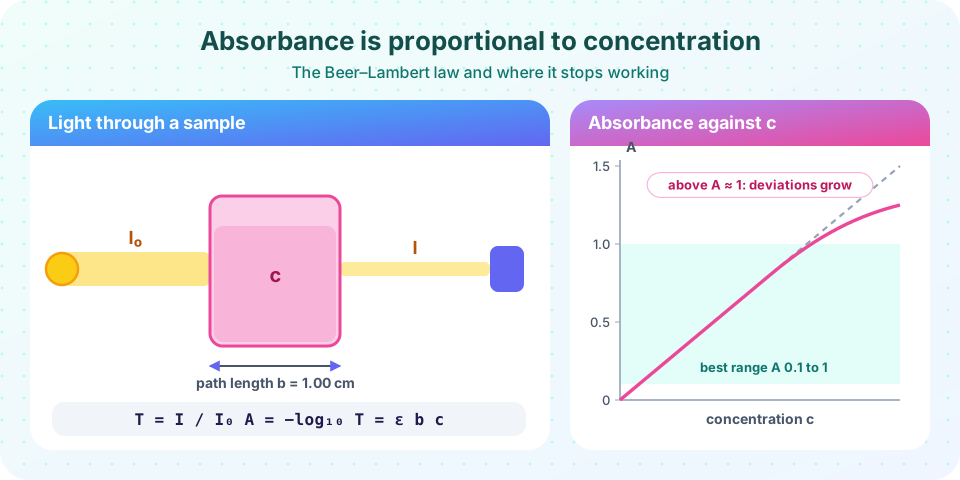
Light entering a sample has intensity I₀. After passing through it has intensity I. The transmittance T = I/I₀ runs from 0 to 1 (or 0 to 100 %). Absorbance is the base-10 logarithm of the inverse:
A = −log₁₀ T = ε · b · c
If T = 0.100, then A = 1.000. If T = 0.010, then A = 2.000. Each extra unit of absorbance cuts the transmitted light by a factor of ten.
The linear form of the law is the useful one. Doubling the concentration doubles the absorbance, and so does doubling the path length. The molar absorptivity ε depends on the compound, the wavelength and the solvent. Large ε means high sensitivity. For example, the orange complex that iron(II) forms with 1,10-phenanthroline has ε ≈ 1.1 × 10⁴ L mol⁻¹ cm⁻¹ at about 510 nm, so a few tenths of a milligram per liter of iron gives a clear reading.
Worked example. A solution of the iron-phenanthroline complex in a 1.00 cm cuvette gives A = 0.500 at 510 nm. With ε = 11,100, c = A / (ε b) = 0.500 / 11,100 = 4.5 × 10⁻⁵ mol/L. In iron terms that is 4.5 × 10⁻⁵ × 55.85 g/mol = 2.5 mg/L.
The instrument
A single-beam UV-vis spectrophotometer has four main parts.
- Source. A deuterium lamp covers about 190–400 nm; a tungsten-halogen lamp covers about 320–2500 nm. Many instruments switch between the two.
- Wavelength selector. A diffraction grating in a monochromator picks a narrow band. Simple colorimeters use filters.
- Sample holder. The cuvette holds the solution. Quartz transmits UV; ordinary glass is fine above about 340 nm; plastic cuvettes are suitable above about 380 nm. Handle them by the frosted sides and wipe the clear faces.
- Detector. A photomultiplier tube or a photodiode converts light to current. In a diode-array instrument the whole spectrum is recorded at once.
Double-beam instruments split the light between a reference cuvette and a sample cuvette to cancel lamp drift. Always measure a blank to set A = 0; it removes absorption by the solvent, the cuvette and any reagents.
Choosing the wavelength
Run a scan of the colored species and select the wavelength of maximum absorbance, λmax. There the signal is largest, and a small error in wavelength changes the absorbance least because the band is flat.
Calibration and unknowns
In practice you rarely trust ε from a table. You prepare standards of known concentration, measure their absorbance, and fit a straight line. The unknown is read from the line. Dilute the sample if it falls above the highest standard.
Press Run (or Ctrl + Enter) to see the result here.
Program input · what you'd type while the program runs
Type the answers before you press Run, one per line. Each time the program reads a line (with input()), it gets the next line from this box.
Mixtures: absorbances add
If two species absorb at the same wavelength, the total absorbance is the sum: A = ε₁ b c₁ + ε₂ b c₂. Measuring at two wavelengths gives two equations and two unknowns. For three or more components you need as many wavelengths as components.
Press Run (or Ctrl + Enter) to see the result here.
Program input · what you'd type while the program runs
Type the answers before you press Run, one per line. Each time the program reads a line (with input()), it gets the next line from this box.
Why the line bends
The Beer–Lambert law is a limiting law. Three families of deviations appear:
- Real deviations. At concentrations above about 0.01 M the molecules interact and the refractive index changes. The law holds for dilute solutions.
- Chemical deviations. If the analyte dissociates, associates or reacts with the solvent, the colored form is not proportional to the total concentration. Weak acid indicators change color with pH. Always buffer the solution.
- Instrumental deviations. The law assumes monochromatic light. Real bands have a width. And stray light, radiation that reaches the detector without passing through the sample, sets an upper limit on the absorbance. If a fraction
sof the light is stray, the apparent absorbance isA_app = log₁₀((1 + s)/(T + s)).
For the best precision work between A = 0.1 and A = 1, which means transmittance between 80 % and 10 %. Below A = 0.1 the noise is a large fraction of the signal; above about 1.5 the detector sees very little light.
Press Run (or Ctrl + Enter) to see the result here.
Program input · what you'd type while the program runs
Type the answers before you press Run, one per line. Each time the program reads a line (with input()), it gets the next line from this box.
Good practice checklist
- Zero the instrument with the blank before each series and again after a break.
- Use matched cuvettes, or the same cuvette, oriented the same way.
- Remove bubbles and wipe fingerprints.
- Measure at
λmax, withinA = 0.1–1. - Prepare standards in the same matrix as the samples.
- Let the lamp warm up (10–15 minutes for many instruments).
Common misconceptions
"A = 0 means there is no analyte." It means no additional absorption relative to the blank at that wavelength. Check that the analyte absorbs at your wavelength.
"Higher absorbance is always more accurate." Above about 1.5 the transmitted light is only a few percent of the incident light, and stray light and noise dominate.
"The path length does not matter because it is always 1 cm." Microplate readers use different path lengths, and sample volume changes it. Correct for it.
Check your understanding
Quick check · 5 questions
of 5 answered You scored / 5 · perfect!
-
1. A sample transmits 25.0 % of the light at a chosen wavelength. What is its absorbance?
A = −log10(0.250) = 0.602. -
2. A solution with ε = 5.0 × 10³ L mol⁻¹ cm⁻¹ gives A = 0.400 in a 1.00 cm cell. What is c?
c = A / (ε b) = 0.400 / (5.0 × 10³ × 1.00) = 8.0 × 10⁻⁵ mol/L. -
3. Why is a blank measured before the sample?
The blank sets zero absorbance for everything that is not the analyte. -
4. Which condition does NOT cause a deviation from Beer–Lambert behavior?
Working at λmax is the recommended practice and improves linearity and sensitivity. -
5. For the best precision, the absorbance should typically lie in the range
Between about 0.1 and 1 (T = 80 % to 10 %) relative errors are smallest.
Summary
A = −log₁₀(I/I₀) = ε b cis linear in concentration and path length for dilute solutions.- A spectrophotometer has a source, monochromator, cuvette and detector; blank, then measure at
λmax. - A calibration line through standards, not a table value, is the usual route to the unknown.
- Mixtures give additive absorbances; as many wavelengths as components are needed.
- Real, chemical and instrumental effects (especially stray light) bend the line above
A ≈ 1.
Track your progress
Create a free account to tick off lessons and pick up where you left off on any device.
of Analytical Chemistry lessons completed