


















Lesson 1 of 45 · Getting Started
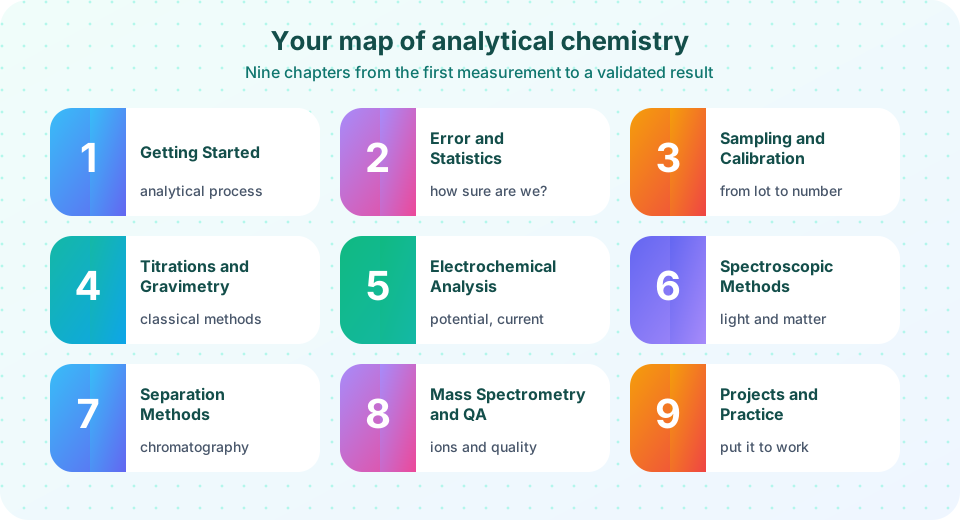
Course map: how to study analytical chemistry
Meet the nine chapters of this analytical chemistry course, see who it is for, what you need first, and how to study it with worked examples and practice.
Analytical chemistry answers two questions that every other science keeps asking: what is in this sample, and how much of it is there? Is the water safe to drink? Does the tablet contain the dose printed on the label? How much lead sits in the paint? This course teaches you how chemists answer those questions reliably, and how they decide how far to trust the answer.
It is written for learners from about age 16 and for adults who want a solid, practical foundation. It follows the common core of international chemistry courses (Cambridge A Level, IB and first-year university analytical chemistry) and uses SI units throughout.
What you will learn
- What analytical chemists do and the steps of a complete analysis.
- How to describe, propagate and test errors so that a number comes with an honest uncertainty.
- How calibration, titration, electrodes, light, chromatography and mass spectrometry turn a sample into data.
- How quality assurance makes results comparable between laboratories and years.
Key terms
Analyte: the substance you want to measure. Matrix: everything else in the sample (water, blood, soil, tablet binder). Signal: what the instrument reports (volume, absorbance, voltage, peak area). Uncertainty: the doubt that remains in a result after you have done everything right.
The nine chapters
Foundations
- Getting started
- Error and statistics
- Sampling and calibration
Methods
- Titrations
- Electrochemistry
- Spectroscopy
- Separations
Trust and practice
- Mass spec and QA
- Projects
What you should know first
You need basic chemistry (moles, balanced equations, acids and bases, concentration), algebra (rearranging equations, straight lines) and comfort with a calculator. Every statistical idea is introduced from scratch. The code examples are short Python or JavaScript programs you can run in the page; you never need to install anything and you do not need to be a programmer, because every program is a calculator you can read like a worked solution.
How to study
- Read with a calculator. Redo every worked example before you read the answer.
- Run and change the code. Each lesson has interactive examples. Change a number and predict the result before you press Run.
- Always ask "how sure?" For every number you compute, write down its uncertainty. This habit is what separates analytical chemistry from plain arithmetic.
- Use the quizzes at the end of each lesson, and the review lesson at the end of each chapter.
A good weekly rhythm is two lessons per week. At that pace the full course takes about five months of part-time study.
Common misconceptions
"A more expensive instrument gives a better answer." Often the weak link is the sample or the preparation, not the instrument. You will see why in the next lesson.
"Analytical chemistry is just following a recipe." Recipes are the last step. The skill is choosing a method, proving it works and knowing when it does not.
Try it
Press Run (or Ctrl + Enter) to see the console output here.
No output.
Check your understanding
Quick check · 3 questions
of 3 answered You scored / 3 · perfect!
-
1. In analytical chemistry, what is the matrix?
The matrix is the rest of the sample. It can interfere with the measurement, which is why later chapters teach matrix-matching and standard addition. -
2. Which pair of questions does analytical chemistry mainly answer?
Qualitative analysis asks what is present; quantitative analysis asks how much. -
3. Why should every computed result come with an uncertainty?
You can only decide whether two results agree, or whether a sample meets a limit, if you know how uncertain each result is.
Summary
- Analytical chemistry finds what is present and how much, and states how reliable the answer is.
- The course has nine chapters from basic ideas to instruments to quality assurance.
- Study actively: calculate, run the code, and always attach an uncertainty.
Next: The analytical process
Track your progress
Create a free account to tick off lessons and pick up where you left off on any device.
of Analytical Chemistry lessons completed