


















Lesson 34 of 45 · Separation Methods and Chromatography
High-performance liquid chromatography (HPLC)
Learn how HPLC works: pumps, injectors, C18 columns, reversed-phase retention, gradient elution, detectors and practical tips for method development.
Gas chromatography needs the analyte to be volatile. Most molecules that matter in medicine, food and the environment are not: vitamins, drugs, amino acids, dyes, preservatives, pesticides and proteins. High-performance liquid chromatography (HPLC) handles them by dissolving the sample in a liquid and pumping it through a column packed with tiny particles under high pressure.
HPLC is the workhorse of pharmaceutical quality control. A single run takes a few minutes, uses microliters of sample and gives peaks that can be identified by retention time and a UV spectrum. This lesson explains the equipment, the dominant reversed-phase mode, and how to tune a separation with the mobile phase.
What you will learn
- Name the parts of an HPLC system.
- Explain reversed-phase retention and how solvent strength changes it.
- Distinguish isocratic and gradient elution.
- Choose a detector for a given analyte.
- Describe what makes a column and a method robust.
Key terms
Reversed phase: a nonpolar stationary phase (such as C18) with a polar mobile phase.
Isocratic: the mobile phase composition stays constant during the run.
Gradient: the composition changes with time, normally with increasing organic solvent.
UHPLC: ultra-high-performance LC, with sub-2 µm particles and pressures up to about 1000 bar or more.
Guard column: a short cartridge that protects the main column from contamination.
The instrument
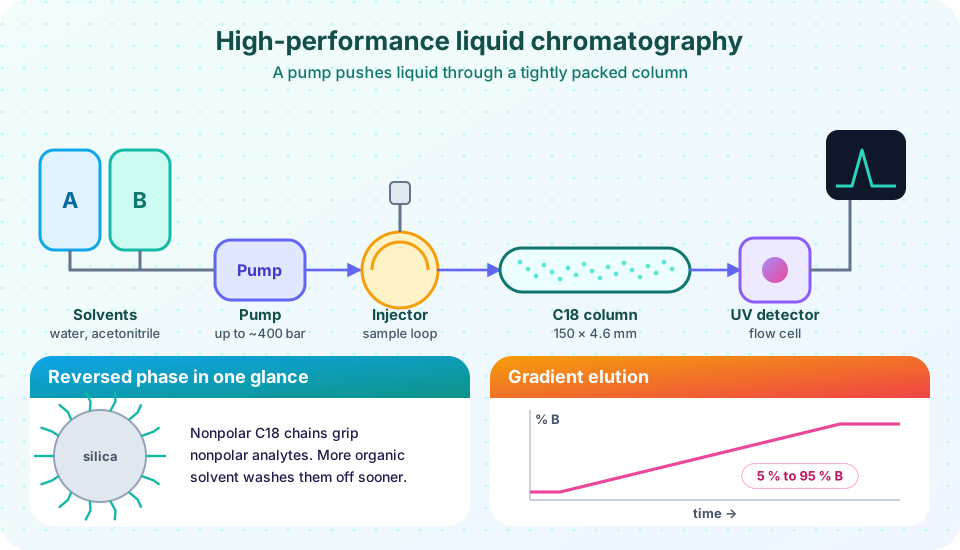
- Solvent reservoirs and degasser. Bottles of water (often buffered) and an organic solvent. The solvents are filtered and degassed, because bubbles disturb the pump and the detector.
- Pump. Delivers a pulse-free flow, typically 0.2–2 mL/min for analytical columns, against a column pressure of 100–400 bar for conventional HPLC. A mixing system blends two or more solvents; in a high-pressure gradient system each solvent has its own pump.
- Injector. An autosampler fills a loop (1–100 µL) and a rotary valve switches it into the flow.
- Column. A stainless-steel tube, commonly 150 mm × 4.6 mm, packed with porous particles of 3–5 µm (UHPLC: under 2 µm and narrower tubes such as 2.1 mm). A thermostatted oven keeps retention reproducible.
- Detector. UV-vis, diode array, fluorescence, refractive index, evaporative light scattering or mass spectrometry.
- Data system. Records the chromatogram and integrates the peaks.
Smaller particles give higher efficiency (a smaller C term in the van Deemter equation) but cost pressure, because backpressure is proportional to 1/dp². Moving from 5 µm to 1.8 µm particles raises the pressure about 7.7-fold for the same column length and flow, which is why UHPLC pumps are built for 1000 bar and above.
Reversed-phase chromatography
About three quarters of HPLC methods use reversed phase. Silica particles are bonded with octadecyl (C18) chains, which makes the surface nonpolar. The mobile phase is polar: water mixed with acetonitrile or methanol.
Nonpolar analytes are drawn out of the polar mobile phase and onto the C18 chains, so they are retained longer. Polar analytes prefer the mobile phase and elute early. Adding more organic solvent makes the mobile phase more nonpolar, so it competes better for the analytes, and retention falls. The elution strength of common solvents increases in the order water < methanol < acetonitrile < tetrahydrofuran.
A simple empirical relationship (the linear solvent strength model) describes retention over a modest range:
log k = log k_w − S · φ
where φ is the fraction of organic solvent, k_w is the extrapolated retention factor in pure water and S is a constant that grows with molecule size. A 10 % rise in organic solvent usually cuts k by a factor of 2 to 3.
Press Run (or Ctrl + Enter) to see the result here.
Program input · what you'd type while the program runs
Type the answers before you press Run, one per line. Each time the program reads a line (with input()), it gets the next line from this box.
Isocratic or gradient?
An isocratic run uses a fixed composition. It is simple, reproducible and perfect for a few compounds with similar polarity. For a complex mixture it fails in the general elution problem: a composition that resolves the early peaks makes the late peaks arrive after an hour, as low, wide humps.
A gradient raises the organic fraction during the run, for example from 5 % to 95 % acetonitrile in 20 minutes. Early peaks are separated at low strength, and later peaks are pushed out progressively, so all peaks have similar width. After each gradient the column must be re-equilibrated with the starting solvent, typically 5–10 column volumes.
Controlling pH
Ionizable compounds such as acids and bases change retention dramatically with pH, because the ionized form is far more polar. A buffer fixes the pH. Choose a pH at least two units away from the analyte's pKa so that it is in one form. Silica-based C18 columns tolerate about pH 2 to 8; below that the bonded phase hydrolyzes, above it the silica dissolves (hybrid particles extend the range). For HPLC coupled to mass spectrometry, use volatile buffers such as formic acid, ammonium acetate or ammonium formate rather than phosphate.
Other HPLC modes
| Mode | Stationary phase | Mobile phase | Typical use |
|---|---|---|---|
| Normal phase | Polar (silica) | Nonpolar solvent | Isomers, lipids |
| HILIC | Polar | High acetonitrile with some water | Very polar compounds, sugars |
| Ion exchange | Charged groups | Aqueous buffer with a salt gradient | Proteins, inorganic ions |
| Size exclusion | Porous gel | Aqueous or organic | Polymers, proteins by size |
| Chiral | Chiral selector | Varies | Enantiomers, a must for many drugs |
Detectors
- UV-vis and diode array (DAD). The most common. Detect anything with a chromophore, at a chosen wavelength such as 254 nm. A diode array records a whole spectrum at each point, which helps to confirm identity and peak purity.
- Fluorescence. Highly selective and sensitive (see Chapter 6), good for vitamins, aflatoxins and tagged amino acids.
- Refractive index. Universal but not sensitive and incompatible with gradients; used for sugars and polymers.
- Evaporative light scattering and charged aerosol. Respond to nonvolatile analytes without a chromophore.
- Mass spectrometry. Identifies compounds by molecular mass; see Chapter 8.
Method development in five steps
- Know the analyte. Structure, pKa, polarity, UV spectrum, solubility.
- Pick the mode and column. For most drugs: C18, 150 × 4.6 mm, 3–5 µm.
- Scout with a fast gradient. For example 5–95 % acetonitrile in 15 minutes, to see where compounds elute.
- Optimize. Adjust the gradient slope, pH, temperature or solvent type until
Rs ≥ 2for the critical pair. - Validate. Check selectivity, linearity, precision, accuracy and limits, as described in Chapter 8.
Common misconceptions
"HPLC and LC are different from chromatography as taught." They obey the same equations: k, α, N, Rs.
"A higher flow rate always saves time." It raises the pressure and widens peaks if you pass the optimum velocity.
"Phosphate buffer is fine with any detector." Phosphate is not volatile and will clog a mass spectrometer.
"Mix solvents in the bottle, whatever the ratio." Premixed organic/aqueous solvents change composition by evaporation and may precipitate buffer salts. Follow the method.
Check your understanding
Quick check · 5 questions
of 5 answered You scored / 5 · perfect!
-
1. In reversed-phase HPLC, which compound elutes first?
Polar compounds prefer the polar mobile phase and are not retained by the nonpolar C18 chains. -
2. What happens to retention if the acetonitrile content is raised from 40 % to 50 %?
A stronger (more organic) mobile phase elutes compounds faster. -
3. Why use a gradient?
A gradient increases solvent strength during the run, so late peaks elute sooner and sharper. -
4. Which buffer is suitable for LC coupled to mass spectrometry?
MS needs volatile buffers; formate and acetate salts evaporate in the source. -
5. Moving from 5 µm to 1.8 µm particles at the same flow and column length changes the pressure by roughly
Backpressure scales with 1/dp², and (5/1.8)² ≈ 7.7.
Summary
- HPLC separates dissolved analytes on columns of small particles at high pressure.
- Reversed phase (C18, water plus organic solvent) dominates; more organic solvent means less retention.
- Gradients solve the general elution problem; buffers control ionization and must suit the detector.
- UV/diode array is the standard detector; fluorescence, refractive index and MS serve special needs.
- Develop methods systematically: scout, optimize to
Rs ≥ 2, then validate.
Next: Chapter 7 review
Track your progress
Create a free account to tick off lessons and pick up where you left off on any device.
of Analytical Chemistry lessons completed