


















Lesson 3 of 45 · Getting Started
Solutions and concentration units
Master molarity, mass percent, ppm and ppb, and learn to prepare standard solutions and dilutions with c1V1 = c2V2, with worked examples and calculators.
Almost every analysis starts with a solution, and every result is a concentration. Unfortunately concentration has many names: molarity for chemists, mass percent for metallurgists, ppm for environmental scientists, mg/dL for doctors. This lesson gives you fluent control of all of them, and shows how to prepare the standard solutions that every calibration depends on.
What you will learn
- Define and convert molarity, mass percent, ppm and ppb.
- Calculate the mass of solid needed for a standard solution.
- Use
c1V1 = c2V2and serial dilutions to make a series of standards. - Know when the ppm shortcut is valid.
Key terms
Molarity (M): moles of solute per liter of solution. Standard solution: a solution of accurately known concentration. Stock solution: a concentrated standard you dilute to make working standards. Serial dilution: repeated dilution, each from the previous one. ppm: parts per million, 1 part in 10⁶ by mass.
Molarity and preparing a standard
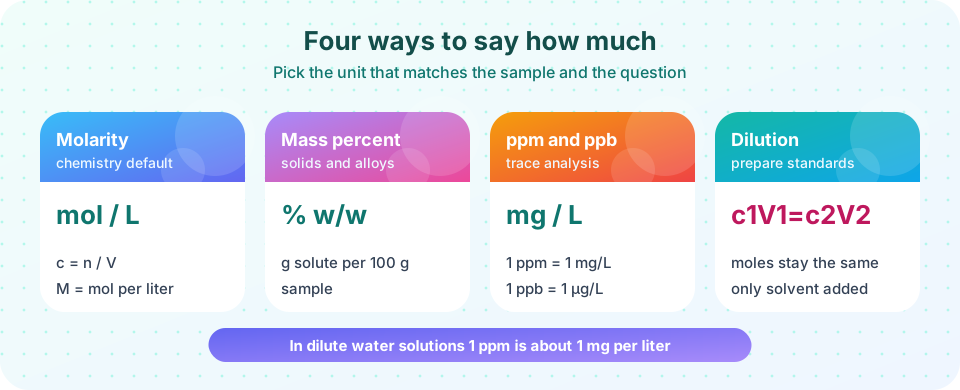
Molarity is c = n / V, with n in mol and V in liters. To make 250.0 mL of 0.0500 M sodium chloride you need n = cV = 0.0500 × 0.2500 = 0.01250 mol. With a molar mass of 58.44 g/mol that is 0.7305 g. You weigh the salt, transfer it to a 250.0 mL volumetric flask, dissolve it in less than the full volume, then fill to the mark and mix. (Do not weigh the salt into 250 mL of water: the concentration is moles per liter of solution, not per liter of solvent.)
Mass-based units
- Mass percent (% w/w) = mass of solute / mass of sample × 100. A brass that is 30.0 % zinc has 30.0 g Zn in every 100 g of alloy.
- ppm (parts per million) = mg of analyte per kg of sample. For solids this is mg/kg.
- ppb (parts per billion) = µg per kg. ppt = ng per kg.
For dilute aqueous solutions the density is almost exactly 1.00 kg/L, so 1 ppm ≈ 1 mg/L and 1 ppb ≈ 1 µg/L. This shortcut fails for seawater, concentrated acids, or organic solvents. Always say whether ppm means w/w or mg/L if there is any doubt; many labs now prefer mg/L and µg/L precisely because "ppm" is ambiguous.
Conversion between molarity and ppm uses the molar mass: a 1.00 × 10⁻³ M solution of Pb²⁺ (207.2 g/mol) contains 0.2072 g/L = 207.2 mg/L = about 207 ppm.
Dilution
Adding solvent does not change the number of moles of solute, so
c1 × V1 = c2 × V2
where 1 is the concentrated solution and 2 is the diluted one. To make 100.0 mL of 2.00 mg/L from a 100.0 mg/L stock, V1 = c2V2/c1 = 2.00 × 100.0 / 100.0 = 2.00 mL. You transfer 2.00 mL with a pipette into a 100.0 mL flask and fill to the mark.
The dilution factor is V2 / V1 (here 50). In a serial dilution the factors multiply: two successive 1-in-10 dilutions give a 1-in-100 dilution. Small volumes are inaccurate, which is why you would not pipette 0.050 mL to make a 2000-fold dilution in a single step.
Worked example
A soil extract contains an unknown amount of copper. You dilute 5.00 mL of the extract to 250.0 mL and measure 0.84 mg/L Cu. What was the concentration in the undiluted extract?
Dilution factor = 250.0 / 5.00 = 50.0. Original = 0.84 × 50.0 = 42 mg/L. Note the significant figures: 0.84 has two, so the answer has two. (More on that in Chapter 2.)
Common misconceptions
"Dissolve in 250 mL of water." Molarity refers to the final solution volume, so you dilute to the mark of a volumetric flask.
"1 ppm is always 1 mg/L." Only when the solution density is about 1.00 g/mL.
"Dilution changes the amount of solute." It changes the concentration only.
Try it
Press Run (or Ctrl + Enter) to see the result here.
Program input · what you'd type while the program runs
Type the answers before you press Run, one per line. Each time the program reads a line (with input()), it gets the next line from this box.
Check your understanding
Quick check · 5 questions
of 5 answered You scored / 5 · perfect!
-
1. How many grams of NaCl (58.44 g/mol) are needed for 500.0 mL of 0.100 M solution?
n = 0.100 mol/L × 0.5000 L = 0.0500 mol; mass = 0.0500 × 58.44 = 2.922 g. -
2. A 50.0 mg/L stock is diluted 1.00 mL to 100.0 mL. What is the new concentration?
The dilution factor is 100, so 50.0 / 100 = 0.50 mg/L. -
3. Under which condition is 1 ppm equal to 1 mg/L?
ppm is a mass ratio (mg/kg). It equals mg/L only when 1 L weighs about 1 kg. -
4. What does the dilution equation c1V1 = c2V2 conserve?
Adding solvent leaves the amount (moles or mass) of solute unchanged. -
5. Why is a 2000-fold dilution usually done in two steps?
A 0.05 mL pipetting error is a large fraction of the transferred volume. Two steps (for example 1:40 and 1:50) use measurable volumes.
Summary
- Molarity is mol per liter of solution; prepare it in a volumetric flask filled to the mark.
- In dilute water solutions 1 ppm ≈ 1 mg/L and 1 ppb ≈ 1 µg/L.
c1V1 = c2V2works because dilution does not change moles of solute.- Serial dilution multiplies dilution factors; avoid tiny volumes.
Next: Glassware and balances
Track your progress
Create a free account to tick off lessons and pick up where you left off on any device.
of Analytical Chemistry lessons completed