


















Lesson 14 of 45 · Sampling and Calibration
Standard addition and internal standards
Handle matrix effects and instrument drift with the method of standard addition and with internal standards, using worked examples and runnable calculators.
External calibration assumes that the signal of the analyte in your standards behaves like the signal in the real sample. But blood, seawater, milk or soil extract contain other substances that can raise or suppress the response. If a standard made in pure water gives a slope of 0.0496 per ppm and the same analyte in the real matrix would give 0.035, the external calibration is silently wrong. Two techniques fix this by putting the calibration inside the sample.
What you will learn
- Explain what a matrix effect is and when external calibration fails.
- Carry out and calculate a standard addition.
- Use an internal standard and the response factor to cancel drift and volume errors.
- Choose among external calibration, matrix matching, standard addition and internal standards.
Key terms
Matrix effect: a change in sensitivity caused by the other sample components. Standard addition: adding known amounts of analyte to portions of the sample itself. Internal standard: a different compound, added in the same amount to all samples and standards, whose signal is used as a reference. Response factor (F): relative sensitivity of the analyte compared with the internal standard.
Standard addition
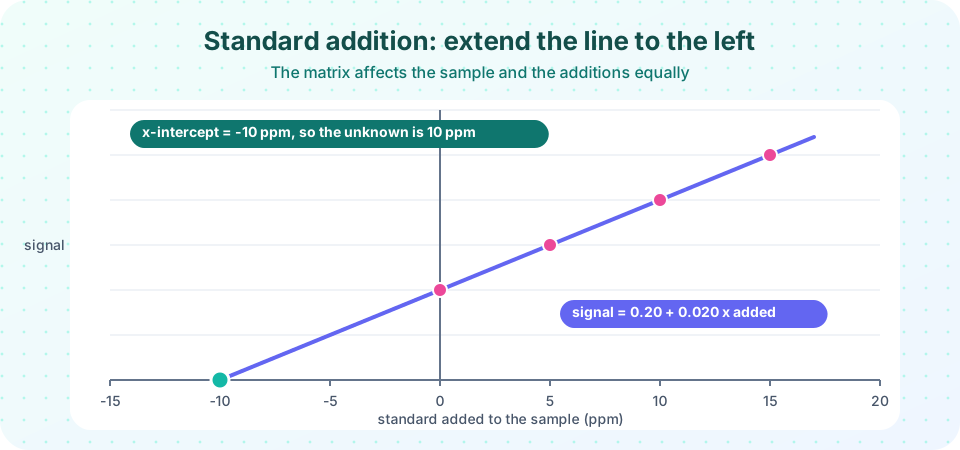
Take equal portions of the sample, add increasing known amounts of analyte standard, dilute each to the same final volume, and measure. The signal rises linearly with the concentration added. The line is
signal = m (c_x + c_added) (when volume changes are negligible or the final volume is the same).
At c_added = 0 the signal is m c_x. The line crosses the signal axis at b = m c_x, and the concentration axis at −c_x. So:
c_x = b / m (the intercept divided by the slope; equivalently the negative of the x-intercept).
Example. Four portions have 0, 5, 10 and 15 ppm added, giving signals 0.20, 0.30, 0.40, 0.50. The slope is 0.020 ppm⁻¹, the intercept 0.20, so c_x = 0.20/0.020 = 10 ppm. Because every portion has the same matrix, the matrix effect is part of the slope and cancels.
Requirements and cautions:
- The response must be linear over the whole range including zero addition.
- It corrects proportional (slope) interferences, not an additive background; subtract a proper blank first.
- It is an extrapolation, so the uncertainty is larger than for interpolation; use at least four points and keep the additions comparable to the unknown (adding two to five times the expected amount is typical).
- It is time-consuming: each sample needs its own calibration. Use it for few, difficult matrices.
Internal standards
Another way to defeat variation: add a fixed amount of a different compound (the internal standard, IS) to every standard and every sample, and use the ratio of the analyte signal to the IS signal. Anything that affects both equally cancels: injection volume, evaporation, drift in instrument sensitivity.
ratio = A_analyte / A_IS = F × (c_analyte / c_IS).
Determine F from a standard with known concentrations of both: F = (A_x/c_x) / (A_s/c_s). Then for a sample with a known c_IS: c_x = (A_x/A_s) × (c_s/F).
A good internal standard behaves like the analyte (similar chemistry, similar retention), is absent from the sample, is stable, and gives a resolved signal. In chromatography a related compound is typical; in mass spectrometry an isotopically labelled analogue (for example deuterated) is the gold standard because it follows the analyte almost exactly.
Choosing a calibration strategy
| Situation | Strategy |
|---|---|
| Simple, well-known matrix | External calibration |
| Known complex matrix (e.g. serum) | Matrix-matched standards |
| Unknown or variable matrix, few samples | Standard addition |
| Variable injection, evaporation or drift | Internal standard |
Common misconceptions
"Standard addition removes all interferences." It corrects only those that change the slope proportionally.
"Any compound can be an internal standard." It must respond to disturbances like the analyte and must not occur naturally in the sample.
"Standard addition is more accurate by default." It also needs linearity and extrapolation, which add uncertainty.
Try it
Press Run (or Ctrl + Enter) to see the result here.
Program input · what you'd type while the program runs
Type the answers before you press Run, one per line. Each time the program reads a line (with input()), it gets the next line from this box.
Press Run (or Ctrl + Enter) to see the console output here.
No output.
Check your understanding
Quick check · 4 questions
of 4 answered You scored / 4 · perfect!
-
1. In standard addition, the unknown concentration equals
The line is signal = m(c_x + c_added); the intercept is m c_x, so c_x = b/m. -
2. Four additions of 0, 2, 4 and 6 ppm give signals 0.30, 0.40, 0.50 and 0.60. The unknown is
Slope 0.05 per ppm, intercept 0.30, so c_x = 0.30/0.05 = 6 ppm. -
3. Which problem does an internal standard correct best?
Both analyte and IS are affected equally by such variations, so the ratio is stable. -
4. Which is the best internal standard for mass spectrometry of caffeine?
An isotopically labelled analogue behaves almost identically but is distinguished by mass.
Summary
- Matrix effects change sensitivity; external calibration may then be biased.
- Standard addition builds the calibration in the sample:
c_x = intercept / slope. - Internal standards use signal ratios to cancel injection, volume and drift errors.
- Pick the strategy by the matrix and the source of variation.
Next: Chapter 3 review
Track your progress
Create a free account to tick off lessons and pick up where you left off on any device.
of Analytical Chemistry lessons completed