


















Lesson 32 of 45 · Separation Methods and Chromatography
Chromatography theory: retention, efficiency and resolution
Learn the numbers behind chromatograms: retention factor, selectivity, plate number, van Deemter equation and the resolution equation, with worked examples.
Two chromatograms can show the same compounds and still differ greatly in quality. In one, the peaks are tall and sharp with clear gaps between them. In the other, they are broad and merge into each other. Chromatography theory gives you the numbers that explain the difference and tells you what to change when a separation is not good enough.
Three ideas carry the whole subject. Retention says where peaks appear. Selectivity says how far apart different compounds are. Efficiency says how narrow each peak is. They combine in one equation for resolution.
What you will learn
- Calculate the retention factor, selectivity, plate number and plate height from a chromatogram.
- Compute and interpret the resolution of two peaks.
- Use the resolution equation to decide whether to change
k,αorN. - Explain the three terms of the van Deemter equation and find the optimum flow.
- Recognize tailing and calculate an asymmetry factor.
Key terms
Retention factor (k): (tR − t₀)/t₀, how many times longer a compound stays on the column than an unretained one.
Selectivity (α): the ratio k₂/k₁ of two compounds; α must exceed 1 for separation.
Plate number (N): a measure of column efficiency; larger means narrower peaks.
Plate height (H): L/N, the column length per theoretical plate.
Resolution (Rs): the separation of two peaks relative to their widths.
Retention and selectivity
Time zero is injection. An unretained compound emerges at the dead time t₀. A retained compound emerges at tR. The retention factor is
k = (tR − t₀) / t₀
It is the ratio of the time spent in the stationary phase to the time spent in the mobile phase. For good analyses, k is usually between 1 and 10. Below 1 the peak is too close to the dead time and interferences co-elute. Above 10 the run is long and the peak is broad.
The selectivity factor compares two compounds, taking the more retained one on top:
α = k₂ / k₁ = (tR2 − t₀) / (tR1 − t₀)
If α = 1 the peaks coincide and no amount of efficiency separates them. Selectivity is changed by chemistry: a different stationary phase, a different mobile phase composition, pH or temperature.
Efficiency
Peaks are roughly Gaussian. The narrower they are for a given retention time, the better the column. With the base width w (4 standard deviations) the plate number is
N = 16 (tR / w)²
or, using the width at half height w½, N = 5.54 (tR / w½)². The plate height is H = L/N. A well-packed 150 mm HPLC column with 5 µm particles gives roughly 10,000 plates. Capillary GC columns give hundreds of thousands in total.
A peak that is not symmetric lowers the quality of the separation. The asymmetry (tailing) factor, measured at 10 % of the peak height, is As = b/a, where b is the distance from the peak maximum to the back edge and a the distance to the front edge. Values between 0.9 and 1.2 are good; above about 2 the peak is badly tailed, often because of unwanted interactions with active sites.
Why peaks broaden: the van Deemter equation
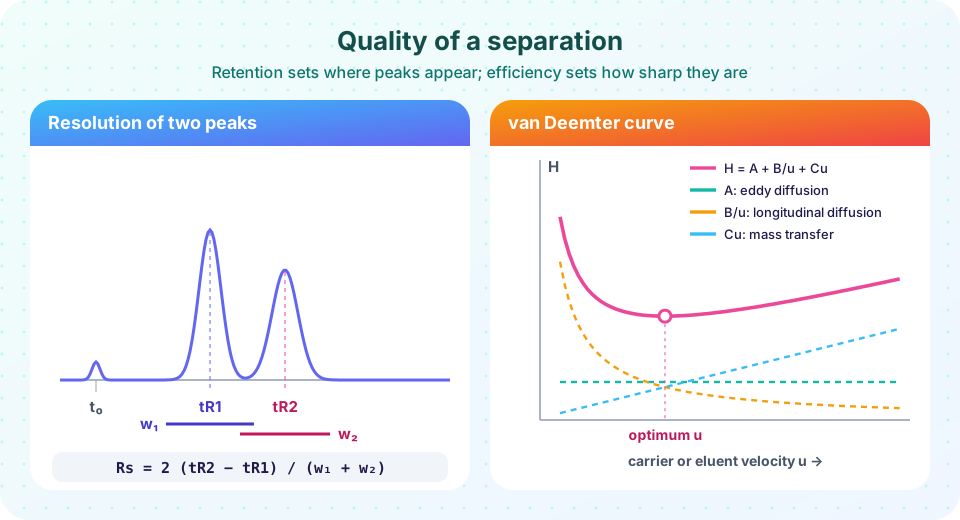
Even a perfect injection broadens as it moves through the column. The van Deemter equation describes the plate height as the sum of three effects:
H = A + B/u + C·u
- A (eddy diffusion): molecules follow different paths between particles of the packing. Smaller, uniform particles reduce it. Capillary columns have no packing, so
A = 0. - B/u (longitudinal diffusion): the band spreads by diffusion along the column. It matters at low velocity, and it is much larger in gases than in liquids.
- C·u (mass transfer): molecules need time to move in and out of the stationary phase. It grows with velocity.
The sum has a minimum at u_opt = √(B/C), where H_min = A + 2√(BC). Running faster costs efficiency, but modern columns with small particles keep a flat C term and allow high speeds.
Press Run (or Ctrl + Enter) to see the result here.
Program input · what you'd type while the program runs
Type the answers before you press Run, one per line. Each time the program reads a line (with input()), it gets the next line from this box.
Resolution
Two peaks are separated when the distance between their maxima is large compared with their widths. The resolution is
Rs = 2 (tR2 − tR1) / (w₁ + w₂)
Rs = 1.5 means baseline resolution, with the peaks touching only at the tails. Rs = 1.0 still leaves about 2 % overlap, which is adequate for qualitative work. Regulated methods usually ask for Rs ≥ 2.
Worked example. A column with t₀ = 1.00 min gives two peaks at tR1 = 5.00 min and tR2 = 5.60 min, both with base width 0.30 min.
k₁ = (5.00 − 1.00)/1.00 = 4.00,k₂ = 4.60α = 4.60/4.00 = 1.15N₁ = 16 (5.00/0.30)² = 4444platesRs = 2 × 0.60 / 0.60 = 2.0
The master resolution equation
Resolution can be written in terms of the three controlling factors:
Rs = (√N / 4) · ((α − 1) / α) · (k / (1 + k))
where k is the retention factor of the later peak. Read the equation as a menu of remedies:
| Factor | How to change it | Effect | Cost |
|---|---|---|---|
N |
Longer column, smaller particles, optimum flow | Rs grows as √N |
Longer time, higher pressure |
α |
Change phase, solvent, pH, temperature | Strongest effect for small α | Method re-development |
k |
Weaker mobile phase, lower temperature (GC) | Useful up to about k = 5 | Longer run |
Doubling the plate number only improves Rs by about 41 %, while changing α from 1.05 to 1.10 roughly doubles the term (α−1)/α. When α is near 1, improve selectivity first.
Press Run (or Ctrl + Enter) to see the result here.
Program input · what you'd type while the program runs
Type the answers before you press Run, one per line. Each time the program reads a line (with input()), it gets the next line from this box.
Quantitative analysis
Peak area is proportional to the amount injected, and usually more robust than height. Build a calibration of area against standard concentration, as in the last lesson. An internal standard, a compound added at a fixed amount to every standard and sample, corrects for injection errors and losses: plot the area ratio A_analyte / A_IS against the concentration ratio. A good internal standard behaves like the analyte, elutes near it, and does not co-elute with anything else.
Common misconceptions
"More plates always means better separation." If α = 1 no number of plates separates two compounds. Resolution grows only with the square root of N.
"The slower the flow, the better the efficiency." Below the optimum, longitudinal diffusion widens the peaks again.
"Rs = 1 means separated." It leaves overlap. Use Rs ≥ 1.5 for accurate quantitation.
Check your understanding
Quick check · 5 questions
of 5 answered You scored / 5 · perfect!
-
1. A column has t₀ = 2.0 min. A compound elutes at 8.0 min. What is its retention factor?
k = (tR − t₀)/t₀ = (8.0 − 2.0)/2.0 = 3.0. -
2. A peak has tR = 10.0 min and base width 0.50 min. What is N?
N = 16 (10.0/0.50)² = 16 × 400 = 6400. -
3. Which change improves resolution the most when α is already very close to 1?
Rs depends on (α − 1)/α. When α is near 1, even a small increase in selectivity gives a large improvement. -
4. In the van Deemter equation, which term dominates at very low flow rates?
At low u there is plenty of time for molecules to diffuse along the column, so B/u is large. -
5. Two peaks have tR of 6.0 and 6.6 min with base widths of 0.4 min each. What is Rs?
Rs = 2 (6.6 − 6.0) / (0.4 + 0.4) = 1.2/0.8 = 1.5.
Summary
k = (tR − t₀)/t₀sets retention;α = k₂/k₁sets selectivity;N = 16(tR/w)²sets efficiency.Rs = 2(tR2 − tR1)/(w₁ + w₂); aim for 1.5 or more.Rs = (√N/4)((α−1)/α)(k/(1+k))shows the three handles: efficiency, selectivity and retention.H = A + B/u + Cuhas a minimum atu_opt = √(B/C).- Quantify with peak areas, ideally with an internal standard.
Next: Gas chromatography
Track your progress
Create a free account to tick off lessons and pick up where you left off on any device.
of Analytical Chemistry lessons completed