


















Lesson 23 of 45 · Electrochemical Analysis
Potentiometry and ion-selective electrodes
Learn how potentiometry works: the Nernst equation, reference electrodes, the glass pH electrode, ion-selective electrodes and potentiometric titrations.
Potentiometry is the quietest electrochemical method. You dip two electrodes into a solution, measure the voltage between them while almost no current flows, and read the concentration of an ion from that voltage. Because nothing is consumed, the sample is left essentially unchanged. This is the method behind every pH meter, and behind sensors for fluoride, potassium, calcium, nitrate and many other ions.
The key idea is the Nernst equation. Once you can use it, calibrate an electrode and spot the typical errors, you can run a potentiometric analysis with confidence.
What you will learn
- Use the Nernst equation to link potential to activity.
- Name the common reference electrodes and their potentials.
- Explain how a glass electrode senses pH and calibrate it with buffers.
- Describe ion-selective electrodes, selectivity coefficients and ionic strength buffers.
- Locate an end point from a potentiometric titration curve.
Key terms
Nernst equation: the relation between electrode potential and the activities of the redox couple.
Activity (a): the effective concentration, a = γ·c, where γ is the activity coefficient.
Junction potential: a small voltage that appears where two different solutions meet.
Selectivity coefficient (K): how strongly an interfering ion is sensed compared with the target ion.
TISAB: total ionic strength adjustment buffer, added to fix pH and ionic strength.
The Nernst equation
For a half-reaction Ox + n e⁻ → Red, the electrode potential is
E = E° − (RT / nF) ln( a_Red / a_Ox )
At 25 °C, converting to base-10 logarithms, the factor 2.303 RT/F is 0.05916 V, so
E = E° − (0.05916 / n) log( a_Red / a_Ox )
That means a tenfold change in activity shifts the potential by 59.16 mV for n = 1, and by 29.58 mV for n = 2. The number depends on temperature, which is why a good meter has a temperature probe: the slope is 54.2 mV per decade at 0 °C and about 61.5 mV at 37 °C.
A metal in a solution of its own ions gives a direct example. A silver wire in Ag⁺ solution has E = 0.799 + 0.05916 log a(Ag⁺) volts against the standard hydrogen electrode. Measure E and you know a(Ag⁺).
Activity, not concentration
Electrodes respond to activity. In dilute solutions the activity coefficient is close to 1, but as ionic strength I grows it falls. The Debye–Hückel limiting law says log γ = −0.509 z² √I at 25 °C, valid only for very dilute solutions. A sensible strategy for real samples is to fix the ionic strength with a large excess of an inert salt, so γ stays the same in standards and samples. Then a plot against concentration is as straight as a plot against activity.
Reference electrodes
A reference electrode must keep a fixed potential even when a small current passes.
| Electrode | Half-reaction | Potential versus SHE (25 °C) |
|---|---|---|
| Standard hydrogen (SHE) | 2 H⁺ + 2 e⁻ ⇌ H₂ |
0.000 V by definition |
| Saturated calomel (SCE) | Hg₂Cl₂ + 2 e⁻ ⇌ 2 Hg + 2 Cl⁻ |
+0.241 V |
| Silver/silver chloride, sat. KCl | AgCl + e⁻ ⇌ Ag + Cl⁻ |
+0.197 V |
| Silver/silver chloride, 3.5 M KCl | same | about +0.205 V |
Ag/AgCl is now preferred because it contains no mercury. A porous frit or ceramic plug lets the filling solution leak very slowly into the sample and completes the circuit. The tiny voltage that appears at this liquid junction (a few millivolts) is a stubborn error source, which is why potentiometric work always uses the same type of junction and calibrates with standards.
The glass pH electrode
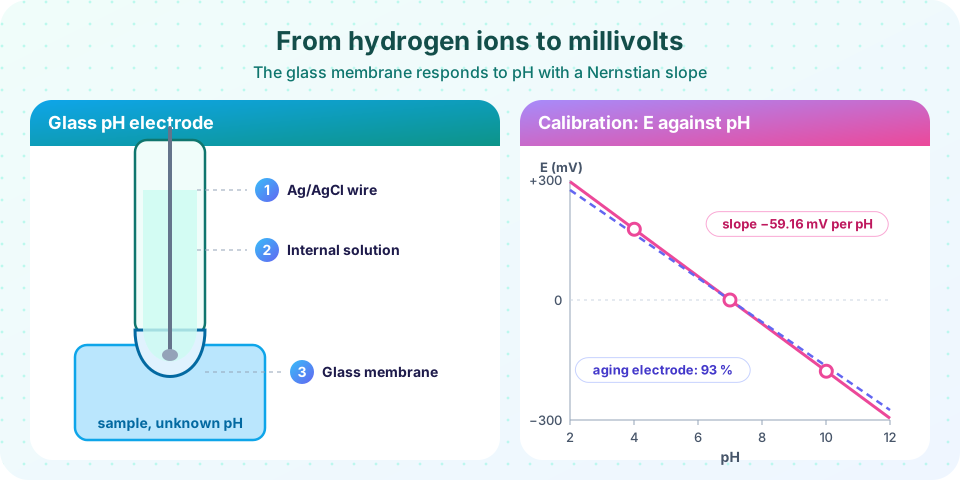
The workhorse of potentiometry is the glass electrode. A thin bulb of special glass separates the sample from an internal solution of fixed pH. The outer surface of the glass hydrates, and hydrogen ions exchange with sites in the gel layer. The difference in pH between inside and outside creates a membrane potential:
E = const − 0.05916 × pH (at 25 °C)
The "const" includes the internal reference, the junction potential and an asymmetry potential, which is why you calibrate. A complete cell contains the glass electrode and a reference electrode, usually combined in one body.
Calibrating
A typical two- or three-point calibration uses buffers at pH 4.01, 7.00 and 10.01 (25 °C). The meter fits a line through the readings. The fitted slope divided by the ideal 59.16 mV is the slope efficiency. Good electrodes give 95–102 %; below about 90 % the electrode needs cleaning or replacement.
Press Run (or Ctrl + Enter) to see the result here.
Program input · what you'd type while the program runs
Type the answers before you press Run, one per line. Each time the program reads a line (with input()), it gets the next line from this box.
Typical errors of the glass electrode
- Alkaline (sodium) error. In strongly basic solutions the glass also responds to
Na⁺, so the measured pH reads too low. Special low-sodium glass reduces this. - Acid error. In very acidic solution (below about pH 1) the reading can be slightly high.
- Dehydration. A dry glass membrane responds slowly. Store the electrode in a storage solution, not in distilled water or air.
- Temperature. Buffer pH values and the electrode slope change with temperature. Calibrate at the temperature of the measurement.
- Slow response in poorly buffered samples. Pure water takes minutes to read steadily.
Ion-selective electrodes
An ion-selective electrode (ISE) has a membrane that responds mainly to one ion. The cell potential follows
E = const + (2.303 RT / zF) log a_ion
with z the charge including sign: the slope is positive (about +59 mV per decade) for cations with z = +1 and negative for anions.
The well-known example is the fluoride electrode. Its membrane is a single crystal of lanthanum fluoride (LaF₃), doped with europium to lift the conductivity. Only fluoride can move through the lattice defects, so the electrode is highly selective. It works best between pH 5 and 7. In acid, F⁻ forms HF and the reading is too low; in strongly basic solution OH⁻ interferes because it has a similar size and charge.
Other designs include a polymer membrane with a neutral carrier for potassium (valinomycin), a liquid ion exchanger for calcium, and a gas-sensing electrode for ammonia and CO₂.
Interference: the Nikolsky–Eisenman equation
No membrane is perfectly selective. For a primary ion i and an interferent j:
E = const + (2.303 RT / z_iF) log [ a_i + K_ij · a_j^(z_i / z_j) ]
K_ij is the selectivity coefficient. A small K_ij means the electrode prefers the target. If K_ij = 0.1, the electrode sees one OH⁻ ion as 0.1 of an F⁻ ion.
Press Run (or Ctrl + Enter) to see the result here.
Program input · what you'd type while the program runs
Type the answers before you press Run, one per line. Each time the program reads a line (with input()), it gets the next line from this box.
At low fluoride concentration the error is much bigger, because the interferent contributes the same absolute amount.
Adding TISAB
For fluoride in water, analysts mix the sample 1:1 with TISAB. It holds the pH near 5.5, fixes the ionic strength with a high concentration of salt, and includes a chelating agent (such as CDTA) that frees fluoride from aluminum and iron complexes. Standards and samples then have the same background, and the potential is linear in log c.
Potentiometric titrations
Instead of an indicator that changes color, a potentiometric titration tracks the potential of an indicator electrode after each addition of titrant. The end point is the volume where the curve is steepest, where ΔE/ΔV is largest. This works for coloured or cloudy solutions and for mixtures that give several end points.
Take 25.00 mL of 0.1000 M NaCl titrated with 0.1000 M AgNO₃, using a silver electrode against a saturated calomel reference. Before the equivalence point, [Ag⁺] = Ksp / [Cl⁻] with Ksp(AgCl) = 1.8 × 10⁻¹⁰. At the equivalence point [Ag⁺] = √Ksp. After it, the excess titrant sets [Ag⁺]. The code below covers all three regions with one equation, [Ag⁺] − Ksp/[Ag⁺] = (excess Ag⁺)/(total volume), which follows from the charge balance. The measured cell potential is E = 0.799 + 0.05916 log[Ag⁺] − 0.241.
Press Run (or Ctrl + Enter) to see the result here.
Program input · what you'd type while the program runs
Type the answers before you press Run, one per line. Each time the program reads a line (with input()), it gets the next line from this box.
Common misconceptions
"A pH electrode measures concentration of H⁺." It responds to activity. In concentrated or high-ionic-strength samples the two differ.
"Calibrate once and the electrode stays calibrated." Drift, temperature and contamination move the intercept and slope. Check against a buffer regularly.
"Rinsing with a paper towel is fine." Rubbing a glass bulb creates a static charge and slows response. Blot gently.
Check your understanding
Quick check · 5 questions
of 5 answered You scored / 5 · perfect!
-
1. A cation with charge +1 and an ideal ISE gives what slope at 25 °C?
For z = +1 the slope is +2.303RT/F = +59.16 mV per decade. Anions give a negative slope. -
2. A pH electrode gives a calibration slope of 52.8 mV/pH at 25 °C. What is its slope efficiency?
52.8 / 59.16 = 0.893, so the efficiency is about 89 %, a sign the electrode needs attention. -
3. Why do analysts add TISAB when measuring fluoride?
TISAB keeps pH near 5.5, equalizes ionic strength and contains a chelating agent that releases fluoride from Al3+ and Fe3+. -
4. On a potentiometric titration curve, where is the end point?
The end point is the steepest part of the curve, which is the maximum of the first derivative. -
5. What does a selectivity coefficient K(ij) much smaller than 1 mean?
A small K means the interferent contributes little to the signal compared with the target ion.
Summary
- The Nernst equation gives a slope of
2.303 RT/(nF), which is 59.16/n mV per decade at 25 °C. - Reference electrodes (SCE, Ag/AgCl) hold a fixed potential; the liquid junction adds a small, unavoidable error.
- A glass electrode responds to pH with a slope near 59 mV per pH unit and must be calibrated with buffers.
- ISEs respond to activity; selectivity coefficients and TISAB control interference and ionic strength.
- A potentiometric titration locates the end point where
dE/dVis largest.
Track your progress
Create a free account to tick off lessons and pick up where you left off on any device.
of Analytical Chemistry lessons completed