


















Lesson 16 of 45 · Titrations and Gravimetry
Chapter 4 overview: titrations and gravimetry
Preview chapter 4: how classical methods count moles with a burette or a balance, and how acid-base, complexometric, redox and gravimetric analyses work.
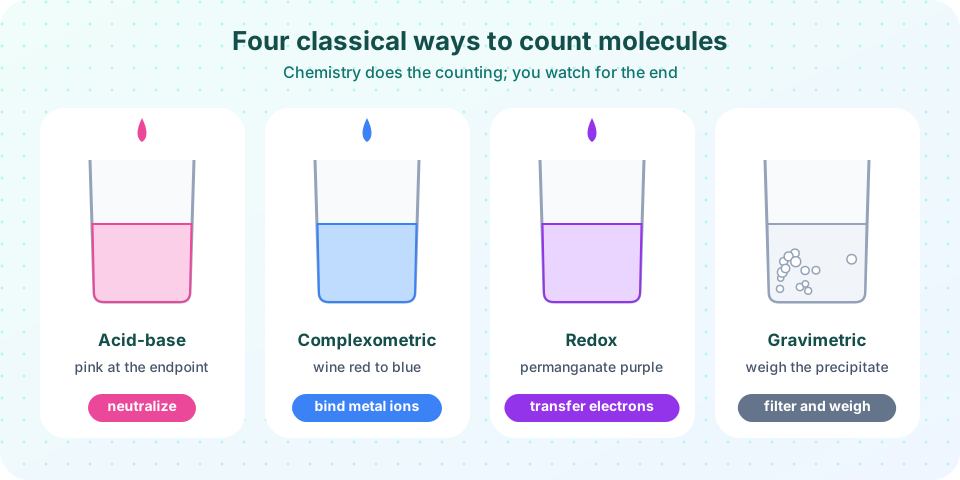
Before electronics, chemists measured amounts with two things: a burette and a balance. Both methods are still essential today because they are absolute: with a pure standard and a balanced equation, the answer follows from stoichiometry and needs no calibration curve. Titration counts moles by the volume of a reagent consumed; gravimetry counts moles by the mass of a product weighed.
What you will learn
- The vocabulary of titration: titrant, analyte, equivalence point, end point, standardization.
- How acid-base, complexometric, redox and precipitation titrations differ.
- How gravimetric analysis turns a weighed precipitate into an amount of analyte.
- Why these methods can reach about 0.1 % precision with simple equipment.
The chapter at a glance
Titration
Types
Gravimetry
Lessons in this chapter
- Titration basics: standards, standardization and the stoichiometry of a titration.
- Acid-base titration curves: pH versus volume, equivalence points and indicators.
- Complexometric and redox titrations: EDTA, permanganate and back titrations.
- Gravimetric analysis: precipitation, filtration, ignition and gravimetric factors.
- Chapter 4 review: recap and quiz.
Try it
Press Run (or Ctrl + Enter) to see the console output here.
No output.
Check your understanding
Quick check · 3 questions
of 3 answered You scored / 3 · perfect!
-
1. Why are titration and gravimetry called absolute methods?
Moles come directly from the balanced reaction and the measured volume or mass. -
2. In a titration the burette holds the
The titrant is the solution of known concentration added from the burette. -
3. What does gravimetric analysis measure?
The mass of a pure, well-defined product is converted to the amount of analyte.
Summary
- Titration and gravimetry count moles from volume or mass; they are absolute methods.
- Four common titration types: acid-base, complexometric, redox, and precipitation.
- Gravimetry weighs a pure product; careful technique gives about 0.1 % precision.
Next: Titration basics
Track your progress
Create a free account to tick off lessons and pick up where you left off on any device.
of Analytical Chemistry lessons completed