


















Lesson 25 of 45 · Electrochemical Analysis
Chapter 5 review: electrochemical analysis
Review Chapter 5 on electrochemical analysis: a one-picture summary, a recap table of methods and equations, and a ten-question mixed quiz.
You have now met four ways to read a cell. This review pulls them together so you can recall what each one measures, which equation governs it and when to choose it. Look at the picture first, study the table, then test yourself with the practice tools and the ten-question quiz.
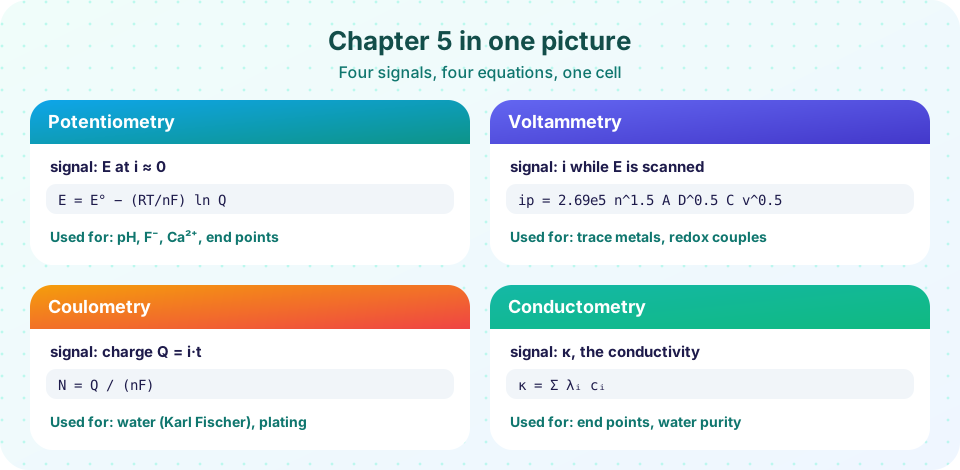
What you will learn
- Recall the signal, equation and typical use of each electrochemical method.
- Practice quick calculations with the Nernst equation and Faraday's law.
- Spot common errors before they reach the lab notebook.
Key terms
Nernst slope: 59.16/n mV per decade at 25 °C.
Ohmic drop (iR drop): voltage lost in the solution resistance when current flows.
Preconcentration: collecting the analyte on the electrode before the measurement.
Current efficiency: the fraction of charge that causes the intended reaction.
Recap table
| Method | Signal | Governing relation | Best for | Typical weakness |
|---|---|---|---|---|
| Potentiometry | Potential at i ≈ 0 | E = E° − (RT/nF) ln Q |
pH, ions, end points | Responds to activity; drift; interferences |
| Voltammetry | Current during a potential scan | ip ∝ n^1.5 A D^0.5 C v^0.5 |
Trace metals, redox studies | Oxygen, fouling, ohmic drop |
| Coulometry | Total charge | N = Q/(nF) |
Absolute amounts, water | Needs 100 % current efficiency |
| Conductometry | Bulk conductivity | κ = Σ λᵢ cᵢ |
Titrations, water purity | Not selective |
The five-minute checklist
- Is the quantity you want the activity of one ion? Try an ISE and keep ionic strength constant.
- Is the concentration below about 10⁻⁶ M? Think stripping voltammetry.
- Do you need an absolute answer with no standards? Think coulometry.
- Is the sample coloured, cloudy or without a good indicator? Titrate with a potentiometric or conductometric end point.
- Did you purge oxygen, clean the electrode and check the reference?
Common misconceptions
"The Nernst slope is always 59 mV." It is 59.16/n mV per decade only at 25 °C. Temperature changes it, and a divalent ion halves it.
"A bigger peak current means a better method." A large peak can come from a larger electrode or a faster scan. Sensitivity must be judged with the signal-to-noise ratio and the detection limit.
Try it
Press Run (or Ctrl + Enter) to see the result here.
Program input · what you'd type while the program runs
Type the answers before you press Run, one per line. Each time the program reads a line (with input()), it gets the next line from this box.
Check your understanding
Quick check · 10 questions
of 10 answered You scored / 10 · perfect!
-
1. A glass electrode reads +177 mV in pH 4.01 buffer and −177 mV in pH 10.01 buffer at 25 °C. What is its slope?
The change is 354 mV over 6.00 pH units, which is 59.0 mV per pH unit (negative as pH rises). -
2. Which signal does conductometry measure?
Conductivity is a bulk property that sums the contribution of every ion. -
3. How many coulombs correspond to 2.00 mg of water in coulometric Karl Fischer titration?
1 mg of water needs 10.71 C, so 2.00 mg needs 21.4 C. -
4. Why does stripping voltammetry achieve very low detection limits?
Deposition over minutes collects many ions onto the electrode, and the stripping step releases them in a sharp peak. -
5. Which ion shows the largest molar conductivity in water?
H+ has a limiting molar conductivity near 350 S cm²/mol because protons hop between water molecules. -
6. The Nernst slope for a divalent cation at 25 °C is about
Slope = 59.16/n, so for n = 2 it is 29.6 mV per decade. -
7. In the Randles–Ševčík equation, the peak current is proportional to which power of the scan rate?
ip is proportional to v^(1/2) for a diffusion-controlled reversible process. -
8. Which error makes a glass electrode read pH too low in strongly basic solutions?
At high pH the glass also responds to Na+, which makes the apparent pH lower than the true value. -
9. A fluoride electrode has K(F, OH) = 0.1. At pH 9 and 1.0 × 10⁻⁵ M fluoride, the apparent fluoride activity is
a(OH) = 10⁻⁵, so the apparent value is 1.0 × 10⁻⁵ + 0.1 × 10⁻⁵ = 1.1 × 10⁻⁵ M. -
10. In a potentiometric titration, the end point corresponds to
The steepest part of the titration curve, where dE/dV is greatest, marks the end point.
Summary
- Each electrochemical method has a signal (E, i, Q or κ) and an equation that links it to concentration.
- Control the background (ionic strength, oxygen, temperature, fouling) before trusting any number.
- Potentiometry reads activity; voltammetry gives low detection limits; coulometry is absolute; conductometry is fast but not selective.
- Chapter 6 moves from electrons to light: spectroscopy.
Track your progress
Create a free account to tick off lessons and pick up where you left off on any device.
of Analytical Chemistry lessons completed