


















Lesson 38 of 45 · Mass Spectrometry and Quality Assurance
Hyphenated MS: GC-MS, LC-MS/MS and ICP-MS
Learn how mass spectrometers are combined with chromatography and plasma: GC-MS, LC-MS/MS with MRM, internal standards, isotope dilution and ICP-MS.
A mass spectrometer is a powerful detector, but it works best when fed one compound at a time. A chromatograph separates the mixture and a mass spectrometer identifies and measures each peak: together they are called a hyphenated technique, written with a hyphen, as in GC-MS and LC-MS. When a second mass analyzer and a collision cell are added, you get tandem mass spectrometry, MS/MS, the most selective detector in routine analysis.
This lesson explains the three combinations you will meet most often: GC-MS for volatile compounds, LC-MS/MS for almost everything else, and ICP-MS for elements.
What you will learn
- Explain how GC-MS and LC-MS interfaces work and what each is used for.
- Describe MS/MS and multiple reaction monitoring (MRM).
- Use internal standards to correct for ion suppression.
- Apply the idea of isotope dilution.
- Outline ICP-MS and its main interferences.
Key terms
Hyphenated technique: a separation method linked online to a detector, such as GC-MS.
Tandem MS (MS/MS): two stages of mass analysis separated by a fragmentation step.
MRM: multiple reaction monitoring, following specific precursor → product transitions.
Ion suppression: loss of analyte signal because co-eluting matrix compounds compete for charge.
Isotope dilution: adding a known amount of an isotopically enriched form of the analyte as the internal standard.
GC-MS
The column outlet of a gas chromatograph feeds directly into the ion source of a mass spectrometer, normally an electron-ionization source with a quadrupole analyzer. Helium carrier gas is pumped away easily, so the interface is simple.
A GC-MS run gives a total ion chromatogram (TIC), the summed signal at each time, and a full mass spectrum for every point. Two ways of acquiring data matter:
- Full scan. The quadrupole sweeps across, for example,
m/z 35–500. Spectra can be matched against a library, so unknown compounds can be identified. Sensitivity is moderate. - Selected ion monitoring (SIM). The quadrupole dwells on a few chosen
m/zvalues, which raises sensitivity by about a factor of 10–100 for target compounds.
GC-MS is the standard for volatile and semivolatile organics: pesticides, solvents, flavors, fragrance compounds, drugs of abuse after derivatization, and fatty acids as methyl esters. Library matching of EI spectra, plus a retention index, gives confident identification.
LC-MS and LC-MS/MS
Linking a liquid chromatograph to a mass spectrometer was a hard problem: a flow of 0.3 mL/min of liquid produces about 200 mL of vapor per minute, and the spectrometer needs a vacuum. The solution was atmospheric pressure ionization, mostly electrospray (ESI), in which the eluate is sprayed at atmospheric pressure and only the ions are admitted through a small orifice.
Consequences for method design:
- Use volatile mobile-phase additives (formic acid, ammonium formate, ammonium acetate) and avoid phosphate and non-volatile ion-pair reagents.
- Lower flow rates (0.2–0.5 mL/min) and narrower columns (2.1 mm) give better ESI response.
- Compounds with groups that readily take a proton (amines) ionize well in positive mode, acids in negative mode.
Tandem mass spectrometry
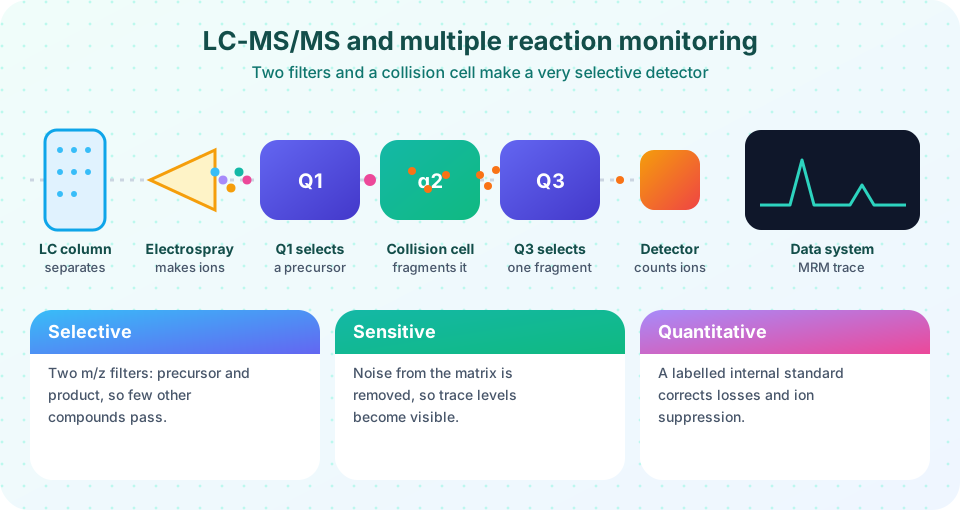
A triple quadrupole has three sections in line.
- Q1 selects a precursor ion, for example
[M+H]⁺. - q2 (the collision cell) is filled with a little argon or nitrogen. Ions collide with it and fragment.
- Q3 selects one product ion.
In multiple reaction monitoring (MRM), Q1 and Q3 are fixed at a precursor → product pair (a transition) for each analyte, and the instrument cycles through the pairs in milliseconds. Because both the precursor mass and the fragment mass must match, matrix compounds that happen to share one of the values are rejected. Detection limits are in the pg/mL range for many drugs in plasma. Usually two transitions are monitored for each compound: a quantifier (the more intense) and a qualifier, whose ratio to the quantifier must stay within a tolerance of the standard.
Matrix effects and internal standards
In ESI, compounds that co-elute compete for the available charge, so the signal for an analyte can fall (suppression) or rise (enhancement) in a real sample compared with a clean standard. The remedy is an internal standard that behaves identically: the best is a stable isotope-labeled version of the analyte (deuterium, ¹³C or ¹⁵N), which co-elutes and experiences the same suppression. The ratio of analyte to internal standard stays constant even when both signals drop.
Press Run (or Ctrl + Enter) to see the result here.
Program input · what you'd type while the program runs
Type the answers before you press Run, one per line. Each time the program reads a line (with input()), it gets the next line from this box.
Isotope dilution
Isotope dilution takes the same idea to its limit and is considered a primary-ratio method. An element or compound has two isotopes, a and b. You add a known amount n_y of a spike, enriched in isotope b, to a sample whose amount n_x is unknown. After mixing, you measure the isotope ratio R = a/b in the blend. With atom fractions A and B of the two isotopes in sample (x) and spike (y):
n_x = n_y · (A_y − R·B_y) / (R·B_x − A_x)
Once the spike has equilibrated with the sample, losses no longer matter, because only a ratio is measured. This makes isotope dilution mass spectrometry the method behind many certified reference values.
Press Run (or Ctrl + Enter) to see the result here.
Program input · what you'd type while the program runs
Type the answers before you press Run, one per line. Each time the program reads a line (with input()), it gets the next line from this box.
ICP-MS
In inductively coupled plasma mass spectrometry, the argon plasma used for ICP-OES (Chapter 6) is used as an ion source. The 6000–10,000 K plasma atomizes and ionizes nearly every element into singly charged positive ions. A quadrupole analyzer sorts the ions by m/z. The results:
- Detection limits of ng/L (parts per trillion) and below for most metals.
- A linear range of eight to nine orders of magnitude.
- Isotopic information, so isotope dilution and isotope ratios are possible.
The price is a number of interferences, mostly polyatomic ions from the argon, the acid and the matrix. ⁴⁰Ar¹⁶O⁺ appears at m/z 56 and disturbs iron; ⁴⁰Ar³⁵Cl⁺ appears at m/z 75 and disturbs arsenic. Modern instruments use a collision/reaction cell filled with helium or hydrogen, where large polyatomic ions lose more energy than analyte ions and are discriminated by kinetic energy. Samples are typically digested in nitric acid, often in a microwave oven, and diluted so that the total dissolved solids stay below about 0.2 %. An internal standard such as rhodium, indium or germanium corrects for drift and suppression.
Choosing a technique
| Question | First choice |
|---|---|
| Unknown volatile organic in a polymer | GC-MS full scan with library search |
| Drug and metabolites in plasma, ng/mL | LC-MS/MS (MRM) with isotope-labeled internal standards |
| Arsenic, lead and cadmium in rice at µg/kg | ICP-MS after microwave digestion |
| Reference value for a certified material | Isotope dilution MS |
| Non-target screening of unknown contaminants | LC with high-resolution MS (Orbitrap or TOF) |
Common misconceptions
"MS/MS removes the need for chromatography." Matrix effects, isomers and carry-over still require separation; the two techniques complement each other.
"A single MRM transition proves identity." Regulations normally ask for at least two transitions and a retention-time match.
"ICP-MS has no interferences because the plasma is so hot." Polyatomic and isobaric interferences are significant and need cells and corrections.
Check your understanding
Quick check · 5 questions
of 5 answered You scored / 5 · perfect!
-
1. In LC-MS/MS, what does Q3 select in MRM?
Q1 selects the precursor, q2 fragments it, and Q3 selects a product ion. -
2. Why is phosphate buffer unsuitable for LC-MS?
Non-volatile salts deposit in the ion source and suppress ionization. -
3. Which is the best internal standard for LC-MS/MS quantitation?
A labelled analogue co-elutes and is affected by the matrix in the same way as the analyte. -
4. What does 40Ar35Cl+ interfere with in ICP-MS?
The polyatomic ion has nominal mass 75, the same as the only isotope of arsenic. -
5. In SIM mode a GC-MS is typically
By monitoring only a few ions, the instrument spends more time on each and gains sensitivity.
Summary
- GC-MS uses EI and libraries for volatile compounds; SIM raises sensitivity.
- LC-MS needs volatile buffers and atmospheric pressure ionization; MS/MS adds a second filter and a collision cell.
- MRM follows precursor → product transitions; use a quantifier, a qualifier and a labelled internal standard.
- Isotope dilution gives a result from isotope ratios, so losses after equilibration do not matter.
- ICP-MS measures trace elements down to ng/L, with polyatomic interferences controlled by cells.
Track your progress
Create a free account to tick off lessons and pick up where you left off on any device.
of Analytical Chemistry lessons completed